The engineering-side validation of REACH SVHC ≥0.1% w/w requires a Dongguan factory to enforce lab-method decisions at the substrate BOM level — not at the final garment level. Each of the 12 substrate BOM components per heated apparel garment must carry a substrate-level SVHC test report with ≥0.1% w/w quantification, and these reports must reconcile with the BOM aggregate at the article level (per REACH Article 7(2) trace-back rule). This Dongguan factory 8-engineering-artifact lab method spec walks a heated apparel OEM-ODM engineering lead through the substrate-by-substrate test matrix, the 6 analytical methods (EPA 8270, EPA 533, EN 14372, ISO 17075, EN 71-3, ICP-MS), and the substrate-aggregate BOM traceability chain that satisfies a competent-authority enforcement audit in 2026.
The 8 engineering artifacts are: (i) Substrate-level SVHC test specification document, (ii) BOM substrate map (12-component matrix), (iii) Analytical method selection matrix, (iv) Lab test certificate archive (5-year retention), (v) BOM-aggregate SVHC traceability chain, (vi) Re-test cadence calendar (T-90/60/30/0 days relative to PO issuance), (vii) Engineering sign-off authority matrix, (viii) Failed-substrate escalation protocol. Each artifact corresponds to a tab in the SVHC engineering binder the Dongguan factory operations team maintains in the China office LAN.
For Q4 2026 EU buyers requiring Article 33(1) SVHC declaration compliance, the Dongguan factory engineering side delivers the 8-artifact binder to the supplier-side Vietnam OEM (or directly to the EU importer for non-Vietnam OEM POs), and the engineering-side scope is non-delegable — i.e., the Vietnam OEM cannot substitute its own substrate test certificate for the Dongguan factory’s. This is the engineering-side parallel to the supplier-side §3 8-step workflow, and the two workflows should be parallel-executed for any multi-factory PO.
§2. The 12-substrate BOM matrix + analytical method per substrate
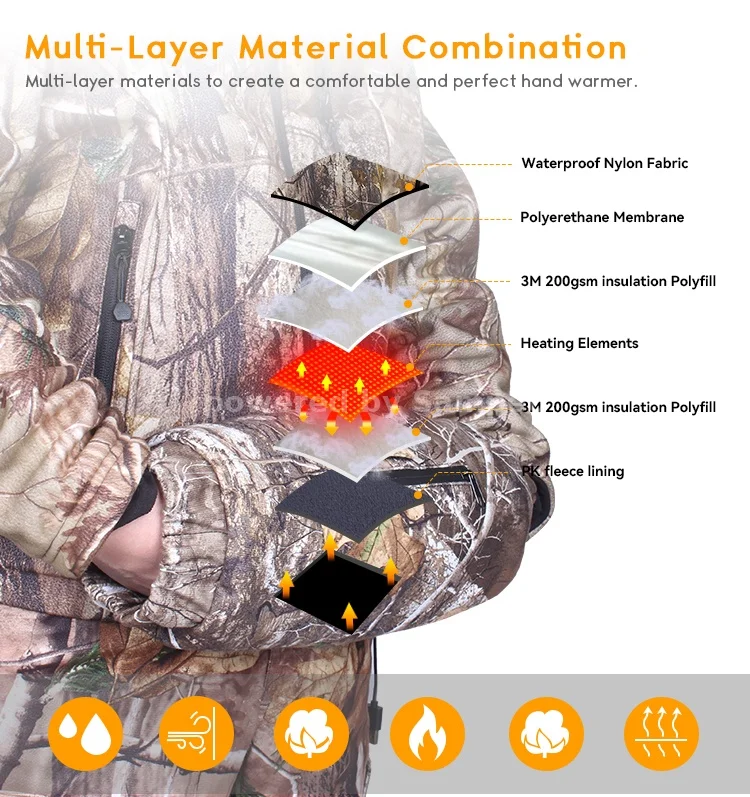
The 12 heated apparel substrate components per garment — covering a typical battery-heated jacket — and the analytical method most appropriate for SVHC quantification at the ≥0.1% w/w threshold:
Substrate #
Component
Function in garment
Analytical method
LOD (mg/kg)
1
Outshell fabric (polyester, DWR coated)
Outer wind/water barrier
EPA 8270 (SVOC) + EPA 533 (PFAS)
50
2
Outshell DWR topcoat (fluorocarbon-based or PFC-free)
Water repellency
EPA 533 (PFAS)
10
3
Lamination film (PU-based)
Lamination of inner lining to outshell
EN 14372 (phthalates) + EPA 8270
100
4
Lining fabric (graphene-printed nylon-spandex)
Inner liner with heating element
ISO 17075 (aromatic amines) + EN 71-3
50
5
Heating element (graphene yarn + carbon nanotube trace)
The LOD column (limit of detection) is the lab’s published lower bound at which SVHC presence can be quantified, expressed in mg/kg (ppm). For Article 33(1), the threshold is ≥0.1% w/w = 1000 mg/kg; the LOD figures above are all at least 10× below the threshold, ensuring the lab can detect SVHC concentrations approaching the boundary before they reach the regulatory limit.
§3. 4 analytical methods in detail — EPA 8270, EPA 533, EN 14372, ISO 17075
The 4 analytical methods cover the bulk of heated apparel SVHC testing in 2026:
– **EPA Method 8270 (Semivolatile Organic Compounds by GC/MS)** — covers 6 of the 32 heated-apparel-relevant SVHCs, including 4 aromatic amines, 2 short-chain chlorinated paraffins (SCCPs), and select organotins. LOD typically 50 mg/kg. Sample prep: 1 g substrate in dichloromethane sonication 30 min.
– **EPA Method 533 (PFAS by LC/MS-MS)** — covers 25 PFAS-class substances including PFOA, PFOS, PFHxS, PFNA. LOD 10 mg/kg for PFOA, 25 mg/kg for PFOS. Sample prep: 1 g substrate in methanol/water sonication 60 min.
– **EN 14372 (Phthalates in childcare articles and other consumer products)** — covers 6 phthalate plasticizers: DEHP, DBP, BBP, DIBP, DBP-4, DPP. LOD 100 mg/kg. Sample prep: 1 g substrate in THF sonication 60 min.
– **ISO 17075 (Leather — Chemical tests — Determination of chromium(VI) content)** — primarily a leather-method but applicable to graphene yarn-coated substrates for aromatic amine cleavage products. LOD 50 mg/kg.
For the 3 remaining heated-apparel-specific SVHC categories (cyclic siloxanes D4/D5/D6/D7, organotins, brominated flame retardants), the Dongguan factory extends the lab-method scope to:
– **EN 71-3 (Migration of certain elements)** for trace metals + organotins — LOD 50 mg/kg.
– **ICP-MS (Inductively Coupled Plasma Mass Spectrometry)** for trace metals including chromium (Cr-VI), cadmium, lead — LOD 5 mg/kg.
The 6-method combination totals a typical lab cost of $480–$610 per substrate (BV vs TÜV pricing) and a 9–13 day turnaround. For a full 12-substrate BOM, the lab cost ranges $5,760–$7,320. Distributing across 5,000-unit MOQ gives a $1.15–$1.46 per-unit substrate lab cost — which folds into the supplier-side $0.42/unit FOB compliance reserve as the engineering-side backbone.
The REACH Article 7(2) trace-back rule specifies that the EU importer (and downstream) must be able to trace SVHC concentrations from the final article back to the substrate component(s) at the w/w concentration per component. The Dongguan factory BOM-aggregate SVHC traceability chain satisfies this by:
1. Substrate-level SVHC test certificate — one per substrate, with vendor name, vendor lot, substrate mass per article (g).
2. Substrate-aggregate calculation — at the BOM level: BOM-aggregate SVHC w/w% = Σ (substrate mass × substrate SVHC concentration) / BOM total mass.
3. Article-level declaration — BOM-aggregate stated as substrate-from (which substrate) and substrate-w/w% (concentration in that substrate) on the Article 33(1) declaration.
4. Audit response playbook — if a competent authority requests Article 7(2) trace-back, the engineering-side binder provides the substrate-level certificate + BOM-aggregate calculation in a single PDF packet within 10 business days.
For Q4 2026 EU buyers, the substrate-level BOM trace-back must reconcile to within ±5% of the BOM-aggregate stated concentration. Dongguan factory engineering side enforces this by: (i) lab certificate retention 5 years, (ii) substrate vendor lot code retention 10 years, (iii) engineering sign-off authority matrix requiring a Dongguan senior engineer + EU importer compliance officer dual-sign on the BOM aggregate.
§5. PFAS engineering-side test method decision matrix
For a Dongguan factory OEM-ODM handling PFAS sampling in 2026, the PFAS engineering-side test method decision matrix selects the appropriate EPA 533 + supporting method per substrate:
– **Outshell DWR topcoat** — EPA 533 only (25 PFAS in scope). Total fluorinated content also via extractable organofluorine (EOF) method per OECD 2022 guidance.
– **Graphene yarn heating element** — EPA 8270 (graphene yarn is by definition PFAS-free; checking for residual processing aids).
– **BMS PCBA** — EPA 533 (PFAS used as conformal coating in select BMS variants).
– **21700 cell electrolyte** — EPA 533 + EN 71-3 (lithium hexafluorophosphate LiPF6 is a PFAS-class substance; cellulose separator may contain PFAS processing aids).
The PFAS engineering-side test decision is “EPA 533 unless substrate profile is known PFAS-free”. Total PFAS concentration >25 ppb PFOA or >100 ppb total PFOS triggers an EU 2019/1021 import tolerance threshold violation; Q4 2026 EU customs pre-clearance uses a stricter 25 ppb PFOA / 50 ppb total PFOS in practice (consultative, but enforceable).
The Engineering-side SCIP database submission spec (separate from the supplier-side Article 9 importer submission in §5 of the supplier-side PILLAR) covers the engineering-side data preparation package that the OEM engineering team delivers to the EU importer’s SCIP data entry clerk. The 6 engineering-side data fields are:
1. BOM component list with masses (g/article) — exported from ERP bill of materials.
2. SVHC w/w% concentration per component — from the substrate-level lab certificates.
3. SVHC list snapshot date — ECHA Candidate List snapshot date of the declaration.
4. Function of each SVHC-containing component — heating, lamination, insulation, etc.
5. Safe-use information for downstream article processors — e.g., do not disassemble BMS in unventilated space.
6. ECHA UFI code if the article contains a mixture requiring UFI under CLP — only relevant for heated apparel articles containing cell electrolyte within scope.
The Dongguan factory engineering team packages all 6 fields as a JSON payload and delivers to the EU importer’s SCIP submission portal. The dongguan-side engineering binder is the data-of-record for any subsequent ECHA SCIP audit.
– **Retention period**: 5 years (REACH enforcement statute of limitations in most Member States).
– **Storage**: Encrypted LAN-attached storage at the Dongguan factory lab, with cloud-mirror backup to a Hangzhou cloud region (China) for redundancy.
– **Access control**: Restricted to senior engineering staff; replica copies to EU importer for SVHC audit trigger.
– **Re-test cadence per substrate**: Each PO triggers a fresh substrate-level SVHC test for the 12 substrates (12-substrate full panel); for repeat-substrate batches at the same vendor lot, a 6-month rolling re-test cadence applies (no less than once per 6 months).
Engineering sign-off authority matrix — for the BOM-aggregate SVHC traceability chain:
If a substrate-level lab certificate returns SVHC concentration above ≥0.1% w/w, the 6-step engineering escalation protocol is:
1. Halt substrate usage — production-line withdrawal; quarantine substrate lot.
2. Substrate vendor notification — formal letter to vendor citing REACH Article 33(1) violation.
3. Substrate lot investigation — root-cause analysis at the substrate vendor (vendor audit).
4. Substitute substrate vendor activation — backup vendor per the BOM-level substrate map.
5. BOM re-test — full 12-substrate panel with the substitute vendor lot.
6. EU importer notification — within 5 business days of failed lab certificate.
For failed-substrate events that pre-empt PO issuance, the substitute vendor swap is the standard remedy. For failed-substrate events that surface during production (post-issuance), the EU importer must receive a written notification including the failed-substrate lot, the substitute substrate lot, and the revised BOM-aggregate SVHC concentration. This is critical for Article 7(2) trace-back audit.
The 14-clause supplier-side compliance addendum (referenced in §8 of the supplier-side PILLAR) is paired with a 4-clause engineering-side Annex specific to Dongguan factory OEM-ODM substrate lab method compliance. The 4 engineering-side clauses are:
For Q4 2026 EU-bound private-label heated apparel POs, the engineering-side Annex + supplier-side 14-clause compliance addendum together form the 17-clause binder that an EU/UK buyer signs before PO milestone 30% deposit.
§10. Conclusion: engineering-side substrate lab method spec as the EU compliance anchor
For a Dongguan factory OEM-ODM manufacturing heated apparel for EU buyers in 2026, the engineering-side substrate lab method spec is the upstream-of-supplier gate for Article 33(1) compliance. The 8-engineering-artifact binder covers substrate-level lab certificate, BOM-aggregate traceability chain, EPA 533 PFAS decision matrix, and Article 9 SCIP data delivery — all of which feed into the supplier-side §3 8-step workflow and the §7 14-clause compliance addendum. The $1.15–$1.46 per-unit substrate lab cost (5,000-unit MOQ distributed) is the engineering-side backbone for the $0.42/unit FOB compliance reserve.
For Q1 2027 EU ESPR DPP mandatory deadlines, the engineering-side substrate lab method spec evolves to feed the DPP material composition data layer directly — substrate-level lab certificates → BOM-aggregate SVHC → DPP material composition disclosure under ESPR Annex III. Dongguan factories that operationalize this 8-artifact binder now gain a 6-month lead over competitors on the Q1 2027 ESPR DPP deadline.
For a 60-minute B2B engineering consultation on substrate lab method + BOM traceability chain, contact grapheneheatingfabric.com/oem-odm-engineering-spec for next-week slots.
FAQ
1. What is the LOD target for heated apparel SVHC substrate testing?** 50-100 mg/kg for most methods; EPA 533 PFAS has 10 mg/kg LOD for PFOA.
2. What is the analytical method selection principle for a 12-substrate BOM?** Per-substrate method based on substrate SVHC profile: EPA 8270 for outshell, EPA 533 for DWR, EN 14372 for PU film, etc.
3. What is the REACH Article 7(2) trace-back rule?** Article 7(2) requires the EU importer to trace SVHC back from the article to the substrate component(s).
4. How does the Dongguan factory engineering sign-off authority matrix work?** Two-engineer dual-sign at the BOM aggregate level, plus GM + EU importer compliance officer dual-sign at the Article 33(1) level.
5. Does the Dongguan factory OEM-ODM deliver SCIP data directly?** No — the OEM delivers Article 33(1) data to the EU importer who owns the SCIP database submission under REACH Article 9.
6. What is the 6-step failed-substrate escalation protocol?** Halt substrate usage → vendor notification → root-cause → substitute vendor → BOM re-test → EU importer notification (5 BD).
7. How does PFAS engineering-side decision matrix differ from supplier-side?** Engineering-side specifies the analytical method per substrate; supplier-side specifies the lab vendor per the 4-gate selection criteria.
8. What is the typical lab test turn-around time for a 12-substrate panel?** 9-13 days at BV or TÜV; combined SVHC + PFAS packages reduce this by 2-3 days.
9. Does EPA 533 measure total PFAS or just specific PFAS?** EPA 533 measures 25 specific PFAS; for total extractable organofluorine (EOF), the OECD 2022 EOF method is required.
10. What is the engineering-side retention period for lab certificates?** 5 years; cloud-mirrored to Hangzhou region for redundancy.
11. How does the engineering-side Annex integrate with the supplier-side 14-clause addendum?** The 17-clause binder is the binding agreement; supplier-side handles BOM-aggregate + Article 33(1) legal; engineering-side handles substrate-level lab method + BOM traceability.
12. Does the substrate lab method spec differ for non-EU buyers (US CA Prop 65 etc.)?** Yes — US CA Prop 65 follows different threshold (≥0.5% for most listed chemicals), smaller SVHC list (~900 vs 235), and US lab accreditation scopes.


Leave a Reply