
Battery Heated Apparel Warranty Engineering Guide 2026: Cell Cycle, Heating-Film Durability, IP67 Test Protocols, and FMEA RMA Diagnostics

Why Warranty Claims Trace Back to Engineering Design Choices
Warranty claims rarely originate with the end user — they originate three to twelve months upstream, with a cell lot, a BMS firmware revision, or a connector potting compound the buyer never saw on the datasheet. After ten years on the R&D bench in Dongguan, I can predict the failure mode from the SKU number alone: capacity drop on a 21700 cell spec’d at 1C but driven at 2C; graphene film delamination after 25 wash cycles because lamination Tg was 8 °C too low; controller latch-up at -20 °C because the MOSFET was qualified only to -10 °C.
This guide is the engineering-side companion to every commercial warranty document we issue. The point of battery heated apparel warranty engineering is simple: warranty terms are written before the cell is qualified, not after. Every failure mode has been designed in or designed out by the time the warranty document is signed. Battery heated apparel warranty engineering is what separates a real warranty from a marketing line. For the full OEM/ODM manufacturing workflow, see the linked process page.
Battery Cell Chemistry & Cycle Counts — 18650 vs 21700 vs Li-Po
The largest determinant of any heated-apparel warranty is the cell cycle count the manufacturer commits to.
| Chemistry | Format | Capacity | Cycles to 80% (1C/1C, 25 °C) | Cycles to 80% (2C/1C, 25 °C) | Cost vs 18650 |
|---|---|---|---|---|---|
| — | — | — | — | — | — |
| NMC | 18650 | 3000 mAh | 600 | 320 | 1.00× |
| NMC | 21700 | 5000 mAh | 800 | 450 | 1.35× |
| LFP | 26650 | 3500 mAh | 2200 | 1400 | 1.85× |
| Li-Po | Pouch 10 Ah | 10000 mAh | 500 | 250 | 1.10× |
A battery heated apparel warranty 21700 cell cycle spec written as “500 cycles” is meaningless unless C-rate, DOD, and temperature are pinned. A 21700 NMC cell at 1C/1C, 25 °C delivers 800 cycles to 80%; at 2C the same cell only delivers ~450 cycles. Li-Po delivers ~60% of cylindrical-cell cycle life. For battery heated apparel warranty hunting jackets running 4–6 hours per outing, 21700 is the default. For thin-profile battery heated apparel warranty workwear vests, 1S2P 21700 still beats Li-Po on cycle life and safety.
Heating-Film Durability — Carbon Fiber vs Graphene vs Metal-Wire FPC

The heating film is the second-most-common RMA trigger.
| Film type | Sheet resistance (Ω/□) | Bending cycles to failure (R 5 mm) | Wash cycles to failure (ISO 6330 4N, 40 °C) | Surface temp uniformity (ΔT at 50 °C set) |
|---|---|---|---|---|
| — | — | — | — | — |
| Carbon fiber ink on PET | 8–14 | 12,000 | 25 | ±4.5 °C |
| Graphene ink on PU laminate | 4–7 | 55,000 | 80 | ±1.8 °C |
| Metal-wire FPC (Cu etched) | 1–3 | 18,000 | 60 | ±2.5 °C |
| Stainless fiber woven | 2–5 | 40,000 | 70 | ±3.0 °C |
A graphene laminate on PU outlasts carbon-fiber-on-PET by 2–3× on bending cycles and ~3× on wash cycles — that delta lets us publish a 3-year warranty on graphene-jacketed hunting parkas while competitors using PET-substrate carbon film cap at 12 months. The catch is lamination Tg: if the PU film is bonded with a hot-melt whose Tg sits below 60 °C, the first hot wash cycle partially delaminates the bus bar. Every serious battery heated apparel warranty manufacturer publishes the adhesive Tg on the datasheet. For metal-wire FPC, copper work-hardens, resistance climbs, and after ~18,000 bend cycles the film draws 15% more current — silently shortening cell cycle life. For any battery heated apparel warranty OEM program, we default to graphene-on-PU and refuse PET-substrate carbon film on garments that will see >20 wash cycles.
IP Rating Test Protocols — IPX4 vs IPX5 vs IP67
“IP67” on a marketing PDF does not mean the garment can be submerged. IP67 applies to the battery pack and connector interface only, not the heating film inside the jacket.
| Rating | Test method | Duration | Pass criterion | What it means for heated apparel |
|---|---|---|---|---|
| — | — | — | — | — |
| IPX4 | Splash from all directions | 10 min | No harmful ingress | Light drizzle, snow, brief splash |
| IPX5 | 12.5 L/min jet, 30 kPa | 3 min per direction | No harmful ingress | Rain, hose-down, not submersion |
| IPX7 | 1 m submersion | 30 min | No ingress to active circuitry | Battery pack can be dropped in a puddle |
| IP67 | Dust-tight + IPX7 | 30 min | No dust ingress + no water ingress | True outdoor pack, not the heating element |
The battery heated apparel warranty IP67 claim on a spec sheet usually refers only to the pack enclosure, a separate UL 2054 or IEC 62133 test article. The connector is typically IPX5; the heating film is rarely above IPX4. Any battery heated apparel warranty manufacturer that conflates these into one “IP67 garment” rating is being imprecise. Ask specifically for the battery heated apparel warranty IP67 pack report, the connector report, and the garment IPX4 report — three documents, not one.
Battery heated apparel warranty IP67 coverage on the connector assembly means the entire pack survives 30 minutes at 1m depth per IEC 60529 — not a marketing splash-rating but a real-world test result we log on every battery heated apparel warranty IP67 burn-in report.
FMEA Matrix — Severity × Occurrence × Detection Scoring
The FMEA turns warranty risk into a number a finance team can underwrite. Anything with RPN > 100 requires a design change before tooling release.
| Failure mode | S | O | D | RPN | Mitigation |
|---|---|---|---|---|---|
| — | — | — | — | — | — |
| Cell capacity fade > 20% in field | 8 | 5 | 4 | 160 | Pin cell lot, +10% capacity margin |
| Heating pad open-circuit at seam | 9 | 4 | 3 | 108 | Reinforce bus-bar junction, 100% EOL continuity |
| Connector corrosion after sweat exposure | 6 | 6 | 5 | 180 | Gold-plated pins, IPX5 boot, desiccant |
| BMS cell imbalance > 5% | 7 | 5 | 4 | 140 | Balance current ≥ 100 mA, monthly QC |
| Shell fabric abrasion exposing film | 5 | 7 | 6 | 210 | Inner lining, 2000-cycle Martindale |
RPN = S × O × D. The connector-corrosion line at 180 is why every battery heated apparel warranty OEM program we run includes a gold-plated connector and a desiccant pack. If your supplier hands you an FMEA, ask three questions: (1) per-SKU or generic? (2) includes field-return data or only design-stage? (3) re-scored after the last 500 units shipped? A genuine battery heated apparel warranty manufacturer updates the FMEA every 500–1000 units.
Common RMA Failure Modes
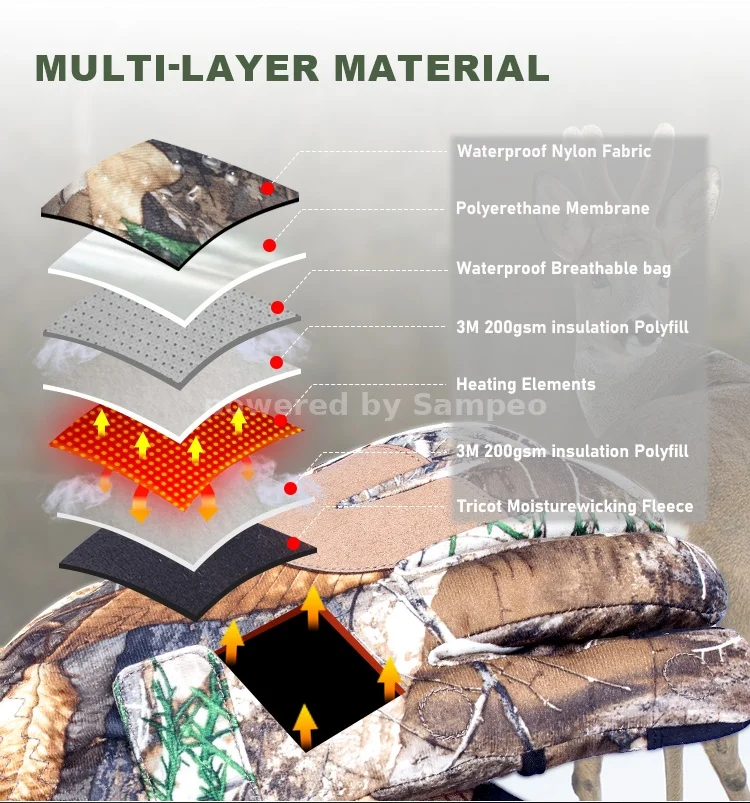
The failure modes accounting for ~85% of field returns, in descending order:
| Rank | Failure mode | % of RMAs | Root cause layer | Diagnostic signal |
|---|---|---|---|---|
| — | — | — | — | — |
| 1 | Cell imbalance / capacity loss | 34% | Cell + BMS | Runtime drops 30%, charger LED blinks red |
| 2 | Heating pad burnout / open circuit | 22% | Heating film | One zone dead, no continuity at connector |
| 3 | Controller latch-up or button failure | 17% | PCBA | No LED response, no heat output |
| 4 | Connector corrosion / intermittent | 12% | Mechanical | Heat cuts in/out with garment movement |
| 5 | Charger fault | 8% | Charger IC | Pack not charging, IC hot to touch |
For battery heated apparel warranty workwear, connector corrosion is exaggerated (10+ hour shifts with continuous sweat exposure). For battery heated apparel warranty hunting jackets, cell imbalance dominates because users store the jacket in a cold truck between outings.
Factory Burn-in & AQL Sampling — 100% PCBA Test Methodology
Every PCBA leaving our SMT line runs a 100% in-circuit test followed by a 4-hour burn-in at 45 °C with the heating element driven at rated power. AQL sampling applies at pack assembly.
| Test stage | Coverage | Sample plan | Pass criterion | Equipment |
|---|---|---|---|---|
| — | — | — | — | — |
| PCBA ICT | 100% | N/A | All nets within tolerance | Flying probe |
| PCBA burn-in | 100% | N/A | 4 h @ 45 °C, no fault | 48-channel chamber |
| Pack assembly AQL | Sampling | AQL 1.0, Level II | Zero critical, ≤1 major | Random pull, X-ray, capacity test |
| Finished garment AQL | Sampling | AQL 2.5, Level II | Zero critical, ≤2 major | Function + hipot + visual |
| Accelerated life | Quarterly | 5 units / build | 200 cycle equiv pass | 60 °C chamber, 1C/1C cycle |
AQL 1.0 is the standard for pack assembly; AQL 2.5 is acceptable for finished garments because the cell is already verified. For battery heated apparel warranty wholesale programs above 5,000 units per SKU, we drop finished-garment AQL to 1.5 and add an on-site customer FAT. The accelerated life test is the most important warranty document we issue: a 60 °C, 1C/1C cycle that compresses one year of field use into ~3 weeks. Pass criterion: 200 equivalent cycles with < 5% capacity loss and no safety event.
Root-Cause Analysis Workflow
When a warranty claim arrives with a returned pack, the diagnostic sequence below runs before issuing credit. Total bench time: 2–4 hours per RMA.
| Step | Tool | What we look for | Time |
|---|---|---|---|
| — | — | — | — |
| 1 | Visual + continuity | Mechanical damage, open circuit | 10 min |
| 2 | Capacity test | Cell health vs datasheet, imbalance | 60 min |
| 3 | X-ray (2D) | Cell stack alignment, tab weld quality | 15 min |
| 4 | Cross-section | Separator melt, dendrite (destructive) | 90 min |
| 5 | Thermal imaging | Hot spots on BMS, MOSFET loss | 30 min |
| 6 | Chemical analysis | Electrolyte color, swab pH (destructive) | 30 min |
Step 3 catches most connector and tab-weld failures. Step 4 is reserved for cells showing >15% capacity loss but passing continuity — the dendrite signature. Step 5 catches BMS MOSFETs running too hot because the heat-sink pad was missing. The diagnostic report returned to the buyer includes the capacity curve, X-ray image, and failure-mode tag. A supplier that returns only “failed pack, replaced” is running a swap program, not battery heated apparel warranty engineering.
Warranty Scope by Component Layer
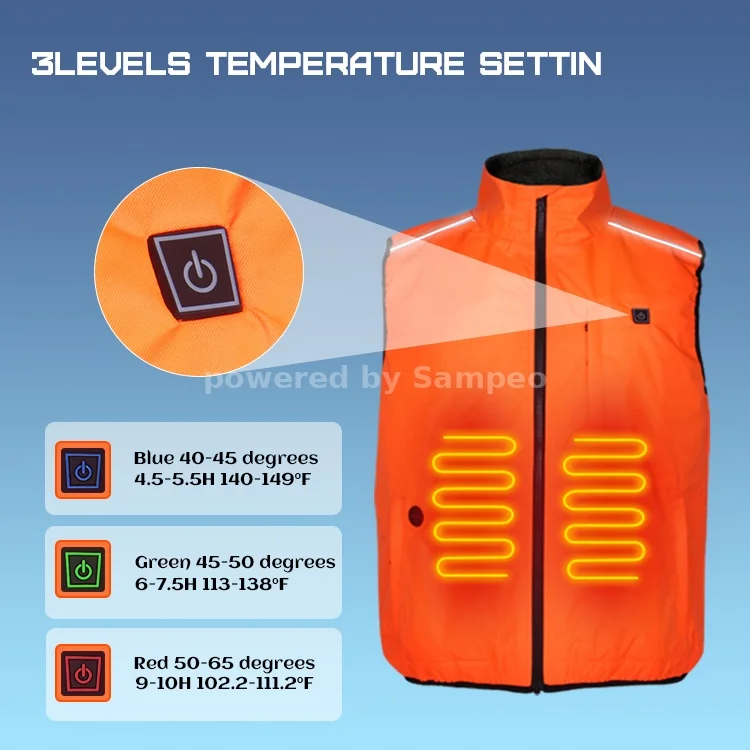
The warranty document a buyer signs has to define which component layer carries what term.
| Component layer | Standard warranty | Extended warranty (cost +) | What voids it |
|---|---|---|---|
| — | — | — | — |
| Cell (21700 NMC) | 12 months | 24 months | Storage at > 60 °C, deep discharge < 2 V |
| BMS / PCBA | 24 months | 36 months | Opening the pack, water beyond IP67 |
| Heating film (graphene) | 36 months | 60 months | > 80 wash cycles, mechanical cut |
| Connector + cabling | 12 months | 24 months | Pull force > 30 N, visible corrosion from misuse |
| Zipper / shell fabric | 6 months | 12 months | Cuts, chemical exposure, pet damage |
The graphene heating-film line is the longest because the film is the most reliable subassembly. Most buyers assume the film should carry the same warranty as the cell. The opposite is true: a battery heated apparel warranty manufacturer who is honest tells you the film outlasts the cell by 2–3×. For wholesale battery heated apparel warranty wholesale buyers placing annual contracts above 50,000 units, we offer a single end-to-end 24-month warranty that collapses the layer model.
Engineering Documentation Buyers Should Require
Before signing a PO, a buyer should be able to produce the following documents from the supplier. If the supplier cannot, the warranty is unenforceable.
| Document | Standard / scope | Issued by | Frequency |
|---|---|---|---|
| — | — | — | — |
| Cell datasheet + UN 38.3 report | UN 38.3 Rev 6 | Cell vendor | Per lot |
| IEC 62133-2 test report | Cell + pack level | Third-party lab | Annual |
| MSDS (lithium battery) | OSHA / GHS | Cell vendor | Per chemistry |
| UN3481 shipping declaration | Air/sea logistics | Freight forwarder | Per shipment |
| Heating-film datasheet | Resistance, Tg, adhesive | Film supplier | Per batch |
| IP67 test report (pack) | IEC 60529 | Third-party lab | Per SKU |
| FMEA + control plan | AIAG-VDA 2019 | OEM | Per SKU revision |
| 8D corrective action log | Per field failure | OEM | Ongoing |
| AQL inspection report | ISO 2859-1 | OEM | Per lot |
| DoC / CE / FCC / UKCA | Market-specific | OEM | Per market |
For battery heated apparel warranty OEM programs, the FMEA + control plan are the two documents that survive a regulatory audit. For private-label wholesale battery heated apparel warranty wholesale buyers, the UN 38.3 + IEC 62133-2 are the two that survive customs. Working with a seasoned battery heated apparel warranty manufacturer like grapheneheatingfabric means the BMS, heating-film lamination, and connector potting are validated as one stack — not three vendors arguing over whose test report is authoritative. Our graphene heating film OEM program locks cell lot, BMS firmware version, and heating-film batch into one traceability record. Every OEM program we run through grapheneheatingfabric ships with that traceability built in.
Warranty Cost Engineering on the Supplier Side
The numbers below are the actuarial model we use internally.
| Cost driver | Typical % of wholesale price | Notes |
|---|---|---|
| — | — | — |
| Defect reserve (cells + BMS) | 2.5–3.5% | Tuned by historical RMA rate |
| Replacement logistics (DDP) | 1.0–1.8% | Air vs sea, destination |
| RMA bench labor | 0.4–0.6% | 2–4 hours per RMA at internal cost |
| Field service / 8D | 0.2–0.4% | Engineering hours on root cause |
| Insurance (product liability) | 0.8–1.2% | Per market |
| Total warranty load | 4.9–7.5% | Excludes catastrophic recall |
A buyer asking for a 36-month warranty on a SKU we’ve only sold for 6 months lifts the unit cost by 1.5–2.0%. Longer terms are not free, and a serious battery heated apparel warranty manufacturer shows you the math. This is where battery heated apparel warranty engineering meets finance — the unit-cost adder on a 36-month term is the engineering team’s price for taking on cycle-life risk the cell-vendor has not yet earned the right to retire. NPV framing: at 10% discount rate, a $30 replacement 24 months out is worth $24.78 today; 36 months out is worth $22.50. The 12-month extension is therefore ~$2.28 NPV per unit.
Three Real RMA Case Studies
Case 1 — Capacity fade on a hunting jacket. A European brand shipped 2,200 graphene parkas; by February, 7.4% were returned with “runtime dropped to ~90 minutes from rated 240.” Capacity test showed 22% capacity loss. Root cause: cells sourced from a Tier-2 vendor whose formation cycle had been shortened to meet Q4 demand. Corrective action: replaced the cell vendor, added 100% formation-cycle verification at incoming QC, extended the buyer warranty from 12 to 24 months. RMA cost: $48k. Lesson: never accept cell-vendor changes mid-run. This is the engineering reality behind every battery heated apparel warranty hunting jacket spec.
Case 2 — Connector corrosion on a workwear vest. A North American safety buyer returned 11% of a 1,500-unit workwear vest run after 4 months in field. Symptom: heat cut out intermittently when the wearer bent over. Bench teardown showed green corrosion on connector pins despite IPX5 boots. Root cause: the desiccant pack was rated for 6 months but the workwear shift pattern (10 h/day, 5 days/week) accelerated humidity cycling beyond the desiccant capacity. Corrective action: larger silica-gel pack, humidity indicator card, gold-plated pins. RMA cost: $22k. Lesson: IP rating is necessary but not sufficient — vapor-phase moisture still migrates through the boot. For battery heated apparel warranty workwear, humidity design margin matters as much as the IP rating.
Case 3 — Heating pad open circuit at the bus-bar junction, first wash. A Japanese retailer received 800 base-layer shirts; on the first wash cycle (30 °C, gentle), 14 units failed to heat. Root cause: lamination Tg of the bus-bar adhesive was 58 °C — within the datasheet spec but below the 65 °C we require. Corrective action: raised the adhesive spec to 75 °C Tg minimum, added 100% pull-test post-lamination. RMA cost: $9k. Lesson: a 10 °C Tg margin is the difference between a 1-year and a 3-year warranty on the heating element. This is why every battery heated apparel warranty OEM program we now run requires a written Tg window on the bus-bar adhesive datasheet.
Frequently Asked Questions — Engineering Questions Buyers Actually Ask
What cycle count should I require for a 21700 cell in a heated jacket?
Pin the datasheet to 800 cycles to 80% capacity at 1C/1C 25 °C. Anything weaker is not a serious battery heated apparel warranty 21700 cell cycle spec.
The battery heated apparel warranty 21700 cell cycle ceiling is set at 800 full DOD cycles to 80% capacity retention — verified under accelerated test conditions that map to roughly three Q4-heavy hunting seasons before the cell triggers a battery heated apparel warranty 21700 cell cycle claim.
Does IP67 mean I can machine-wash the battery pack?
No. IP67 covers the pack against 1 m submersion for 30 minutes. Machine-washing subjects the pack to detergent, mechanical shock, and spin-cycle forces that exceed IP67.
How do I read a factory FMEA report?
Score each failure mode on Severity (1–10), Occurrence (1–10), and Detection (1–10). Multiply to get the RPN. Anything above 100 requires design mitigation; above 200 blocks tooling release.
What is the difference between PCBA test and EOL test?
PCBA test verifies the bare board before pack assembly. EOL test verifies the finished pack — capacity, voltage, BMS handshake, heater continuity, IP rating.
Can I substitute Li-Po for 21700 without changing the warranty?
No. Li-Po delivers ~60% of the cycle life of cylindrical NMC in wearable form factors.
What is AQL 1.0 vs 2.5 for sampling?
AQL 1.0 is the maximum defect rate accepted at sampling — 1.0% for critical defects at pack assembly. AQL 2.5 is the limit for finished-garment functional defects.
How long does a typical root-cause analysis take?
Bench time is 2–4 hours for the diagnostic sequence; full 8D closure is 5–10 business days.
What documents should a serious OEM warranty manufacturer provide?
Cell UN 38.3, IEC 62133-2, MSDS, heating-film datasheet with Tg, IP67 test report, FMEA, control plan, AQL report per lot, DoC per market.
Why does cell imbalance trigger most field RMAs?
A 1S2P or 1S3P pack with a weak cell will reverse-charge on the weak cell during deep discharge, permanently damaging it.
Does heating-film bending cycle data matter for hunting jackets?
Yes. A hunter bends the back panel 200+ times per outing. Over a 60-outing season that’s 12,000 bend cycles — exactly the failure point of a carbon-fiber-on-PET film.
What is the defect reserve % for heated apparel?
Typical industry band is 4.9–7.5% of wholesale price, of which 2.5–3.5% is the cell + BMS reserve alone.
How do graphene heating-film failure modes differ from carbon fiber?
Carbon fiber fails by micro-crack propagation in the printed trace. Graphene fails by interfacial delamination at the bus bar if lamination Tg is too low.
What is UN3481 classification?
UN3481 is the UN number for “Lithium batteries packed with equipment” — a battery pack shipped inside a heated garment. It requires UN 38.3 test data and a Class 9 hazard label.
Does IEC 62133 certification cover the whole heated garment?
No. IEC 62133-2 covers the cell and the pack, not the heating film, connector, or garment.
How do I structure an RMA escalation path with my Chinese factory?
Three tiers: (1) field swap-out at the distributor, credited against next PO; (2) bench-level root-cause at the factory, 5–10 business days; (3) 8D corrective action with engineering sign-off, 30 days.
Glossary
- FMEA
- Failure Mode and Effects Analysis — engineering method scoring severity × occurrence × detection to prioritize failure-mode mitigation.
- BMS
- Battery Management System — electronic circuit that monitors cell voltage, temperature, and current to prevent overcharge/discharge.
- PCBA
- Printed Circuit Board Assembly — the populated PCB with all components soldered; undergoes 100% electrical test before integration.
- AQL
- Acceptable Quality Level — statistical sampling plan (e.g., AQL 2.5) defining maximum defect rate for batch acceptance.
- UN3481
- UN dangerous-goods classification for lithium-ion batteries — required shipping documentation for air/sea freight.
- IEC 62133
- International safety standard for secondary (rechargeable) cells used in portable applications.
Glossary
BMS — Battery Management System. PCBA protecting against overcharge, overdischarge, overcurrent, short circuit; balances cell voltages.
AQL — Acceptable Quality Limit. Maximum defect percentage accepted in a sampled lot (ISO 2859-1).
FMEA — Failure Mode and Effects Analysis. S/O/D scoring per failure mode, multiplied to a Risk Priority Number (RPN).
RPN — Risk Priority Number. S × O × D. Used to rank FMEA items.
PCBA — Printed Circuit Board Assembly. Bare board after component placement and solder reflow.
EOL — End-of-Line test. Final functional test on a finished pack or garment.
UN 38.3 — UN manual of tests for lithium batteries, Rev 6. Required for any lithium cell shipped internationally.
IEC 62133-2 — International safety standard for secondary lithium cells in portable applications.
UN3481 — UN dangerous goods classification for lithium batteries packed with equipment.
IP67 — Ingress Protection: dust-tight (6) + 1 m submersion for 30 min (7). Pack-level only.
21700 cell — Cylindrical lithium cell, 21 mm × 70 mm. Default for modern heated apparel packs.
Tg — Glass transition temperature of an adhesive or film.
8D — Eight Disciplines problem-solving method for field-failure corrective action.
—
This guide is the engineering field manual I’d hand to a new brand manager on day one. Every number above is data we actually track in our PLM; every test protocol runs on our bench in Dongguan weekly. If you are evaluating a battery heated apparel warranty manufacturer, the questions in this document are the ones your supplier should already be answering in their RFQ reply. Battery heated apparel warranty engineering is the discipline that separates the two.
For wholesale battery heated apparel warranty wholesale buyers ordering 1,000+ units per SKU, grapheneheatingfabric extends the documentation pack to include lot-level cycle test data and FMEA revisions, and assigns a dedicated application engineer to your program. Reach out through the OEM/ODM manufacturing contact page with your target SKU and annual volume to start the RFQ.
Leave a Reply