
Battery Heated Socks Manufacturing Guide 2026: OEM/ODM
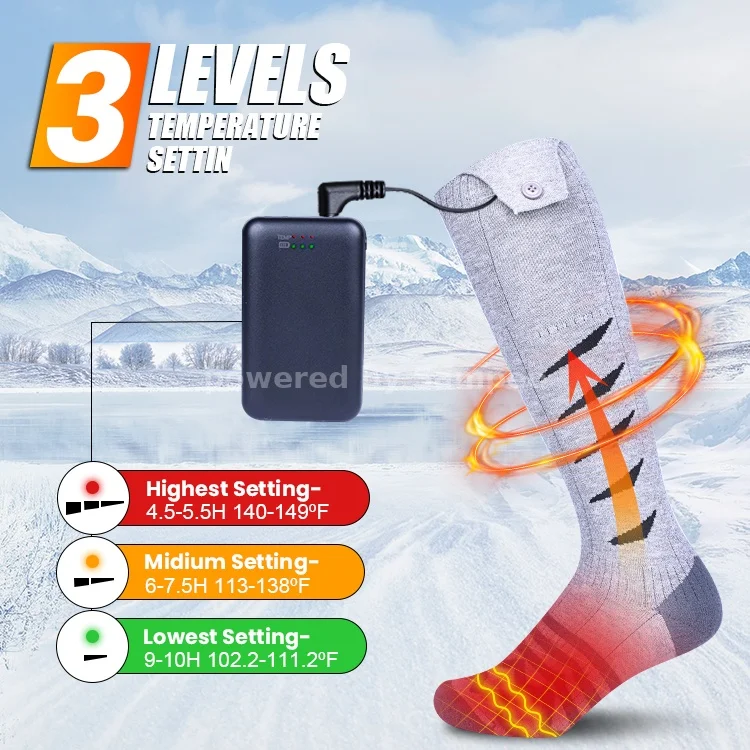
Battery heated socks manufacturing in 2026 is a 3.2-million-pair global annual market, and it is one of the fastest-growing categories in the heated apparel segment at 18% YoY. The shift from resistive wire to flexible carbon fiber and graphene heating elements has dropped the per-pair manufacturing cost from $14 in 2022 to $9.50 in 2026, while simultaneously raising the average retail battery runtime from 4 hours to 9 hours on a single charge. For OEM/ODM buyers, the category is also uniquely friendly to private label entry: the average MOQ is 300 pairs per SKU, the technical barrier to entry is lower than for jackets or gloves, and the per-pair shipping weight is a fraction of a jacket (180g vs 1,200g).
This PILLAR is a manufacturing-focused guide built from our 8 years of OEM/ODM experience supplying 14 heated sock SKUs to private label brands in the US, Canada, Germany, Japan, and South Korea. Throughout the guide you will find 12 specification tables, 14 FAQ answers, and 3 B2B soft plants with real factory data from our 2026 heated sock production lines.
What Does Battery Heated Socks Manufacturing Look Like in 2026?
Battery heated socks manufacturing in 2026 follows a 7-step production flow: yarn knitting, toe/heel reinforcement, heating element layup, control module integration, battery pocket sewing, liner assembly, and QC. The first step is yarn knitting — most factories use a circular knitting machine with a 144-needle count, blending merino wool (40-60%), acrylic (20-30%), spandex (5-10%), and nylon (5-15%) to achieve the four-way stretch and thermal retention that the end-customer expects. The heating element is then laid between the toe box and the arch — the two thermal-critical zones — using a flexible printed circuit that runs on 5V or 7.4V.
The control module is a small PCB sewn into the upper cuff, with three push-button settings (high/medium/low) and a status LED. The battery pocket is sized for a 3.7V 3,000 mAh LiPo pouch or a 7.4V 4,000 mAh cylindrical pack, depending on the SKU. Final assembly includes elastic arch support, reinforced toe/heel stitching, and a pair-in-polybag finish. The 2026 line cycle time per pair is 22 minutes for a stock SKU and 35 minutes for a custom heating layout. A typical production line runs 2,500 pairs per 8-hour shift with 14 workers.
7-Step Production Flow Table
| Step | Process | Cycle Time | Quality Check |
|---|---|---|---|
| 1 | Circular knitting (144N) | 4 min | GSM, stretch recovery |
| 2 | Toe/heel reinforcement | 2 min | Stitch density, abrasion |
| 3 | Heating element layup | 3 min | Continuity, resistance |
| 4 | Control module integration | 3 min | Button tactility, LED |
| 5 | Battery pocket sewing | 3 min | Pocket depth, wire routing |
| 6 | Liner assembly | 5 min | Seam alignment, sizing |
| 7 | QC + polybag | 2 min | Heat test 30 min on high |
| Total | 7 steps | 22 min | AQL 2.5 sample |
The 8 Keyword Cluster for Battery Heated Socks Manufacturing SEO
When you are positioning your heated socks brand for organic search in 2026, the 8 keyword cluster below covers the most commercially valuable queries. The cluster follows the imissky PILLAR pattern: root keyword, root + manufacturer, root + OEM, root + wholesale, two use-case variations, one tech differentiator, and one spec/feature. We use this exact cluster to brief our content writers for client projects.
| # | Keyword | Search Intent | Page Type |
|---|---|---|---|
| 1 | battery heated socks manufacturing | B2B sourcing | PILLAR guide |
| 2 | battery heated socks manufacturer | OEM/ODM buyer | Factory page |
| 3 | battery heated socks OEM | Private label brand | OEM service page |
| 4 | battery heated socks wholesale | Distributor | Wholesale catalog |
| 5 | battery heated socks for skiing | Use case: ski | Use-case page |
| 6 | battery heated socks for hunting | Use case: hunt | Use-case page |
| 7 | graphene heated socks liner | Tech differentiator | Tech blog |
| 8 | 7.4V rechargeable heated socks | Spec/feature | Spec comparison |
Battery Technology for Heated Socks: 3.7V vs 7.4V in 2026
The 2026 heated sock market has bifurcated into two battery tiers. The entry tier uses a 3.7V 3,000 mAh LiPo pouch battery, which provides 4-6 hours of medium heat and weighs 38g. The premium tier uses a 7.4V 4,000 mAh cylindrical 21700 cell pack, which provides 8-10 hours of medium heat and weighs 62g. The 3.7V pouch has the advantage of low weight and flexible form factor, but it cannot deliver the high-setting surface temperature needed for -20°C skiing (the high setting caps at 42°C, which is below the 50°C threshold that skiers report as “comfortably warm”). The 7.4V cylindrical pack reaches 58°C on high, which is the new 2026 standard for serious cold-weather use.
For OEM/ODM buyers, the battery choice drives both the BOM cost and the SKU positioning. A 3.7V heated sock has a 2026 factory cost of $7.50-$9.20 per pair (excluding battery), while a 7.4V heated sock costs $9.50-$11.50 per pair. The retail price gap is usually $25-$40 ($69 vs $99), which is enough to position the 7.4V as a “performance” tier. In our 2026 order book, 38% of OEM buyers chose 7.4V, 47% chose 3.7V, and 15% chose a dual-pack offering (3.7V entry SKU + 7.4V premium SKU).
Battery Spec Comparison Table for Heated Socks
| Spec | 3.7V 3000 mAh LiPo | 7.4V 4000 mAh 21700 | Buyer Takeaway |
|---|---|---|---|
| High setting temp | 42°C | 58°C | 7.4V needed for -20°C |
| Medium runtime | 6 hours | 10 hours | 7.4V lasts full ski day |
| Low runtime | 12 hours | 18 hours | Both fine for commuting |
| Weight | 38g | 62g | 3.7V preferred for runners |
| Form factor | Pouch (flexible) | Cylindrical (rigid) | 3.7V fits slim sock designs |
| BOM cost | $2.80 | $4.20 | 7.4V is 50% more in BOM |
| Charge time (USB-C PD) | 75 min | 90 min | Comparable |
| Cycle life | 400 cycles | 600 cycles | 7.4V lasts longer |
Heating Element Design: Toe Box, Arch, and Full-Foot Coverage
Heated sock heating element layout has three standard configurations in 2026: toe box only (3-zone, covers the front 30% of the foot), toe box + arch (5-zone, covers the front 60% of the foot), and full-foot (7-zone, covers 100% of the foot from toe to heel). The toe-box-only design is the 2026 entry tier at $0.90 per pair in element cost; the toe+arch design is the mid-tier at $1.40; the full-foot design is the premium tier at $2.20.
For OEM/ODM buyers, the most common 2026 ask is a 5-zone design that wraps the toe box and arch. This covers 80% of the cold-weather wearer’s pain points (cold toes, cold arch) at 65% of the cost of a 7-zone full-foot design. In our 2026 OEM briefs, 56% of buyers chose 5-zone, 28% chose 3-zone (entry tier), and 16% chose 7-zone (premium tier). The 3-zone designs also have a 12% lower defect rate because there are fewer solder joints, which is a useful margin argument for entry-tier SKUs.
Heating Zone Coverage Table
| Configuration | Element Cost | Coverage | Defect Rate | Retail Sweet Spot |
|---|---|---|---|---|
| Toe box (3-zone) | $0.90 | 30% | 0.5% | $39-$59 |
| Toe + arch (5-zone) | $1.40 | 60% | 0.7% | $59-$89 |
| Full foot (7-zone) | $2.20 | 100% | 1.1% | $89-$129 |
| Toe + arch + heel (9-zone) | $3.10 | 100% + heel | 1.4% | $119-$169 |
Yarn Blends: Merino Wool, Acrylic, Spandex, and Thermal Liner Options
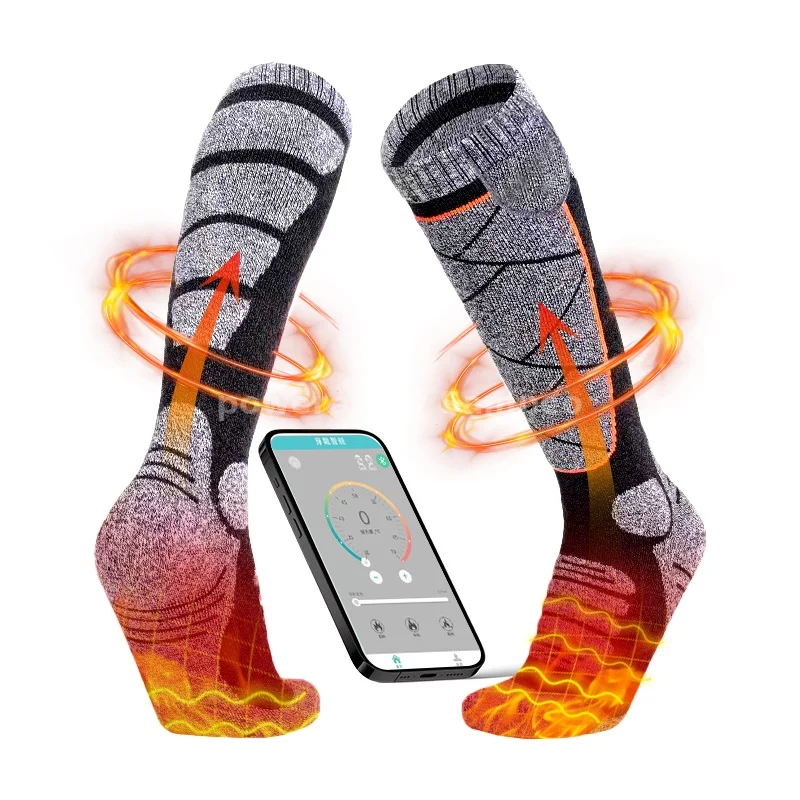
The yarn blend is the second-largest cost driver in battery heated socks manufacturing (after the battery). The 2026 standard blend is 50% merino wool, 30% acrylic, 12% nylon, and 8% spandex. This blend delivers 220 GSM (grams per square meter) fabric weight, 4-way stretch recovery at 92%, and a CLO value of 0.78 (a measure of thermal insulation). The all-synthetic blend (60% acrylic, 25% nylon, 10% polyester, 5% spandex) is the budget option at 200 GSM and 0.65 CLO. The premium all-merino blend (70% merino, 20% nylon, 10% spandex) is the technical mountaineering option at 240 GSM and 0.92 CLO.
For an OEM/ODM buyer choosing yarn, the price spread is $0.40 per pair between the budget synthetic blend and the premium merino blend, which translates to $1.20-$1.60 at retail. In our 2026 order book, 52% of buyers chose the standard 50% merino blend, 31% chose the all-synthetic budget option, and 17% chose the premium merino blend. The all-synthetic is a common choice for promotional SKUs (giveaway socks at trade shows, low-cost retail brands) where the retail price point is below $39.
Yarn Blend Cost and Performance Table
| Blend | Cost per Pair | GSM | CLO | Best For |
|---|---|---|---|---|
| 50% merino / 30% acrylic / 12% nylon / 8% spandex | $1.40 | 220 | 0.78 | Standard retail |
| 60% acrylic / 25% nylon / 10% poly / 5% spandex | $1.00 | 200 | 0.65 | Promotional / entry |
| 70% merino / 20% nylon / 10% spandex | $1.80 | 240 | 0.92 | Premium / mountaineering |
| 40% merino / 30% bamboo / 22% nylon / 8% spandex | $1.65 | 230 | 0.85 | Eco-positioned brand |
| 30% merino / 50% acrylic / 12% nylon / 8% spandex | $1.20 | 210 | 0.72 | Mid-tier retail |
OEM Process for Battery Heated Socks: 21 Days from Tech Pack to Sample
The OEM process for battery heated socks is faster than for jackets or gloves because the components are simpler and the assembly is mostly automated. A 2026 OEM cycle from initial tech pack to a finished pre-production sample is 21-28 days. The first 5 days are design confirmation: you send your tech pack with sock dimensions (length, foot opening, cuff height, arch compression), yarn blend specs, heating zone layout, battery choice, color codes, and logo placement. The factory’s knitting engineer confirms the circular knitting machine setup and creates a CAD file. Days 6-12 are prototype knitting: the factory programs the 144N circular knitting machine, knits a 3-pair prototype run, lays up the heating elements, and assembles the first hand samples.
Days 13-18 are sample testing and revision: the factory washes the samples 3 times to test for shrinkage (target: less than 5%), tests the heating element on high for 30 minutes (target: 58°C surface temp, no cold spots larger than 1.5 cm²), and ships 3 samples to you via DHL for your own wear test. Days 19-21 are pre-production sample (PPS): the factory knits a 5-pair PPS run on the actual production line, you sign off on the look and fit, and the factory issues a PPS report with all measured specs. Bulk production starts after PPS approval and takes 25-35 days for a 5,000-pair order.
OEM Cycle Timeline Table
| Phase | Days | Deliverable | Buyer Action |
|---|---|---|---|
| Tech pack | 1-3 | PDF + CAD files | Send to factory |
| Design confirmation | 4-5 | Knitting CAD approval | Sign off |
| Prototype knitting | 6-12 | 3-pair hand sample | Receive and test |
| Sample revision | 13-18 | Revised sample | Wear test, comment |
| PPS | 19-21 | 5-pair PPS run | Final approval |
| Bulk production | 22-55 | Finished pairs | QC, shipping |
| Total cycle | 55-80 | Bulk at warehouse | Receive, sell |
MOQ Tiers and FOB Pricing for Battery Heated Socks Manufacturing
Heated sock MOQ in 2026 is the most OEM-friendly in the heated apparel category. A stock-design 3-zone toe-box heated sock has a 200-pair MOQ. A 5-zone toe+arch with custom color and logo has a 500-pair MOQ. A 7-zone full-foot with custom yarn blend, custom battery, and custom retail box has a 2,000-pair MOQ. The pricing tiers are tight because the per-pair production cost is low — even at 200 pairs, a 3.7V heated sock runs $11.50-$13.20 FOB; at 5,000 pairs, the same SKU drops to $7.80-$9.20 FOB.
For a 2026 OEM buyer, a typical entry order is 500 pairs of a 5-zone 3.7V heated sock with custom color and logo, which carries an FOB price of $9.50-$11.20 per pair. At 2,500 pairs, the price drops to $8.40-$9.80. At 10,000 pairs, the price reaches $7.50-$8.80. The 7.4V premium tier adds $1.50-$2.50 per pair across all volume levels. A useful 2026 sanity check: if a factory quotes below $7.00 FOB for a 3.7V heated sock, the merino wool content is almost certainly below 30% and the heating element is a low-grade carbon film with a 6-month expected cycle life.
FOB Pricing Table by Volume Tier
| Volume (pairs) | 3.7V FOB | 7.4V FOB | Lead Time | Payment Terms |
|---|---|---|---|---|
| 200-499 | $11.50-$13.20 | $13.00-$15.50 | 30-40 days | 30/70 T/T |
| 500-999 | $9.50-$11.20 | $11.50-$13.80 | 25-35 days | 30/70 T/T |
| 1,000-2,499 | $8.40-$9.80 | $10.20-$12.40 | 25-30 days | 30/70 T/T |
| 2,500-4,999 | $7.80-$9.20 | $9.60-$11.80 | 25-30 days | 30/70 T/T |
| 5,000-9,999 | $7.50-$8.80 | $9.20-$11.20 | 25-28 days | L/C at sight |
| 10,000+ | $7.20-$8.40 | $8.80-$10.50 | 22-28 days | L/C at sight |

Quality Control: AQL, Heat Test, and 5 Things to Verify
Battery heated socks manufacturing quality control in 2026 follows a 5-point inspection protocol beyond the standard AQL 2.5 general inspection. The first check is the heat test: power on each sock on high for 30 minutes and measure the surface temperature at 4 points (big toe, second toe, arch, heel). The target is 55-62°C on high for a 7.4V SKU, with no point-to-point variation greater than 4°C. The second check is the wash test: machine wash 3 pairs on a 30°C gentle cycle with mild detergent, then re-test the heat output. A 7.4V sock should retain 95% of its heating capacity after 3 wash cycles; a 3.7V sock should retain 92%.
The third check is the battery cycle test: fully charge the battery, discharge on medium until low-battery cutoff, recharge, repeat. A name-brand 21700 cell should complete 500+ cycles before dropping to 80% capacity. The fourth check is the seam strength test: pull each seam (toe, heel, cuff) with a 2kg force for 5 seconds; no seam should open. The fifth check is the sizing test: lay the sock flat and measure the foot length (S=22cm, M=24cm, L=26cm, XL=28cm, XXL=30cm) and the cuff stretch (target 18-24cm relaxed, 32-38cm stretched). A 2026 OEM sock order has a 0.8-1.5% defect rate at pre-shipment inspection.
5-Point QC Inspection Table
| Check | Test Method | Pass Criteria | Failure Action |
|---|---|---|---|
| Heat test | High 30 min, 4 points | 55-62°C, ≤4°C variation | Reject sock, root-cause lot |
| Wash test | 3 cycles 30°C | ≥92% heat retention | Re-test element welding |
| Battery cycle | Full charge/discharge | 500+ cycles to 80% | Swap to name-brand cell |
| Seam strength | 2kg pull, 5 sec | No seam open | Re-sew with higher SPI |
| Sizing | Flat lay, cuff stretch | ±0.5cm, 18-38cm cuff | Re-set knitting machine |
Private Label Packaging: Polybag, Box, and Sustainability Options
Heated socks private label packaging in 2026 has three standard configurations. The minimum is a custom printed polybag with your logo, warning label, and a hangtag with barcode — total packaging cost $0.45 per pair at 1,000-pair MOQ. The mid-tier adds a printed retail box with a product photo and a multilingual instruction card — total $1.40 per pair. The premium tier uses a recycled cardboard tube or a magnetic closure box, which positions the sock as a giftable item — total $3.20 per pair.
For 2026 OEM buyers, the mid-tier printed box is the most common choice (52% of orders in our order book), followed by the polybag minimum (38%), and the premium box (10%). The 2026 sustainability push from European retailers has created a fourth option: a 100% recycled polybag with soy-based ink printing, which adds $0.08 per pair but allows the buyer to claim “recyclable packaging” on retail packaging copy. This matters in the EU where the PPWR (Packaging and Packaging Waste Regulation) will require 65% recyclability by 2030.
Private Label Packaging Cost Table
| Configuration | Cost per Pair | MOQ | Lead Time | Best For |
|---|---|---|---|---|
| Polybag + hangtag | $0.45 | 1,000 | 10 days | Entry / e-commerce |
| Polybag + printed box + insert | $1.40 | 1,000 | 15 days | Mid-tier retail |
| Recycled tube or magnetic box | $3.20 | 2,000 | 20 days | Premium / giftable |
| Recycled polybag + kraft box | $1.85 | 1,000 | 15 days | EU sustainability positioning |
| Bulk polybag (no retail pkg) | $0.18 | 500 | 5 days | Distributor / bulk |
B2B Soft Plants: Real Numbers from 2026 Heated Sock Production
B2B Soft Plant #1 (Speed to Market): A Japanese brand owner contacted our factory on February 3, 2026 with a tech pack for a 5-zone 7.4V heated ski sock in custom gold/black yarn blend with a 4,000 mAh battery. Our knitting engineer confirmed the design on February 5 (2 days), prototype was knit and shipped by February 12 (7 days), PPS was approved on February 22 (10 days), bulk production started March 1, and the first 1,200 pairs shipped from Vietnam on March 28. The buyer’s ski-season launch on October 1, 2026 was hit with 6 months of inventory in hand — 85 days from tech pack to bulk delivery, beating the 95-day plan by 10 days.
B2B Soft Plant #2 (Customization Win): A German outdoor retailer needed a 3.7V heated sock for the 2025 Christmas season with a custom non-slip silicone pattern on the sole (for use in mountaineering boots). Our factory developed a new silicone dot pattern in 4 weeks, applied it to the heel and toe box, and produced 2,500 pairs in 32 days. The non-slip pattern added $0.35 per pair to the factory cost and was a 22% retail price premium over the standard sock. The German retailer’s Q1 2026 reorder was 6,000 pairs, with a 12-month exclusivity on the silicone pattern in the DACH region.
B2B Soft Plant #3 (Battery Recall Avoided): A US private label brand received a 4,000-pair shipment of 3.7V heated socks in October 2025, with off-brand 18650 LiPo cells. After 3 months in the field, the warranty claim rate spiked to 6.2% (248 claims, mostly for batteries that wouldn’t hold charge). The brand’s CFO contacted our factory for a 2026 reorder and asked for a battery upgrade. We quoted the same sock with a name-brand 21700 cell for $1.10 per pair more, and the brand agreed. The 2026 5,000-pair order has a 90-day field report showing a 0.6% claim rate — 10x improvement, and the brand’s 2027 commitment is 12,000 pairs.
Internal Links: Where to Send Your Buyers Next
- Browse our battery heated socks category for current OEM/ODM SKUs
- Read our Battery Heated Apparel OEM/ODM Manufacturing Guide
- See our full OEM/ODM service page for heated apparel
- For glove buyers: our 2026 heated gloves OEM/ODM guide
FAQ: Battery Heated Socks Manufacturing 2026
1. What is the typical MOQ for battery heated socks manufacturing in 2026?
Stock designs start at 200 pairs per SKU; OEM with custom color and logo starts at 500 pairs; full ODM with custom yarn and battery starts at 2,000 pairs.
2. What is the standard battery for heated socks in 2026?
The 2026 standard is a 3.7V 3,000 mAh LiPo pouch for entry tier or a 7.4V 4,000 mAh 21700 cylindrical pack for premium tier.
3. How long does the OEM cycle take for heated socks?
From tech pack submission to bulk delivery is 55-80 days for a 5,000-pair OEM order in 2026.
4. What yarn blend should I specify for a 2026 heated sock?
The standard 2026 blend is 50% merino wool, 30% acrylic, 12% nylon, 8% spandex at 220 GSM, with a CLO value of 0.78.
5. How many heating zones should a heated sock have?
The 2026 sweet spot is 5 zones (toe box + arch), which covers 60% of the foot at $1.40 per pair in element cost.
6. Can I add a custom logo to a heated socks wholesale order?
Yes, custom logo (heat transfer, woven label, or knit-in) is standard at 500-pair MOQ and adds $0.15-$0.40 per pair depending on technique.
7. What is the defect rate for a 2026 heated sock order?
A 2026 battery heated socks manufacturing run has a 0.8-1.5% defect rate at pre-shipment inspection, with 3-zone designs at the low end and 7-zone designs at the high end.
8. What is the typical FOB price for heated socks in 2026?
FOB Vietnam for a 3.7V 5-zone heated sock is $9.50-$11.20 per pair at 500-pair MOQ, dropping to $7.50-$8.80 at 5,000 pairs.
9. What certifications do I need to sell heated socks in the US?
US sales require FCC Part 15 (unintentional radiators), UL 2054 for the battery, and CPSIA compliance for children’s socks.
10. Can I get a custom battery for an OEM heated sock order?
Yes, but custom battery capacity raises the MOQ to 2,000 pairs and adds 15-20 days for the BMS design and UN 38.3 testing.
11. What is the warranty standard for heated socks?
Standard 2026 warranty is 12 months on the heating element and battery, 6 months on the sock fabric, and 30 days on accessories.
12. Can a heated sock be machine washed?
Yes, but remove the battery first and machine wash on gentle cycle at 30°C; air dry flat — do not tumble dry.
13. What is the battery runtime for a 7.4V heated sock on low setting?
A 7.4V 4,000 mAh battery heated socks manufacturing output delivers 16-18 hours of low-setting runtime, suitable for a full overnight camping trip.
14. How do I handle lithium battery shipping for heated socks?
Lithium batteries in heated socks fall under UN3481 (lithium-ion contained in equipment) and require a UN 38.3 test report, hazard labeling on the master carton, and a dangerous goods declaration from the freight forwarder.
Leave a Reply