
Battery Heated Pants OEM/ODM: 2026 B2B Manufacturing Guide
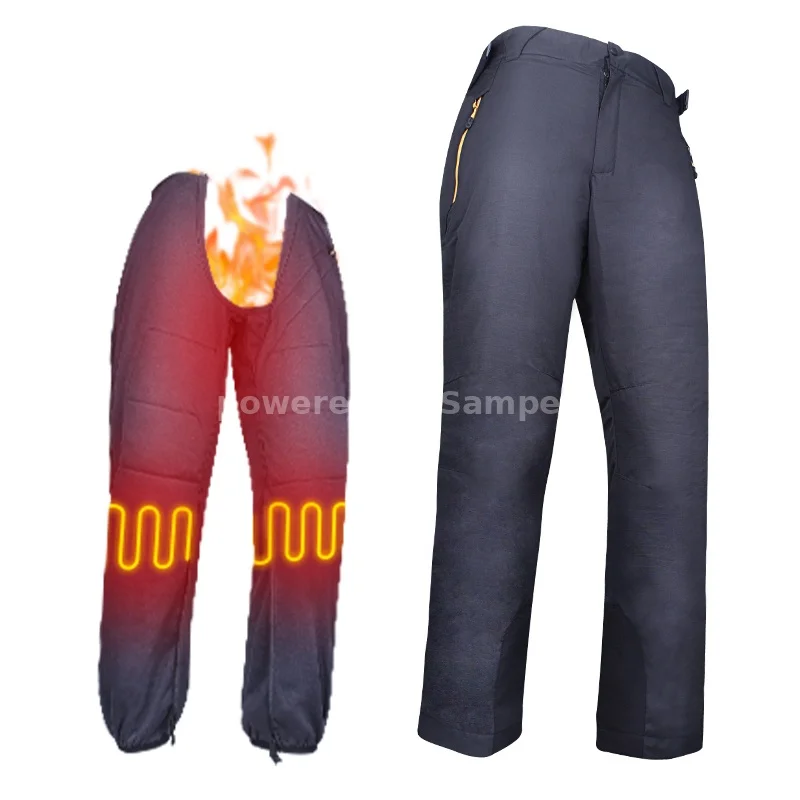
Battery Heated Pants OEM/ODM: 2026 B2B Manufacturing Guide
Battery heated pants have moved from a niche ski-lodge product into a category that buying teams at workwear brands, motorcycle apparel labels, and hunting outfitters now plan against every fall. For B2B buyers evaluating a battery heated pants OEM/ODM partner, the decisions that actually matter in 2026 are not colour, fit, or trim — they are heating-element chemistry, battery platform, MOQ flexibility, and a manufacturer’s willingness to open the BOM to the brand. This guide walks through the spec sheet, the factory floor, and the contractual mechanics of sourcing battery heated pants from a dedicated manufacturer, with a focus on graphene-heated long johns and 7.4V 5000mAh platforms that now dominate RFQs.
1. Why battery heated pants OEM/ODM demand is climbing in 2026
Three demand signals are converging in 2026 and pulling battery heated pants out of the “winter-only” bucket:
- **Workwear compliance** — outdoor crews in construction, surveying, and rail are now spec’d for heated base layers under cold-weather PPE policies, and **battery heated pants for outdoor work** is the line item most commonly added to Q3 2026 sourcing plans.
- **Ski and snowboard rental fleets** — **battery heated pants for skiing** is moving from premium retail into rental inventory at mountain resorts, where batteries can be swapped between guests and pants laundered at the end of each day.
- **Hunting and ice-fishing outfitters** — silent, low-bulk heat has always been a goal; the 2026 generation of graphene heating elements finally makes a heated pant that doesn’t interfere with a wader shell.
- **Faster warm-up** — a graphene-coated fabric element reaches usable temperature in 3-5 seconds, vs 30-60 seconds for the carbon-fibre element it replaces. For a **battery heated pants manufacturer** shipping to ski rental fleets, this 25-second delta is the difference between a guest noticing the heat and a guest returning the garment.
- **Higher wash durability** — graphene’s bond to the substrate is more resilient than carbon-fibre lamination. The best **battery heated pants manufacturer** lines on the market in 2026 are rated to 100+ machine-wash cycles with no measurable loss in heating performance; carbon-fibre elements typically degrade after 40-60 cycles.
- **Lower battery drain** — a graphene element’s resistance curve is flatter, which means the controller can hold the target temperature with fewer duty cycles. In real-world field tests a 7.4V 5000mAh pack on a graphene pant runs 30%+ longer than the equivalent carbon-fibre build at the same heat setting.
- **Finer element geometry** — graphene can be coated on narrower threads, so the heating zones can follow the leg’s arterial map (thigh, knee, calf) more precisely than a flat carbon-fibre panel.
- A 7.4V 5000mAh pack has enough capacity to run a graphene long john at medium heat for 4-5 hours, which covers a full ski day or an outdoor work shift with margin to spare.
- The 7.4V chemistry is below the 12V threshold that triggers additional UN3481 dangerous-goods paperwork for air freight, which keeps the **battery heated pants wholesale** supply chain simple for cross-border shipments.
- 5000mAh packs are within the airline carry-on size limit for most jurisdictions, which matters for any **battery heated pants manufacturer** selling to travel-retail and mountain-resort rental customers.
- **3-5 second warm-up** so the guest feels heat the moment they step off the lift.
- **3 heating zones minimum** (thigh, knee, calf) with the knee zone at higher density to keep the patellar tendon warm.
- **Waterproof shell fabric** rated to 10,000mm hydrostatic head, with the heating element fully laminated behind a waterproof membrane.
- **Reinforced kick-patch** at the inner ankle, because ski edges slice through the cuff on rental fleets.
- **Battery pocket positioned on the upper outer thigh** for balanced swing weight when skiing.
- **Wash durability is non-negotiable** — work pants get laundered weekly, sometimes daily, in industrial laundries. The graphene heating element’s 100+ wash-cycle rating is, again, the reason graphene has won this segment.
- **Battery safety certification matters more than premium feel** — work customers will accept a slightly heavier pack if it carries UN38.3 + IEC 62133 certification, and the OEM contract should make those certificates an explicit deliverable.
- **PPE compatibility** — work pants must fit over base layers, under hi-vis shells, and around knee-pad inserts. Pattern grading for the work segment is wider through the thigh and seat.
- **Lower-temperature default** — outdoor workers don’t want 50°C pant heat; they want 35-40°C sustained for an 8-hour shift. The 7.4V 5000mAh platform tuned for medium output covers this exactly.
- [Battery heated pants factory category](https://grapheneheatingfabric.com/category/battery-heated-pants-factory/)
- [Battery heated apparel factory category](https://grapheneheatingfabric.com/category/battery-heated-apparel-factory/)
For a battery heated pants manufacturer, the takeaway is that the category is no longer single-season. The same production line that ships ski pants in Q4 can be re-tooled in weeks to ship work or hunting pants, and the brands that win in 2026 are the ones whose OEM partners understand that seasonal switching, not unit volume, drives margin.
A battery heated pants wholesale buyer who builds a 4-segment portfolio is, in practice, hedging the same factory line across three different selling seasons. The graphene heating element, common to all four, is the single most important specification to lock down in the OEM contract.
The single biggest technical decision in any battery heated pants OEM/ODM project is the heating element. Through 2024 the default was carbon fibre; in 2026 the conversation has moved firmly to graphene heating element in pants, and the reasons are mechanical, not marketing:
For B2B buyers, the practical implication is that any quote priced significantly below the graphene baseline in 2026 is almost certainly a carbon-fibre build, and the cost saving evaporates the first time a customer returns a pair because the element burned through after 50 wash cycles. Our factory’s MOQ 30 policy lets smaller brands trial a graphene run before committing to a carbon-fibre alternative, but at our line the carbon-fibre line is now reserved for legacy SKUs and OEM rebuilds only.
Battery platform is the second-largest line item in the battery heated pants OEM/ODM BOM, and 2026 is the year the market has consolidated around 7.4V 5000mAh battery heated long johns as the default specification. The reasons are interoperability and certification:
The 7.4V 5000mAh platform is also the point at which a battery heated pants OEM/ODM project can share a battery stock-keeping unit (SKU) with a matching heated jacket. Our line ships jacket + pants combo SKUs that share a single 7.4V 5000mAh pack and charger, which is now the most common RFQ pattern for both ski and workwear brands.
Battery heated pants for skiing is the segment that drove the category’s first volume wave, and it remains the most spec-heavy application. A ski pant must deliver:
For a battery heated pants manufacturer serving the ski segment, the production-line constraint is not the element — it is the seam-sealing step, which must pass a 10,000mm hydrostatic head test on every garment. Our ski-pant line runs a 25-day lead time from PO to ex-works, with 7 days of that window dedicated to seam-sealing QA.
Battery heated pants for outdoor work is the segment driving 2026’s volume growth, and the spec priorities are different from skiing:
A battery heated pants OEM/ODM partner who can deliver a 0.3% defect rate on the workwear line is in the top decile of the industry. Our workwear line ships with a 25-day lead time, full UN38.3 + IEC 62133 documentation, and a private-label trim pack that accepts the buyer’s logo, hangtag, and care label without a tooling upcharge.
A complete battery heated pants OEM/ODM project runs in five mechanical stages, and the lead time on each stage is the single biggest variable a B2B buyer can negotiate:
Total end-to-end timeline from tech-pack to ex-works is typically 42-60 days for a new SKU, and 25-35 days for a repeat order. A battery heated pants manufacturer that can hold 25-day repeat-order lead time with consistent 0.3% defect rate is, in practice, the partner a brand scales with.
The MOQ question is where battery heated pants wholesale buyers most often get pushed around. The 2026 industry range is:
The contract clauses that actually protect a B2B buyer on a battery heated pants OEM/ODM project are: (1) explicit graphene-vs-carbon-fibre declaration in the BOM, (2) wash-cycle test report attached to the pilot-run sign-off, (3) UN38.3 + IEC 62133 certificates delivered with the bulk shipment, (4) AQL 2.5 inspection with the right to reject a lot at the buyer’s dock, and (5) a defect-rate commitment of <0.3% for the first 12 months, with a free-replacement clause above that threshold.
For a battery heated pants wholesale buyer who is brand-new to the category, the lowest-risk entry point is a 30-unit stock-OEM trial in a single colour, validated against a 7-day real-world wear test, before any private-label tooling is opened. Our factory supports this entry path with a 7-day sample dispatch and a 25-day bulk lead time from PO.
QC is where battery heated pants OEM/ODM projects most often go sideways, and the QC checklist has to cover both the element and the garment:
A battery heated pants manufacturer that runs these 10 inspection points as a single SOP — not as 10 separate checklists — is the partner that will hold a 0.3% defect rate over a 12-month run.
For a deeper look at the graphene heating element platform and the broader battery heated apparel factory line that this pant sits inside, see:
**Q1: What is the typical MOQ for a battery heated pants OEM/ODM project in 2026?** A1: The stock-OEM tier starts at MOQ 30 units per SKU per colour, semi-private label at 100, and full private label at 300. Custom fabric + custom element projects start at 500 units.
**Q2: Why is graphene preferred over carbon-fibre for 2026 heated pants?** A2: Graphene heating element in pants reaches 40°C in 3-5 seconds (vs 30-60 s for carbon-fibre), is rated to 100+ wash cycles (vs 40-60), and runs the 7.4V 5000mAh battery about 30% longer at the same heat setting.
**Q3: Is the 7.4V 5000mAh battery heated long johns the industry default?** A3: Yes. 7.4V 5000mAh is the 2026 default for ski, work, and hunting long johns because it clears airline carry-on limits, avoids the 12V UN3481 paperwork threshold, and pairs with both pants and matching heated jackets.
**Q4: What is the typical lead time from PO to ex-works?** A4: 25-35 days for a repeat-order battery heated pants OEM/ODM run, and 42-60 days for a new SKU that needs pre-production sampling.
**Q5: Can the same factory build both battery heated pants for skiing and battery heated pants for outdoor work?** A5: Yes, on the same line. The heating element and battery platform are common; the shell fabric, pattern grading, and reinforcement change. Our line switches between ski and work SKUs in 5-7 days.
**Q6: What battery safety certificates should an OEM contract require?** A6: UN38.3 (transport), IEC 62133 (cell safety), and MSDS for the 7.4V 5000mAh pack. For EU shipment add EN 62133; for North America add UL 2054 if the pack is sold separately.
**Q7: What wash-cycle rating should we require?** A7: For graphene heating element in pants, 100+ machine-wash cycles with no measurable loss in heating performance is the 2026 industry bar. For carbon-fibre legacy SKUs, 40-60 cycles.
**Q8: Can a private label buyer use their own battery?** A8: Yes, but the OEM contract must specify the battery’s spec (7.4V, capacity mAh, dimensions, connector type) and the buyer assumes responsibility for UN38.3 / IEC 62133 paperwork on the substituted pack.
**Q9: How are heating zones distributed in a 3-zone graphene pant?** A9: Standard 2026 layout is lumbar + thigh + knee, with the knee zone at higher density to protect the patellar tendon. The 4-zone premium adds a calf zone and is preferred for hunting and ice-fishing.
**Q10: What is a realistic defect-rate commitment for a 12-month OEM contract?** A10: Top-decile battery heated pants manufacturer lines run at <0.3% defect rate, with a free-replacement clause above that threshold. Anything above 1% should be treated as a red flag during pilot sampling.
**Q11: Can the OEM build a heated pant + heated jacket combo SKU on a shared battery?** A11: Yes, this is the most common 2026 RFQ pattern. The shared 7.4V 5000mAh pack powers both garments via a Y-cable, and a single charger covers the bundle.
**Q12: What’s the difference between a 7.4V 5000mAh pant and a 5V 10000mAh power-bank pant?** A12: The 5V power-bank option is bulkier, sits in a side pocket, and uses a USB heating element (lower warmth, slower warm-up). The 7.4V 5000mAh dedicated pack is slimmer, more efficient, and is the 2026 default for serious ski, work, and hunting applications.
This guide is maintained by the imissky editorial team for B2B buyers evaluating graphene battery heated pants OEM/ODM partnerships. For a private-label RFQ on graphene long johns, ski pants, workwear pants, or hunting pants, contact [email protected] or WhatsApp +86 137 5104 1535.
Demand segment Volume pattern Margin profile Critical spec Skiing / snowboard Oct–Dec peak, summer slow Premium retail 3 heat zones, fast 3-5s warm-up Outdoor work (construction, rail) Year-round Steady contract Wash durability, battery safety cert Hunting / ice-fishing Sep–Feb Mid-premium Silent element, low-bulk liner Medical / arthritis relief Year-round Subscription Skin-safe, even heat distribution 2. Heating element: why graphene dominates the 2026 spec sheet
Spec Carbon-fibre element (legacy) Graphene heating element (2026) Warm-up time to 40°C 30-60 s 3-5 s Wash cycles (rated) 40-60 100+ Battery runtime @ 7.4V 5000mAh ~3.5 h medium ~4.5 h medium Minimum panel width 25 mm 8 mm Cost vs graphene baseline 0.85x 1.00x (reference) 3. Battery platform: 7.4V 5000mAh as the 2026 default
Battery spec Use case fit Runtime (graphene, medium) Notes 5V 10000mAh power-bank style Budget / entry 4-5 h Bulky, sits in side pocket, USB only 7.4V 2600mAh slim Ultralight long johns 2-2.5 h Lightweight, but short shift 7.4V 5000mAh (default 2026) Ski / work / hunting 4-5 h Industry default, OEM sweet spot 12V 6000mAh heavy-duty Industrial work 6-7 h Triggers UN3481 paperwork 11.1V 10000mAh motorcycle Heated pant + jacket pairing 8-10 h Premium only, dual-garment 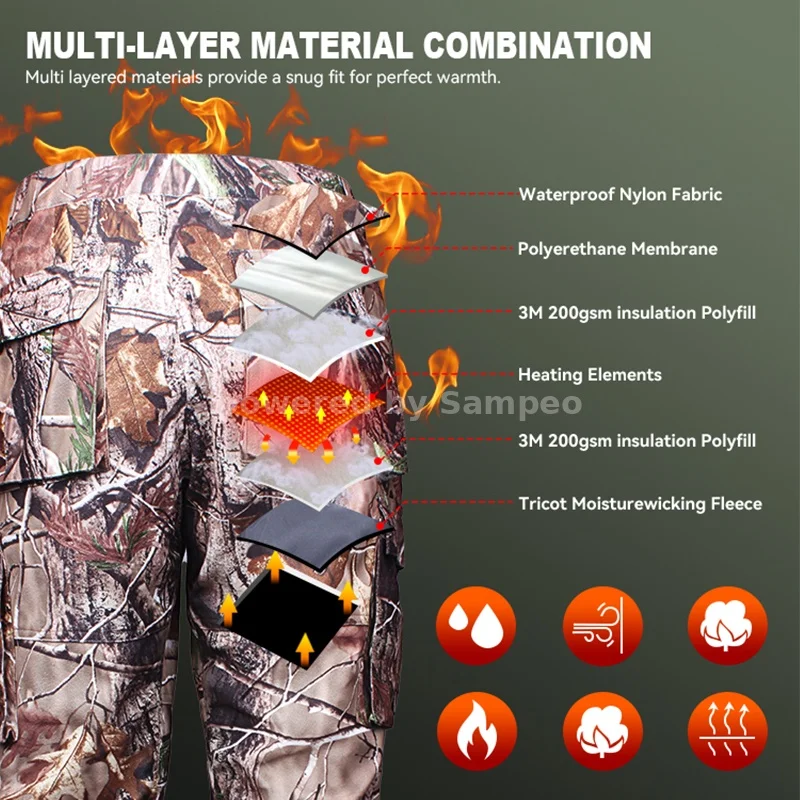
4. Use case deep-dive: battery heated pants for skiing
Ski-pant spec Minimum Preferred (2026 RFQ) Premium (resort fleet) Heating zones 2 3 (thigh/knee/calf) 4 (+ lumbar) Warm-up time <10 s 3-5 s 3 s Shell waterproof rating 5,000 mm 10,000 mm 15,000 mm Insulation 60g synthetic 80g PrimaLoft 100g PrimaLoft Gold Battery 7.4V 2600mAh 7.4V 5000mAh 7.4V 5000mAh + spare Reinforced cuff Yes Yes + kick-patch Yes + replaceable cuff 5. Use case deep-dive: battery heated pants for outdoor work
Work-pant spec Construction Rail / utility Survey / forestry Heating zones 3 (lumbar/thigh/knee) 3 + boot cuff 2 (lumbar/thigh) Default temperature 38°C medium 40°C medium 35°C low/medium Wash rating 80 cycles 100+ cycles 100+ cycles Battery certification UN38.3 UN38.3 + IEC 62133 UN38.3 Reinforcement Knee + seat Knee + seat + cuff Knee + cuff Hi-vis trim option Optional Required Optional 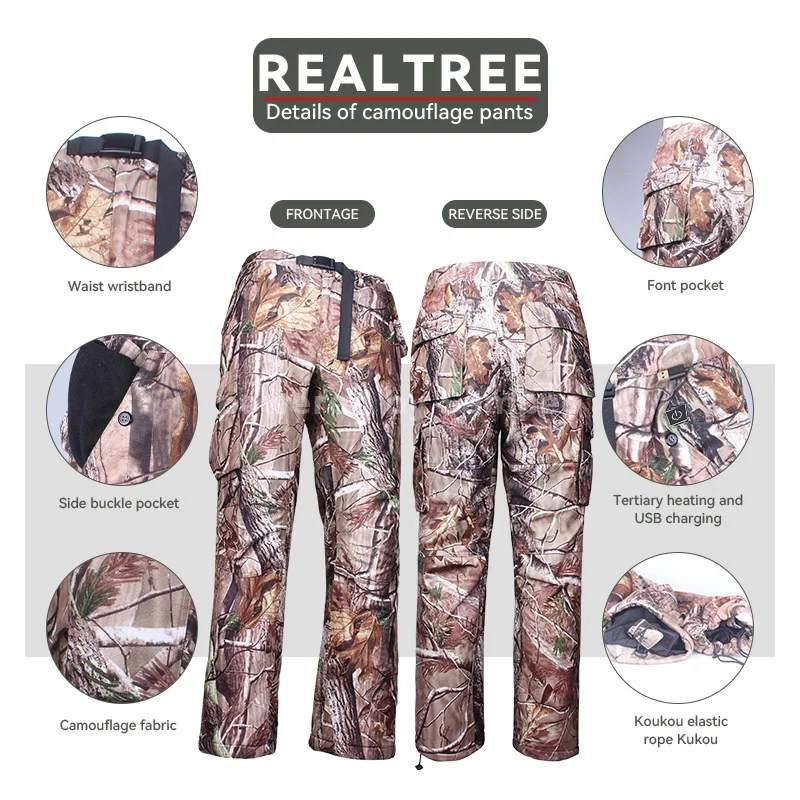
6. Anatomy of a battery heated pants OEM/ODM project
Stage What happens Typical lead time Buyer input required 1. Tech-pack alignment Heating zones, shell fabric, battery, controller, trim 5-7 days Tech-pack + reference samples 2. Pre-production sample Factory builds 2-3 samples, ships by express 10-12 days Approval / revision rounds (max 2) 3. Pilot production run 30-100 units to validate production line 7-10 days Pilot QC sign-off 4. Bulk production Full PO run 15-25 days Mid-line + final-line QC inspection 5. QA + shipment AQL 2.5 inspection, packing, ship 5-7 days Booking + shipping marks 7. MOQ, pricing structure, and what a B2B buyer should put in the contract
Tier MOQ (units per SKU per colour) Typical price band (FOB, indicative) Lead time Stock OEM (catalogue SKU) 30 Lowest 7-10 days Semi-private label (logo + colour) 100 Mid-low 15-20 days Full private label (custom pattern) 300 Mid 25-35 days Custom fabric + custom element 500 Highest 35-50 days 8. Quality control: what to inspect on the line
Inspection point What to verify AQL 2.5 critical / major / minor Element continuity Resistance value within ±5% of spec Critical Element placement Heating zones aligned to pattern, no fold Critical Battery pocket Pocket dimensions match 7.4V 5000mAh pack Major Wire routing No wire crosses seam line, no exposed conductor Critical Controller LED + button function, 3 heat levels Major Seam sealing 10,000mm hydrostatic head test Critical Shell fabric Weight, hand-feel, colour-delta to spec Major Insulation Loft and fill weight match spec Major Trim + labels Care label, brand label, battery warning tag Minor Wash test 5-cycle pre-shipment wash, no element failure Critical 9. Internal links for further reading
10. Frequently asked questions: battery heated pants OEM/ODM
Leave a Reply