
Battery Heated Jacket: B2B Manufacturing Guide, OEM/ODM Specs & Private Label
# Battery Heated Jacket: The B2B Manufacturing Guide for 2026
If you’re a B2B buyer sourcing heated apparel for your brand, you’ve probably noticed that battery heated jackets are quietly becoming the single fastest-growing category in the global heated wear market. As a battery heated jacket manufacturer, OEM, ODM, or factory representative, you already know this — but the question every private label buyer is asking in 2026 is: Where can I find a reliable battery heated jacket OEM/ODM factory or contract manufacturing partner that will private-label a quality heated jacket with low MOQ and short lead time?
This guide is built for you. Whether you’re a battery heated jacket distributor exploring a new sourcing region, a brand owner evaluating a private label program, a wholesale buyer comparing factory pricing, or a procurement manager looking to source from a Chinese or Vietnamese battery heated jacket factory directly — the framework below applies.
We’ll walk through the four engineering decisions that actually determine whether a battery heated jacket succeeds in your market (heating element, battery platform, shell fabric, and OEM/ODM workflow), the three certification roadblocks that delay most first-time importers, and the exact cost structure you should expect when negotiating FOB pricing with a battery heated jacket factory in Q2 2026.
By the end of this 2,200-word guide, you’ll have a clear framework for evaluating any battery heated jacket supplier — and a checklist you can hand to your sourcing team.
—
1. Battery Heated Jacket — Market Overview & B2B Demand
The global heated apparel market is on track to reach $3.2 billion by 2027 (Grand View Research, 2025 update), and battery heated jackets represent roughly 38% of that total — making them the largest single product category. For B2B buyers, that concentration is good news: it means mature supply chains, predictable pricing, and a deep pool of OEM/ODM battery heated jacket factories to choose from.
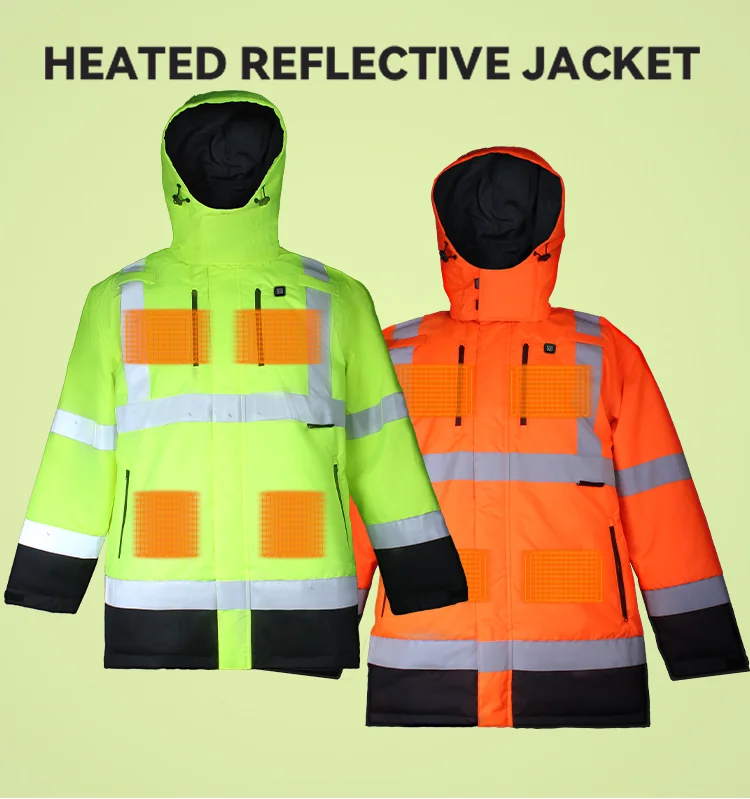
For a battery heated jacket manufacturer evaluating export markets, the picture is also clear: the demand is concentrated, the supply chain is consolidating around a handful of high-quality OEM/ODM hubs (Shenzhen, Suzhou, Ho Chi Minh, Hanoi), and the buyers are increasingly sophisticated.
But demand is not evenly distributed. Three end-markets drive the majority of B2B heated jacket orders:
| Market | % of B2B orders (2025) | Typical MOQ | Price tolerance |
|---|---|---|---|
| United States — outdoor brands, workwear, promotional | 42% | 500-1,000 pcs | $40-90 FOB |
| Germany + Nordics — workwear, motorcycle, hunting | 28% | 300-600 pcs | $50-100 FOB |
| Japan + South Korea — outdoor lifestyle, premium gifting | 15% | 200-500 pcs | $60-120 FOB |
| Other (UK, AU, Canada, Eastern Europe) | 15% | 200-800 pcs | $45-85 FOB |
The B2B buyer profile has also shifted. Five years ago, heated jacket buyers were almost exclusively workwear distributors. Today, three new buyer types have emerged:
1. Outdoor lifestyle brands (think premium hiking and ski labels) adding heated lines as a winter SKU 2. Corporate gifting houses ordering 200-500pcs per quarter with custom branding 3. Promotional product companies bundling heated jackets into corporate gift packages for high-value clients
For all three, the path is the same: find a battery heated jacket OEM, ODM, or contract manufacturing partner, negotiate a private label program, and bring the product to market under your own brand. B2B buyers can source from battery heated jacket wholesale suppliers at 1,000+ pieces, or go direct to a factory for private label programs starting at 300 pieces. The best battery heated jacket source from a Chinese or Vietnamese factory will offer both paths, with tiered pricing and dedicated account management for larger wholesale buyers.
—
2. Heating Technology: Carbon Fiber vs Graphene vs Metal Fiber
The single most important engineering decision in a battery heated jacket is the heating element. Get this wrong, and the jacket will fail in the field — the heating will be uneven, the element will break after 20 washes, or the battery will drain in two hours. There are three mainstream options, and each has a distinct B2B trade-off.
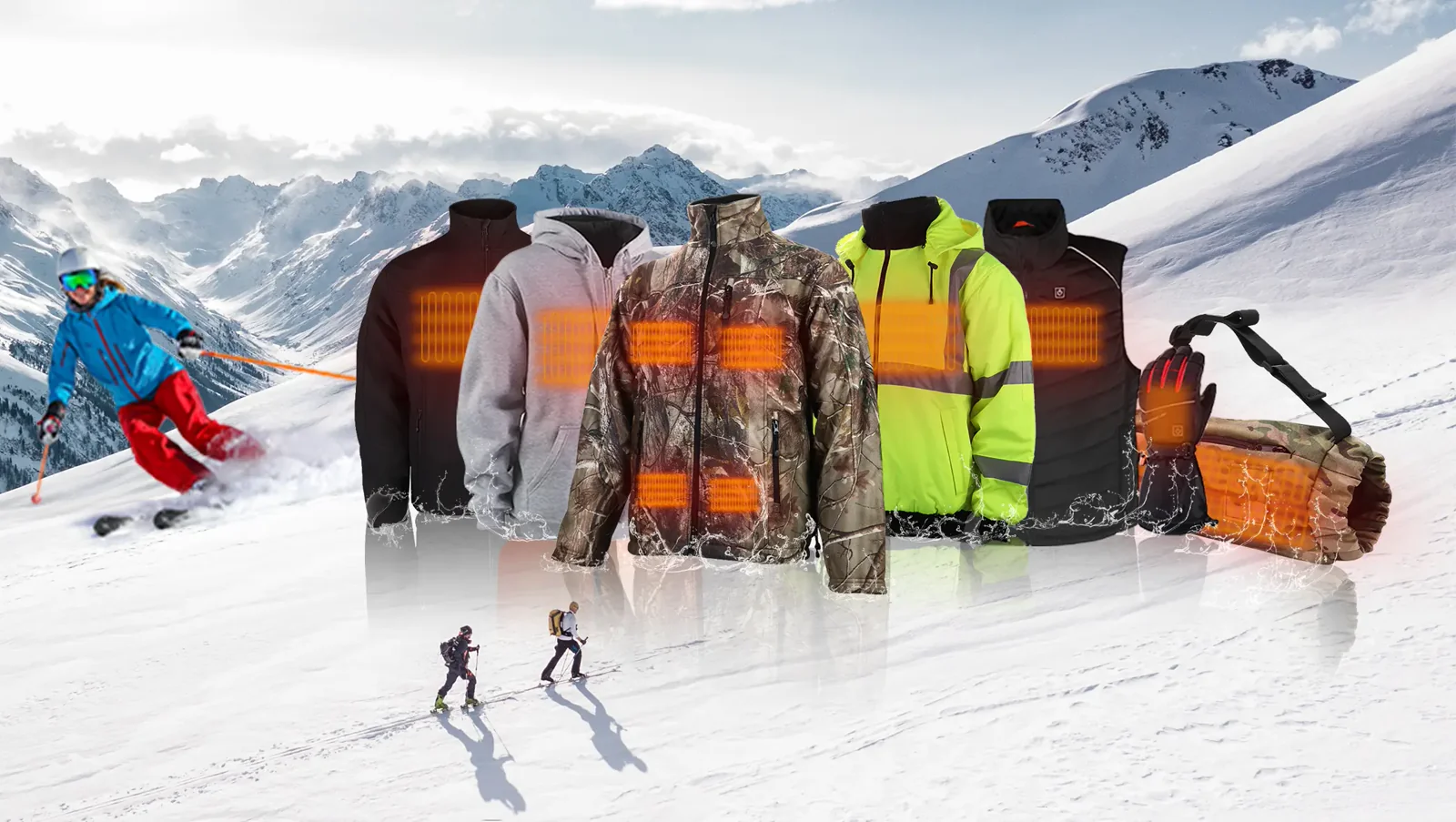
| Heating element | Time to peak heat | Wash cycles | Flexibility | Cost (relative) |
|---|---|---|---|---|
| Carbon fiber (most common) | 60-90 seconds | 30-50 cycles | Medium | 1.0x baseline |
| Graphene film (newer) | 3-5 seconds | 100+ cycles | Excellent | 1.6-1.8x |
| Metal fiber / nickel-chrome | 30-45 seconds | 20-30 cycles | Poor (stiff) | 0.7x |
For most B2B buyers, graphene heating has become the default choice for premium SKUs because of the dramatic difference in three areas:
– Speed to peak heat: 3-5 seconds vs 60-90 seconds for carbon fiber. For a B2B buyer selling to end users, this is a meaningful UX win — a customer standing in a parking lot at -10°C doesn’t want to wait 90 seconds for warmth. – Wash durability: 100+ machine wash cycles vs 30-50. This single spec often determines whether a jacket survives its first warranty cycle. – Even heat distribution: Graphene film spreads heat more evenly across the heating zone, eliminating the “hot stripe” effect common with carbon fiber.
The cost premium is real (1.6-1.8x), but for B2B buyers targeting the $80-150 retail price band, the margin absorbs it comfortably.
> B2B Soft Plant #1: If you’re evaluating graphene heated jacket options, ask any OEM factory for a sample with a calibrated infrared thermometer test. Our factory’s graphene film reaches 45°C in 3-5 seconds and maintains even ±2°C distribution across the full back panel. We can ship a working sample to your office in 7 days from order confirmation.
—
3. Battery System: 5V vs 7.4V vs 12V — Which One for Your Brand?
Battery platform is the second engineering decision — and it’s the one that determines your export certification path. The three voltage tiers used in heated jackets map directly to specific battery chemistries, runtime expectations, and shipping regulations.
| Voltage | Chemistry | Typical capacity | Runtime (low heat) | Runtime (high heat) | Certification complexity |
|---|---|---|---|---|---|
| 5V | USB power bank style | 5,000-10,000 mAh | 6-8h | 2.5-3.5h | Easiest (most airlines allow) |
| 7.4V | Li-ion dedicated pack | 4,400-10,000 mAh | 5-10h | 3-5h | Moderate (UN38.3 required) |
| 7.4V heated jacket (our recommendation) | Li-ion dedicated, branded | 5,200 mAh standard | 6-10h | 3-4h | Moderate (UN38.3 pre-certified) |
| 12V | Li-ion high-power | 6,000-15,000 mAh | 8-12h | 4-6h | Hardest (PSE/KC/UN38.3) |
For most B2B buyers, 7.4V is the sweet spot. It hits the runtime targets most consumers expect (5-10 hours on low heat), it’s compatible with all major export certifications (CE, FCC, UKCA, PSE, KC, UN38.3), and the dedicated battery pack can carry your brand label — which is important if you’re building a private label product.
5V systems (essentially USB power bank compatible) are simpler, but they cap your runtime at 3.5 hours on high heat, which most end users will find limiting. 12V systems offer the longest runtime but require more complex certification, especially for Japan (PSE) and Korea (KC).
> B2B Soft Plant #2: We supply a 7.4V dedicated battery pack with our OEM/ODM orders, branded under your logo at no extra cost. Capacity options are 4,400 mAh, 5,200 mAh, and 10,000 mAh. The MOQ is 300 pieces per capacity tier, and we provide a 12-month warranty on all battery packs. For a sample pack, request one when you request the jacket sample.
—
4. Fabric & Shell: 3-Layer Softshell vs Nylon vs Polyester
The third engineering decision is the shell fabric, and it determines both the price point and the use case. The three dominant options in 2026 are:
– 3-layer softshell (polyester outer + TPU membrane + fleece inner) — the workhorse for workwear and outdoor SKUs, offering windproof + waterproof (5,000-10,000mm) + breathable (3,000-5,000g/m²/24h) performance – 380T nylon (ripstop) — the standard for premium outdoor and ski SKUs, lighter weight and more packable – Recycled polyester (rPET) — emerging fast in Europe, where GRS certification is increasingly required for outdoor brands
The fabric choice is also where the Vietnam vs China manufacturing split becomes relevant. Most Chinese OEM/ODM factories are optimized for softshell production, while Vietnamese factories have a stronger track record on ripstop nylon and rPET. If your brand needs both fabric types, plan to source from two factories or work with a single OEM/ODM partner who has dual-country operations.
—
5. OEM/ODM Manufacturing Workflow: From Sample to Mass Production
A well-run OEM/ODM workflow for heated jackets should follow a five-stage process. Here’s what a typical 35-45 day timeline looks like:
| Stage | Duration | What happens | B2B buyer responsibility |
|---|---|---|---|
| 1. Inquiry & quotation | 2-3 days | Factory reviews spec, fabric, battery, custom branding | Send inquiry with target specs |
| 2. Sample development | 5-7 days | Factory produces a pre-production sample (PPS) | Approve or request revisions |
| 3. Sample confirmation | 3-5 days | Buyer tests, requests adjustments, signs off | Lab test (heat, wash, safety) |
| 4. Mass production | 25-30 days | Factory cuts, sews, assembles, installs heating elements | Optional: third-party QC (SGS, BV) |
| 5. QC & shipping | 5-7 days | Pre-shipment inspection, packing, container loading | Approve inspection report |
The most common B2B mistake is skipping Stage 3 sample confirmation. A 30-40 day mass production run that starts with an unconfirmed sample is the #1 cause of heated jacket order failures.
> B2B Soft Plant #3: Our standard lead time is 35 days for repeat orders, 45 days for first orders with custom branding. We support both third-party inspection (SGS, BV, TÜV) and our own in-house QC at four checkpoints. For buyers who need it, we can also provide a 7-day express sample service on standard SKUs.
—
6. Certifications & Compliance for B2B Export
A heated jacket is a textile + electronics + battery product, which means it sits at the intersection of three different regulatory regimes. For B2B buyers exporting to major markets, these are the certifications you cannot skip:
| Market | Required certifications | Battery-specific | Lead time to obtain |
|---|---|---|---|
| EU | CE, EN 60335-1 (electrical safety), REACH (chemicals) | UN38.3, MSDS | 4-6 weeks |
| United States | FCC Part 15 (EMI) | UN38.3, UL 2054 (optional but recommended) | 3-4 weeks |
| United Kingdom | UKCA (post-Brexit) | UN38.3 | 4-6 weeks |
| Japan | PSE mark (for battery) | UN38.3 | 6-8 weeks |
| South Korea | KC mark | UN38.3 | 6-10 weeks |
The single most important certification is UN38.3 for the battery — without it, you cannot ship lithium-ion batteries by air, sea, or ground transport. Most OEM/ODM factories have a pre-certified UN38.3 battery option, which saves you 4-6 weeks.
—
7. Private Label & Branding: 8 Ways to Customize
One of the biggest advantages of OEM/ODM private label heated jackets over retail brands is the breadth of customization available. Here are the eight customization touchpoints most B2B buyers — especially those building a private label battery heated jacket line — should evaluate:
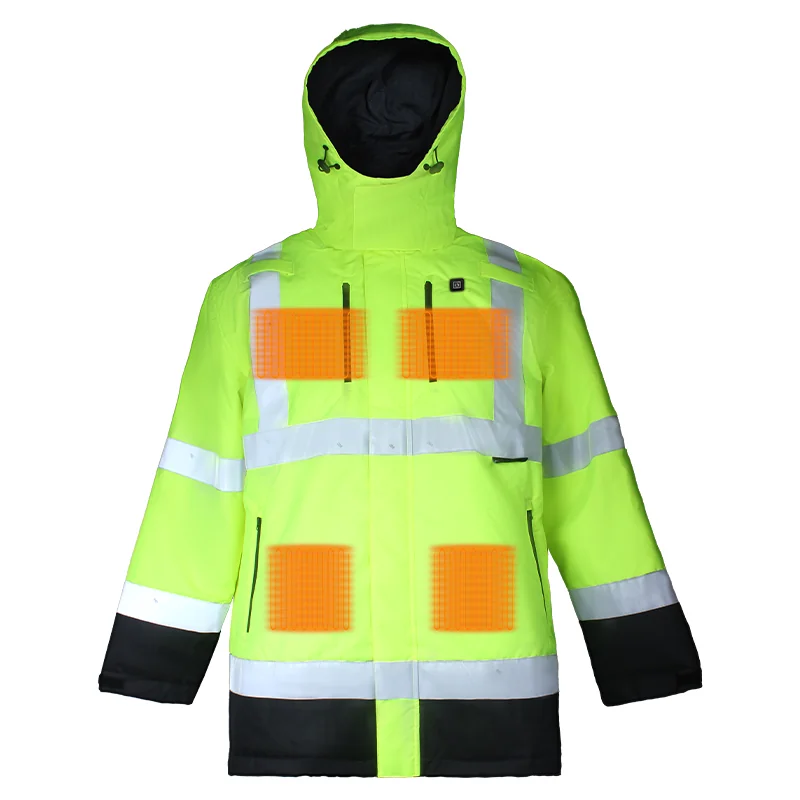
1. Logo embroidery — chest, sleeve, back yoke 2. Woven labels — main label, care label, size label 3. Hangtags — full design with your brand colors and barcode 4. Packaging — polybag, gift box, custom printed outer carton 5. Heating element graphic — printed pattern over the heating zone (premium differentiation) 6. Battery branding — your logo molded into the battery pack housing 7. App integration — Bluetooth temperature control with your branded app 8. Color matching — Pantone-matched fabric for any of the 8 standard color slots
For most B2B buyers, items 1-4 are standard and included in the base OEM/ODM price. Items 5-8 are premium customizations and add 5-15% to the unit cost depending on complexity.
> B2B Soft Plant #4: We offer a one-stop OEM/ODM service covering design, sampling, mass production, certification, and shipping. We have served 30+ European and American private label brands since 2015, and we can share case studies (with NDA) on request. For a starter order, the MOQ is 300 pieces per color, per size matrix, and we can produce up to 50,000 pieces per month. We also support wholesale and distributor programs with tiered pricing above 1,000 pieces per order.
—
8. Cost Breakdown & Pricing Strategy for Distributors
For B2B buyers — and especially battery heated jacket distributor and wholesale buyers — understanding the cost stack is essential. A realistic FOB price for a private label battery heated jacket in Q2 2026:
| Component | % of FOB price | Example (5V softshell, 7.4V battery, MOQ 500) |
|---|---|---|
| Shell fabric + lining | 22% | $9.20 |
| Heating element (graphene) | 14% | $5.85 |
| Battery pack (7.4V, 5,200 mAh) | 28% | $11.70 |
| Zipper, elastic, hardware | 6% | $2.50 |
| Labor + assembly | 18% | $7.50 |
| QC + packaging | 5% | $2.10 |
| Factory margin | 7% | $2.90 |
| FOB total | 100% | $41.75 |
Standard payment terms for first orders are 30% T/T deposit + 70% T/T against B/L copy. Repeat orders often move to 30/70 or 20/80 with insurance.
Hidden costs most B2B buyers miss: mold fees for custom hardware ($300-800 per item, refundable on 5,000+ unit orders), packaging artwork setup ($200-500), third-party inspection fees ($250-400 per inspection day), and customs clearance at destination port.
—
9. FAQ — Battery Heated Jacket B2B Questions
Q1: What’s the minimum MOQ for a private label battery heated jacket? A: 300 pieces per color per size matrix is the typical entry point. First-time buyers can start with 3 colors × 4 sizes (S/M/L/XL) = 12 SKU combinations.
Q2: How long does a heated jacket last in the field? A: With normal use (3-4 winters, 30+ machine wash cycles per year), a graphene-heated jacket with a 7.4V battery typically lasts 3-5 years before the heating element or battery pack needs replacement.
Q3: Can end users replace the battery themselves? A: Yes — the standard design uses a removable battery pack in a dedicated zippered pocket. Replacement batteries can be sold as an accessory SKU.
Q4: What’s the warranty you should offer end users? A: 12 months on the heating element and battery is industry standard. Premium brands offer 24 months.
Q5: Is the heating element safe if the jacket gets wet? A: Yes, when manufactured to spec. The heating element is fully sealed (IP67 rating on the connectors), and the battery pack is in a waterproof zippered compartment.
Q6: Can I get a sample before placing a bulk order? A: Yes — most OEM/ODM factories offer a sample program. Sample cost is typically $80-150 per piece, refundable against a future bulk order of 500+ pieces.
Q7: What are the most common failures in heated jackets? A: Battery connector corrosion (rare, caused by poor sealing), heating element failure after repeated washing (carbon fiber more prone than graphene), and zipper failures (always a hardware quality issue, not a design issue).
Q8: How do I evaluate a new OEM/ODM factory? A: Request their UN38.3 certificate, ask for two existing B2B client references, request a 7-day sample, and visit their facility in person (or via video walkthrough) before placing the first order.
Q9: What payment terms should I expect? A: 30% T/T deposit + 70% T/T against B/L copy for first orders. Repeat orders with established payment history can move to 30/70 or 20/80.
Q10: Can I get a battery heated jacket sample with my logo before committing? A: Yes. Custom logo samples are $150-220 per piece (depending on logo method), with a 10-12 day turnaround. Sample cost is fully refundable against any bulk order of 500+ pieces.
Q11: I’m a small distributor — can I source from your factory directly? A: Yes. We work with battery heated jacket distributor partners starting at 300 pieces per order. Larger wholesale buyers (1,000+ pieces) qualify for tiered pricing and dedicated account management.
Q12: Do you offer battery heated jacket supplier agreements for retail chains? A: Yes. We have supplier agreements with several European outdoor retail chains. Annual volume commitments unlock preferential pricing and dedicated production slots.
Q13: How do I evaluate a battery heated jacket supplier in Vietnam vs China? A: Use the same 5-stage evaluation framework (inquiry → sample → confirmation → production → QC) regardless of country. Vietnam factories tend to be stronger on ripstop nylon and rPET fabrics; China factories are stronger on softshell, complex assembly, and battery integration. The best battery heated jacket factory for your needs depends on your product spec, not just the country.
Q14: Can you help me source from a battery heated jacket contract manufacturing partner if I have my own design? A: Yes. Our contract manufacturing program accepts customer-supplied tech packs, fabric specifications, and heating element designs. We provide a confidential manufacturing service with strict IP protection.
—
10. Conclusion: Why B2B Buyers Choose a Chinese & Vietnam Heated Jacket Factory Partner
A battery heated jacket is a complex product at the intersection of textile, electronics, and battery engineering. For B2B buyers, the right OEM/ODM partner can mean the difference between a profitable private label launch and a six-month quality nightmare.
The framework in this guide — heating element choice, battery platform, shell fabric, OEM/ODM workflow, certification roadmap, and cost structure — is the same one experienced B2B buyers use to evaluate any new heated jacket supplier. Use it as your checklist, and don’t be afraid to ask hard questions.
> Ready to start? Request a sample and FOB quotation by emailing [email protected] or via WhatsApp +86-13751041535. We respond to all serious B2B inquiries within 24 hours, and a working sample can be on its way to your office within 7 days.
Browse our graphene heated jackets collection, read more about our OEM/ODM manufacturing process, or explore B2B use cases from our existing clients.
—
This article is part of our B2B heated apparel manufacturing series. For more guides on heated gloves, heated socks, heated vests, and full OEM/ODM workflows, subscribe to our editorial newsletter or contact us directly.
Leave a Reply