
Graphene Heating Fabric Logistics: 2026 Engineering Guide to Battery-Integrated Freight Compliance & Heated Apparel Shipping Standards
Graphene Heating Fabric Logistics: 2026 Engineering Guide to Battery-Integrated Freight Compliance & Heated Apparel Shipping Standards
Engineering-side logistics guide for OEM-ODM factories producing graphene-fabric heated apparel — battery integration design choices that affect UN3481/UN3480 freight classification, IMDG documentation, and end-customer shipping compliance.
More oem odm manufacturing guides
—
1. Why Engineering Decisions Drive Logistics Compliance
For an OEM-ODM manufacturer of graphene-fabric heated apparel, logistics is not just a freight-forwarder conversation — it is engineered into the product at the design stage. The battery chemistry, cell form factor, BMS topology, and heating-element integration each carry freight consequences under IMDG, IATA DGR, and UN 38.3. An engineering team that treats “battery as a black box” produces a garment that ships expensively, fails hazmat inspection, or gets seized at the destination port.
This guide is written for the factory engineering team: R&D, battery sourcing, quality, and production engineering who design the heating system and whose decisions cascade into freight cost, documentation load, and customer delivery risk.
The three engineering questions that determine logistics cost:
- Cell chemistry — Li-ion 18650 vs Li-Po vs LiFePO4. Each carries different UN classifications and air-freight eligibility.
- Battery pack integration — removable vs welded-in. Removable batteries ship cleaner; welded-in packs can complicate MSDS.
- BMS protection — PCM, BMS, or passive-only. Battery protection circuits affect Section II eligibility.
2. Battery Cell Form Factors: Engineering Tradeoffs That Map to Logistics
| Cell Type | Form Factor | Energy Density | Air Freight (IATA) | Sea Freight (IMDG) | Best For |
|---|---|---|---|---|---|
| **Li-ion 18650** | Cylindrical 18x65mm | 250-300 Wh/kg | Section II ≤10 kg net Li | UN3481 standard | Heated jackets, vests |
| **Li-ion 21700** | Cylindrical 21x70mm | 300-350 Wh/kg | Section II ≤10 kg net Li | UN3481 standard | Higher-power jackets |
| **Li-Po pouch** | Flat laminated | 200-260 Wh/kg | Section II stricter on damage | UN3481 with care | Gloves, socks, slim vests |
| **LiFePO4** | Cylindrical or prismatic | 90-160 Wh/kg | Section II more lenient | UN3481 standard | Industrial workwear, EU markets |
| **Graphene-hybrid Li-ion** | Pouch or cylindrical | 280-330 Wh/kg | Section II ≤10 kg net Li | UN3481 standard | Premium graphene jackets |
**Engineering rule of thumb:** Li-ion 18650 remains the **most universally accepted** form factor for heated apparel export because every freight forwarder has handled it. Li-Po requires more careful packaging documentation because of dent/puncture sensitivity.
3. UN Classification Decision Matrix for Heated Apparel Engineering
| Product Configuration | UN Number | IATA Section | IMDG Class | Documentation Load |
|---|---|---|---|---|
| Heated jacket with battery **installed** in pocket | **UN3481** | Section II | Class 9, UN3481 | MSDS + UN 38.3 + packing list |
| Heated jacket with battery **packed separately** in same carton | **UN3481** | Section II | Class 9, UN3481 | MSDS + UN 38.3 + carton photo |
| Replacement battery pack shipped alone | **UN3480** | Section IB or II (depends on Wh) | Class 9, UN3480 | Full DG declaration + testing summary |
| Heated jacket with **<100 mAh** disposable coin cell (non-rechargeable) | Not regulated | n/a | n/a | None |
| Heated jacket with **USB power bank** (removable, consumer-grade) | UN3481 if provided | Section II | Class 9 | Depends on battery source |
4. Battery Pack Design Engineering: What Impacts Freight Most
The factory engineering team’s design choices map directly to logistics cost:
| Design Choice | Engineering Reality | Freight Impact |
|---|---|---|
| **Battery pack voltage** | 3.7V (1S) standard, 7.4V (2S) for higher heat output | Higher voltage packs may require additional testing |
| **Capacity (Wh)** | 5-10 Wh typical for jacket, 2-4 Wh for gloves | Air freight ≤100 Wh per pack is Section II; >100 Wh needs full declaration |
| **Removable vs welded** | Removable allows user to swap; welded simplifies waterproofing | Removable = UN3481 (packed with); welded = UN3481 (contained in equipment) — both work |
| **BMS/PCM protection** | Short-circuit, over-charge, over-discharge, temperature | Required for Section II air freight eligibility |
| **Connector type** | DC barrel, USB-C, magnetic | Magnetic reduces user error but adds assembly step |
| **Indicator LEDs** | 3-stage or 4-stage charge level | No freight impact |
**Engineering rule:** if you design the pack at **≤100 Wh with PCM/BMS protection**, every major courier (DHL, FedEx, UPS) and every ocean carrier will accept it under Section II with no extra surcharge beyond the per-parcel DG fee.
5. Heating Element Engineering: Carbon Fiber vs Graphene vs Metal Wire
| Element Type | Conductivity | Durability | Wash Cycle Rating | Effect on Freight |
|---|---|---|---|---|
| **Carbon fiber** | High | Excellent | 50+ wash cycles | Neutral — flexible, no DG impact |
| **Graphene-printed fabric** | Very high | Excellent | 50+ wash cycles | Neutral — flat integration, no DG impact |
| **Metal wire (nickel-chrome)** | Moderate | Moderate | 30-40 wash cycles | Adds weight → carton weight up → freight cost up |
| **Silver-coated fiber** | High | Good | 30-50 wash cycles | Premium pricing, neutral freight |
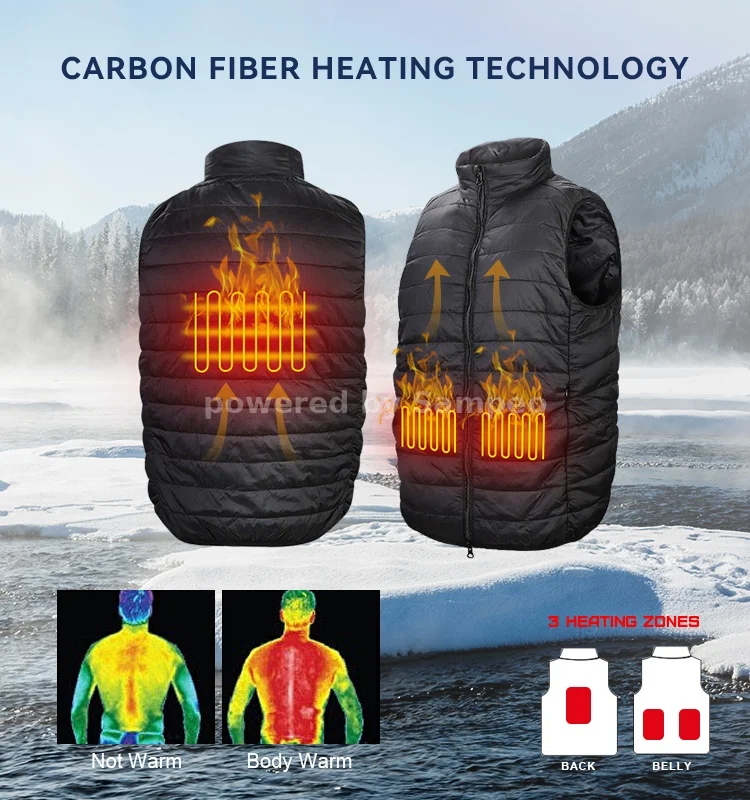
**Engineering rule of thumb:** **carbon fiber and graphene heating elements** are freight-neutral — they add no DG classification. **Metal wire elements** add 80-180 g per garment, raising master carton weight by 4-7%, which adds 2-3% to ocean freight cost per kg.
6. BMS/PCM Protection Circuit Engineering for Section II Eligibility
For a graphene-fabric heated apparel battery pack to qualify for IATA Section II air freight (the cheapest, fastest lane), it must have:
- Short-circuit protection — PCM or BMS cuts off at <0.1V over-depletion
- Over-charge protection — typically 4.25V/cell cutoff
- Over-discharge protection — typically 2.75V/cell cutoff
- Temperature protection — discharge cutoff at 60-80°C
- Cell balancing (multi-cell packs only) — passive or active balancing circuit
- UN 38.3 test summary on file — 8 tests (T1-T8) per cell model
Without these, the pack defaults to Section I or Section IB, which requires:
- Full dangerous goods declaration on AWB
- Higher freight surcharge ($1.50-4.00/kg vs $0.40-0.80/kg Section II)
- Cargo-only aircraft (CAO) routing — slower, fewer daily flights
**Engineering implication:** spending $0.40-0.80 per pack on a proper PCM/BMS saves $1.10-3.20 per pack in air freight. This is one of the highest-ROI design decisions for export-heavy heated apparel OEMs.
7. Carton-Level Packaging Engineering for Hazmat Compliance
| Element | Spec | Why It Matters |
|---|---|---|
| Master carton | 5-ply corrugated, double-wall, ECT-32 | Holds 18 kg of heated apparel without crush |
| Battery pocket in garment | Insulated sleeve, foam surround | Prevents short-circuit in transit |
| Battery locking mechanism | Velcro + snap or zip + tether | Battery cannot dislodge during handling |
| Carton labels | “Li-ion, packed with equipment, UN3481” + Class 9 DG label | IMDG requirement |
| Pallet spec | Standard 1200x1000mm, heat-treated, ISPM 15 | EU/US import compliance |
| Pallet wrap | Stretch wrap + anti-static layer | Reduce static discharge risk |
| Pallet height | ≤2.0m (US) / ≤2.2m (EU) | Container door clearance |
| Max battery quantity per carton | ≤24 kg battery weight, ≤10 kg net Li | Section II limit |
8. Quality & Pre-Shipment Engineering Tests for Freight Readiness
| Test | Frequency | Doc Required |
|---|---|---|
| Battery capacity verification | Every batch | Battery QC report |
| Visual inspection (carton labels) | Every carton | Packing list |
| Drop test (1.2m, 6 faces) | Per battery model | UN 38.3 reference |
| Short-circuit functional test | Sample 1% per batch | PCM test log |
| Heating element continuity | Every garment | Heating test log |
| Charging cycle test | Sample 5 per batch | Cycle test log |
| Voltage verification (no unit <3.0V at ship) | Every battery | Pre-ship QC summary |
| MSDS freshness check | Every shipment | MSDS dated within 12 months |
9. Engineering Documentation: What the Factory Must Keep on File
| Document | Storage | Retention |
|---|---|---|
| UN 38.3 test report (per cell model) | Factory server + lab copy | Lifetime of cell model |
| MSDS (per battery model) | Factory server + supplier copy | Until 12 months past last shipment |
| Battery cell supplier audit report | Quality dept | 3 years |
| PCM/BMS spec sheet | R&D | Lifetime of product |
| Heating element datasheet | R&D | Lifetime of product |
| Carton label artwork | Production | Per product revision |
| Packing list template (DG version) | Logistics | Per product revision |
| Class 9 DG label artwork | Logistics | Per product revision |
| IMDF/IMDG compliance matrix | Logistics + R&D | Per product revision |
| Forwarder DG agreement | Logistics | Per forwarder relationship |
10. Engineering Decision Checklist for a New Heated Apparel SKU
Before green-lighting a new SKU for export:
- [ ] Battery cell model identified and UN 38.3 tested (lab report on file)
- [ ] MSDS dated within 12 months
- [ ] Pack design uses PCM or BMS protection for Section II air freight eligibility
- [ ] Battery pack capacity ≤100 Wh (stays under Section II threshold)
- [ ] Battery physically locked in pocket with secondary retention (velcro + snap)
- [ ] Carton label artwork includes UN3481 + Class 9 DG label
- [ ] Heating element datasheet documents wash-cycle and durability
- [ ] Pre-shipment QC includes voltage check, capacity check, continuity check
- [ ] Forwarder relationship signed for DG-capable carrier (DHL DG, FedEx IDG, UPS Standard, etc.)
- [ ] Packing list and commercial invoice templates reviewed by logistics team
If all 10 boxes check, the SKU is export-ready for global freight under standard IMDG/IATA terms.
—
Frequently Asked Questions (FAQ)
Q1: What is the difference between UN3480 and UN3481 for heated apparel? UN3481 = lithium-ion batteries packed with equipment (e.g., battery in jacket pocket, shipped as finished garment). UN3480 = lithium-ion batteries standalone (e.g., replacement battery pack shipped alone). Heated apparel always ships under UN3481.
Q2: Do I need UN 38.3 testing for every battery model? Yes. UN 38.3 is mandatory per cell model and per shipping configuration. Test reports are valid for the lifetime of the cell model — re-test only if cell chemistry, capacity, or supplier changes.
Q3: Can I use a Li-Po pouch cell in heated apparel for air freight? Yes, but stricter packaging is required because of puncture/dent sensitivity. Most cargo airlines require additional cushioning and the battery must be in the equipment (not loose) under UN3481.
Q4: Does the heating element type affect freight classification? No. Carbon fiber, graphene, and metal wire heating elements are not regulated as dangerous goods. Only the battery cell and pack carry freight regulation.
Q5: What is the maximum Wh rating for a heated apparel battery under Section II? 100 Wh per pack for Section II air freight eligibility. Above 100 Wh, the pack requires Section IB with full dangerous goods declaration.
Q6: Do I need a Class 9 lithium battery label on every carton? Yes — under IMDG, every master carton containing lithium-ion batteries must display the Class 9 DG label (orange, 100x100mm minimum) and the UN3481 mark.
Q7: What if my battery supplier refuses to provide UN 38.3? Walk away. No reputable battery cell supplier (LG, Samsung SDI, CATL, BAK, EVE, or their authorized distributors) refuses UN 38.3 documentation. If they refuse, the cells are likely counterfeit or out-of-spec.
Q8: Is LiFePO4 safer than Li-ion for heated apparel freight? LiFePO4 has lower thermal runaway risk and is generally more freight-friendly, but it has 40-50% lower energy density — meaning a heavier pack for the same heating duration. Most consumer heated apparel stays with Li-ion 18650.
Q9: How does graphene heating element differ from carbon fiber in freight terms? No freight difference. Both are inert heating elements under IMDG/IATA. Graphene is lighter, more flexible, and more durable — but it does not change dangerous goods classification.
Q10: Can I ship heated apparel samples by DHL without a DG declaration? No — DHL requires Section II dangerous goods declaration for any parcel containing lithium-ion batteries, even 1 unit. Expect a $35-95 DG surcharge per parcel.
Q11: What is the typical capacity for a heated jacket battery? 5V/2A USB power bank form, 7.4V 4400-5200 mAh = 32-38 Wh. This is well under the 100 Wh Section II limit. Two-cell packs at 7.4V 2200 mAh are also common.
Q12: How long is the UN 38.3 test summary valid? Lifetime of the cell model under UN recommendations, but forwarders and customs may request a summary dated within 12 months. Keep the original on file and refresh the dated summary annually.
—
Glossary
| Term | Meaning |
|---|---|
| UN3481 | Lithium-ion batteries packed with equipment (heated apparel standard) |
| UN3480 | Lithium-ion batteries standalone (replacement batteries) |
| UN 38.3 | UN transport test standard for lithium cells |
| MSDS | Material Safety Data Sheet |
| IMDG | International Maritime Dangerous Goods Code |
| IATA DGR | International Air Transport Association Dangerous Goods Regulations |
| Section II | IATA classification for lower-risk lithium shipments |
| Class 9 | UN dangerous goods class for lithium batteries |
| Wh | Watt-hour (energy unit for battery capacity) |
| mAh | milliamp-hour (charge unit) |
| PCM | Protection Circuit Module |
| BMS | Battery Management System |
| 18650 | Cylindrical lithium cell, 18mm diameter x 65mm length |
| 21700 | Cylindrical lithium cell, 21mm x 70mm |
| Li-Po | Lithium polymer (pouch form factor) |
| LiFePO4 | Lithium iron phosphate (safer, lower energy density) |
| Wh/kg | Watt-hour per kilogram (energy density metric) |
| ECT-32 | Edge Crush Test rating for corrugated cartons |
| ISPM 15 | International Standard for Phytosanitary Measures No. 15 (pallet treatment) |
| SKU | Stock Keeping Unit |
| CAO | Cargo Aircraft Only (air freight routing) |
—
**About grapheneheatingfabric.com** — OEM-ODM factory specializing in graphene-fabric heated apparel engineering. From cell selection to freight compliance, our R&D team supports private-label buyers with full technical documentation, UN 38.3 test summaries, and battery integration engineering for global B2B distribution.
Leave a Reply