
Heated Clothing Engineering QC 2026: SPC, MTBF Reliability & Incoming Inspection
Heated Clothing Engineering QC 2026: SPC, MTBF Reliability & Incoming Inspection
Why Engineering QC Matters More Than Ever for Graphene Heated Apparel (2026)
The heated apparel market in 2026 is no longer a cottage industry of stitched carbon-fibre pads. Graphene heating films, lithium-polymer pouch cells, and zonal thermal-control firmware have pushed the bill-of-materials into a category that resembles consumer electronics more than outerwear. That shift has consequences for every heated clothing QC engineering team. A 5% defect-escape rate that was once absorbed by returns is now a recall, a customs hold, and a damaged brand reputation. Battery incidents travel on social media within hours; an under-temperature zone flagged by an end-user is a one-star review that lives forever on the product page.
From an engineering standpoint, the variability we used to tolerate — ±10% on element resistance, ±15% on cell capacity — is now the primary driver of field failures. Add tighter retailer acceptance gates (UN38.3, IEC 62133, OEKO-TEX Class II for infant lines, REACH SVHC <0.1% w/w) and the room for informal inspection has effectively closed. Modern heated clothing QC engineering is a data discipline: statistical process control on the line, MTBF modelling on the bench, and incoming material gates that reject drift before it propagates into finished goods.
Talk to our engineers about SPC dashboards and MTBF test reports for your next OEM run.
SPC Statistical Process Control Heating: Fundamentals for Element Integration
SPC statistical process control heating programs translate material and process variation into actionable signals. The first step is distinguishing common-cause variation — the inherent noise of extrusion, lamination, and cell formation — from special-cause variation that points to assignable defects: a worn die, a contaminated slurry bath, a drifting spot-welder. Western Electric and Nelson rules give us the trip-wires (any single point >3σ from the mean, two of three beyond 2σ on the same side, eight in a row on one side, etc.).
For graphene integration, the four characteristics that matter most are sheet resistance (Ω/□), peel strength of the laminate (N/25 mm), insulation resistance after lamination (MΩ at 500 VDC), and thermal output at rated wattage (W at 7.4 V). Each of these has its own measurement system and sub-group cadence. A typical heated clothing manufacturer QC baseline samples five consecutive units every 30 minutes of machine time; a subgroup size of n=5 yields a stable estimate of within-subgroup standard deviation and feeds both X-bar/R and I-MR charts downstream.
A mature heated clothing QC engineering programme treats the measurement system as part of the process, not as a separate concern. Gauge R&R below 10% of tolerance on every CTQ is the gate; anything above 30% should halt PPAP submission until the fixture, the operator, or the calibration cadence is fixed.
Control Charts: X-bar/R, I-MR, p- and c-Charts for the Defect Stream

Choosing the right chart is half the battle. The table below summarises how each major control chart maps to heated-apparel process signals. Heated clothing OEM QC teams typically run three charts in parallel: one for continuous critical-to-quality (CTQ) characteristics, one for subgroup means, and one for attribute defects.
| Chart | Data type | Subgroup size | Typical CTQ at the heated-apparel line | Decision rule |
|---|---|---|---|---|
| X-bar / R | Continuous, subgrouped | n = 2–10 | Sheet resistance Ω/□, wattage at 7.4 V | Out-of-control if any point >3σ or 7 in a row trending |
| I-MR | Continuous, individual | n = 1 | Oven temperature, lamination pressure | Plot moving range; trip if MR exceeds UCL of MR-bar × 3.267 |
| p-chart | Attribute (proportion defective) | Variable n | Solder-joint defects per panel | Centre line = p̄; UCL = p̄ + 3√(p̄(1−p̄)/n) |
| c-chart | Attribute (count per unit) | Fixed area | Wire nicks per 10 m bus | λ = c̄; UCL = c̄ + 3√c̄ |
| EWMA | Continuous, low-frequency drift | n ≥ 1 | Slow cell-capacity fade | λ = 0.2, L = 3; sensitive to 1.5σ shifts |
| CUSUM | Continuous, step detection | n ≥ 1 | Punch-to-punch calibration | Decision interval h = 4σ, reference k = 0.5σ |
The chart suite is only as good as the underlying gauge R&R. A measurement system with >30% GRR will produce more out-of-control signals than the process itself, leading engineers to “chase ghosts” — tightening variance on the gauge instead of on the part. Embedding these charts in the battery heated apparel factory MES gives supervisors a wall-mounted view of every line, every shift, every CTQ.
Incoming Material Inspection: Graphene Film Resistance, Cell Capacity, Wire Insulation
Incoming material inspection graphene protocols are where most field failures are actually born. Three streams dominate: the heating film itself, the lithium-polymer cell, and the interconnect wire harness. Sampling per ANSI/ASQ Z1.4 with a switching rule between normal and tightened inspection is the industry norm; AQL 0.65 for critical, 1.0 for major, 2.5 for minor remains a reasonable starting point for heated clothing wholesale QC contracts.
| Material | Test | Method | Acceptance | Reference |
|---|---|---|---|---|
| Graphene film | Sheet resistance | 4-point probe, 25 mm spacing | 8–12 Ω/□ ±10% lot mean | ASTM F390 |
| Graphene film | Peel strength | 180° peel, 100 mm/min | ≥8 N/25 mm | ASTM D903 |
| Li-Po cell | Capacity at 0.2C | Rest 1 h, CC discharge to 3.0 V | ≥100% of rated mAh | IEC 62133 |
| Li-Po cell | Internal resistance | 1 kHz AC | ≤60 mΩ for 5,000 mAh | Manufacturer spec |
| Wire harness | Insulation resistance | 500 VDC, 60 s | ≥100 MΩ | UL 758 |
| Wire harness | Continuity | 4-wire Kelvin | <0.5 Ω end-to-end | In-house |
| Connector | Pull strength | Axial, 25 mm/min | ≥30 N retention | USCAR-2 |
| Textile laminate | Hydrostatic head | AATCC 127 | ≥10 kPa for IPX5 claim | ISO 811 |
A lot failing any single critical row is rejected in full; the supplier is notified within 24 hours with a First-In-First-Out (FIFO) hold tag and a request for an 8D corrective-action response within 10 business days. Heated clothing QC engineering review boards sign off on every accepted lot before it moves to WIP.
MTBF / MTTR Definitions and How to Estimate Heating-Element Reliability
MTBF reliability heated apparel conversations often start with confused terminology. MTBF (Mean Time Between Failures) is meaningful only for repairable systems; for non-repairable components it is better expressed as MTTF (Mean Time To Failure). Heated apparel sits in a hybrid zone — the garment is non-repairable, but the battery pack, controller, and heating-element modules can be replaced.
For a representative graphene jacket zone we observe:
- MTTF (graphene film, wear-out) ≈ 50,000 h at 25 °C operating temperature
- MTTF (Li-Po cell, calendar) ≈ 8,000 h at 25 °C / 100% SoC
- MTTF (controller MOSFET) ≈ 200,000 h at 60 °C junction
- MTTR (controller swap, depot) ≈ 1.5 h; field ≈ N/A (end-user replaceable)
These figures come from accelerated-life testing on chamber-aged coupons. Series-reliability summation across non-redundant sub-systems gives a system MTBF target of ≥30,000 h for the heating subsystem, with a derated field expectation closer to 8,000–12,000 h once calendar cell fade and connector wear are factored in. Within a structured heated clothing QC engineering programme, MTBF is reviewed at every design review against a published FMEA-derived target.
Request our reliability-test white paper for the full Arrhenius dataset and confidence intervals.
Battery Reliability Test Protocol
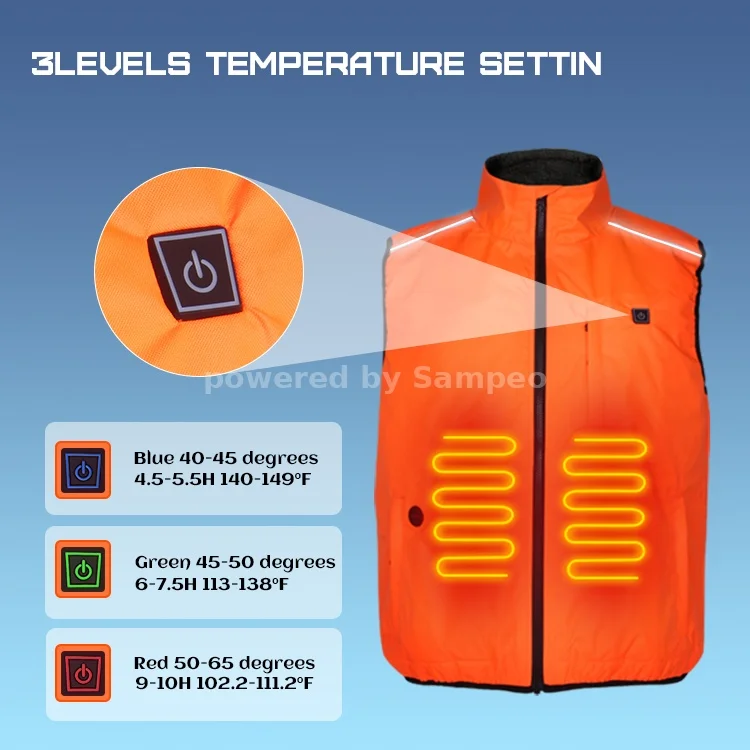
The battery reliability test bench is the most expensive single piece of equipment in any serious heated-apparel lab. A representative protocol layers electrical, thermal, and mechanical stresses, each in its own chamber or fixture. Pass criteria must be defined up-front in the DFMEA and re-checked after every ECO.
| Cycle stage | Temperature | C-rate | Cycles | Capacity retention | Pass criteria |
|---|---|---|---|---|---|
| Formation | 25 °C | 0.2C charge/discharge | 3 | Baseline | ΔV < 50 mV per cell |
| Cycle life | 25 °C | 1C charge / 1C discharge | 500 | ≥80% | No swelling >3% thickness |
| Cycle life | 45 °C | 1C charge / 1C discharge | 300 | ≥75% | No leakage, no thermal event |
| High-temp storage | 60 °C | OCV | 30 days | ≥90% recover | ΔIR ≤ 15% |
| Low-temp discharge | −20 °C | 0.5C discharge | 1 | ≥60% of rated | No voltage collapse |
| Vibration | 25 °C | Sweep 10–500 Hz, 3 axes | 12 h per axis | ≥95% | No structural shift |
| Shock | 25 °C | 50 g, 11 ms half-sine | 26 drops | ≥95% | No swelling, no fire |
| UN38.3 (T1–T8) | Altitude / thermal / shock / short | Per UN manual | Full | Pass | No fire, no explosion |
UN38.3 (T1–T8) is non-negotiable for air shipment; OEM customers shipping through integrators should expect a copy of the test summary and a valid shipping label on every cell lot. Cross-link the battery reliability test report to the cell bill-of-materials in the PLM so that a supplier change triggers re-test automatically.
Heating Uniformity Test: 9-Point Grid IR Thermography
A graphene film rated at 7.4 V / 8 W is a useless specification if half the pad runs 32 °C while the other half runs 48 °C under identical ambient. The 9-point IR grid quantifies that delta. Place the garment flat on a low-thermal-mass table in a 23 °C / 50% RH chamber, power to rated wattage, allow a 10-minute soak, and capture a calibrated IR image. Average the centre pixel of each 3×3 grid sector.
| Grid sector | Position | Pass criterion |
|---|---|---|
| A1 | Top-left | Within ±2 °C of mean |
| A2 | Top-centre | Within ±2 °C of mean |
| A3 | Top-right | Within ±2 °C of mean |
| B1 | Mid-left | Within ±2 °C of mean |
| B2 | Centre (reference) | Reference point |
| B3 | Mid-right | Within ±2 °C of mean |
| C1 | Bottom-left | Within ±2 °C of mean |
| C2 | Bottom-centre | Within ±2 °C of mean |
| C3 | Bottom-right | Within ±2 °C of mean |
Zones that fail uniformity are usually traced to (a) inconsistent pressure during lamination thinning the film, (b) bus-bar misalignment creating asymmetric current density, or (c) cold solder joints at the lead-wire junction. Each is recoverable with an ECO. The test becomes a gate before pack-out in any mature heated clothing QC engineering flow.
Waterproof Rating Verification: IPX5 / IPX7 Spray and Immersion
IP claims are binary in the standards but continuous in the field. IPX5 (water-jet, 12.5 L/min, 3 min) and IPX7 (immersion 1 m for 30 min) are the two ratings most commonly printed on heated-apparel hang-tags. Heated clothing manufacturer QC teams must verify on a lot sample basis, not rely on the sealer supplier’s certificate.
| Test | Standard | Duration | Post-test requirement | Pass criteria |
|---|---|---|---|---|
| IPX5 jet | IEC 60529 | 3 min, 12.5 L/min | Functional test within 5 min | No water ingress on PCB; insulation >100 MΩ |
| IPX7 immersion | IEC 60529 | 30 min at 1 m | Functional test within 5 min | No water ingress; insulation >100 MΩ |
| Salt-fog | IEC 60068-2-52 | 96 h, 5% NaCl | Functional + visual | No corrosion of contacts |
| Sweat simulation | ISO 105-B07 | 24 h, pH 5.5 | Visual + insulation | No discolouration, no delamination |
| Flex-after-wet | Internal | 5,000 cycles | Heating continuity | ΔR < 10% |
A garment that passes IPX5 can still fail in a downpour if the seam tape has lifted — always pair the spray test with a visual seam-tape inspection on the same lot. Tying these results into the battery heated clothing factory MES closes the loop from incoming seam-tape supplier to finished SKU.
Reliability Test Chamber: Thermal-Shock, Humidity, Vibration

Beyond the cell-level chambers, finished garments and sub-assemblies need to survive combined environment stress. Three chambers form the backbone of a serious reliability lab: a thermal-shock chamber (typically −40 °C to +85 °C with <10 s transfer), a humidity chamber (10–98% RH, 20–85 °C), and an electrodynamic shaker (up to 50 g RMS).
| Profile | Temperature | Humidity | Vibration | Duration | Pass criteria |
|---|---|---|---|---|---|
| Storage cold | −20 °C | Ambient | Off | 72 h | No cracking, functional OK |
| Storage hot | +60 °C | 30% RH | Off | 168 h | No delamination, ΔR < 10% |
| Thermal shock | −20 °C ↔ +60 °C | Ambient | Off | 100 cycles | No solder fracture, no film crack |
| Humidity soak | 40 °C | 95% RH | Off | 168 h | Insulation >50 MΩ |
| Random vibration | 25 °C | Ambient | 10–500 Hz, 4.2 gRMS | 3 h per axis | No fastener back-off, ΔR < 5% |
| Combined stress | 25 °C ↔ 45 °C | 60% RH | 2 gRMS | 240 h | Insulation >50 MΩ, capacity ≥90% |
A 240-hour combined profile is roughly equivalent to one alpine season of use; we recommend running it as a design-qualification gate before any OEM volume ramp. Heated clothing QC engineering sign-off on this profile is what unlocks PPAP level 3.
Process Capability Indices Cp / Cpk for OEM Line Acceptance
Heated clothing OEM QC contracts typically include a process-capability clause requiring Pp/Ppk ≥ 1.33 for safety-critical and ≥ 1.67 for cosmetic CTQs at production start. Cp measures potential capability (the spread of the process relative to spec width); Cpk measures actual capability (centring included). For two-sided specs:
Cp = (USL − LSL) / (6σ)
Cpk = min[(USL − μ) / 3σ, (μ − LSL) / 3σ]
| CTQ | Spec (LSL / USL) | Sample size | σ (long-term) | μ | Cp | Cpk | Decision |
|---|---|---|---|---|---|---|---|
| Sheet resistance | 8 / 12 Ω/□ | 125 | 0.7 | 10.0 | 0.95 | 0.95 | Reject — narrow the die or screen incoming lots |
| Wattage at 7.4 V | 7.2 / 8.8 W | 125 | 0.25 | 7.95 | 2.13 | 1.87 | Accept |
| Insulation resistance | 100 / ∞ MΩ | 125 | — | 5,200 | — | — | Use single-sided Cpk; reported ≥ 5.0 |
| Cell capacity | 4,900 / 5,500 mAh | 125 | 45 | 5,150 | 2.22 | 1.85 | Accept |
| Peel strength | 8 / ∞ N | 125 | 1.2 | 11.5 | — | 1.94 | Accept, single-sided |
| Lamination thickness | 0.45 / 0.65 mm | 125 | 0.03 | 0.55 | 1.11 | 1.11 | Marginal — re-centre |
A Cpk below 1.00 means the process cannot meet spec even in the short term; below 0.67 means the process is producing scrap by design. Heated clothing QC engineering reviews re-baseline these values quarterly and after every ECO.
Engineering Change-Order (ECO) Workflow for QC Failures
When the field or the lab flags a failure, the response must be structured. An effective ECO workflow turns a one-off defect into a permanent improvement.
| Step | Owner | Output | Gate |
|---|---|---|---|
| 1. Failure capture | Quality tech | NCR with photos, log files | Within 24 h of detection |
| 2. Containment | Quality engineer | Sorted stock, hold tag | Within 48 h |
| 3. Root-cause analysis | Reliability engineer | 5-Why + fishbone, verified | Within 5 working days |
| 4. Risk classification | Program manager | Low / Med / High / Critical | Decision recorded in PLM |
| 5. Action plan | Cross-functional team | Design / process / supplier actions | Approval at CCB |
| 6. Implementation | Process engineer | Updated PFMEA, control plan | Documented in MES |
| 7. Verification | Reliability engineer | Repeat test plan, sample size | Pass / fail result |
| 8. Closure | Quality manager | Updated FMEA, lessons learned | Archive in knowledge base |
A Cpk dip on sheet resistance in the previous quarter would trigger Steps 1–7 in parallel across two supplier lots. The CCB (Change Control Board) is the same body that signs off on heated clothing OEM QC PPAP submissions, so ECO closure and PPAP renewal share a single calendar.
Reliability Prediction Handbook: Arrhenius Model for Accelerated Life
For non-repairable components — graphene film, connector seals, polymer insulation — the Arrhenius model translates elevated-temperature life into field-life estimates:
AF = exp[(Ea / k) × (1/Tuse − 1/Tstress)]
where Ea is the activation energy (eV), k is Boltzmann’s constant (8.617 × 10⁻⁵ eV/K), Tuse and Tstress are absolute temperatures in Kelvin. Typical Ea values: 0.6 eV for polymer insulation aging, 0.8 eV for graphene-ink oxidation, 1.0 eV for silicone seal hydrolysis.
| Failure mode | Ea (eV) | Tstress (°C) | Tuse (°C) | AF | 1,000 h stress ≈ field hours |
|---|---|---|---|---|---|
| Polymer insulation aging | 0.6 | 85 | 25 | 30.5 | 30,500 |
| Graphene-ink oxidation | 0.8 | 85 | 25 | 156 | 156,000 |
| Silicone seal hydrolysis | 1.0 | 85 | 25 | 794 | 794,000 |
| Solder-joint creep | 0.9 | 60 | 25 | 12.3 | 12,300 |
AF = acceleration factor; 1,000 h stress is the typical chamber dwell time.
The Arrhenius assumption — a single dominant failure mechanism across the temperature window — is the model’s biggest limitation. Always inspect coupons after each interval to confirm the failure mode is consistent with the prediction; if not, switch to a multi-stress model such as Peck or Coffin-Manson for thermo-mechanical fatigue. The heated clothing QC engineering team should publish its acceleration-factor handbook alongside the reliability-test white paper so that brand-side reliability engineers can replicate the calculation.
Schedule a video factory walkthrough of the inspection line to see SPC dashboards, chamber layouts, and ECO tooling in action.
FAQ
What is the single most important metric in heated clothing QC engineering?
The Cpk of the heating-element wattage at rated voltage. It captures film uniformity, bus-bar integrity, and connection quality in a single number and is directly traceable to end-user experience.
How does MTBF differ from MTTF for a heated garment?
MTTF is for non-repairable components (the graphene film itself). MTBF applies to repairable sub-systems (the controller, the battery pack). Most heated clothing QC engineering programmes report both, with MTTF tracked on the film and MTBF tracked on the controller.
SPC statistical process control heating — where do I start?
Begin with an I-MR chart on the highest-volume CTQ, run it for 30 shifts, then layer in X-bar/R for subgrouped characteristics and a p-chart for attribute defects. Validate gauge R&R before you trust the chart.
What AQL should a wholesale contract specify?
For OEM-grade graphene apparel, AQL 0.65 critical / 1.0 major / 2.5 minor on ANSI/ASQ Z1.4 normal inspection is a reasonable starting point for heated clothing wholesale QC tenders. Tighten to 0.10 critical after a clean six-month supplier scorecard.
Do I need UN38.3 for every cell shipment?
Yes. UN38.3 (T1–T8) is mandatory for any lithium cell shipped by air, sea, or land. Maintain a five-year retention of the test summary for each cell family and tie the certificate to the lot number on the packing list.
What is a realistic MTBF target for a graphene jacket?
For the heating subsystem, MTBF ≥ 30,000 h calculated and ≥ 8,000 h demonstrated at 25 °C operating ambient is a defensible target for premium outdoor categories. Field-returned data should be fed back into the model annually.
How many cycles should a battery reliability test run?
500 cycles at 25 °C / 1C is the floor; add 300 cycles at 45 °C for hot-climate SKUs. Battery reliability test cycles should be defined in the DFMEA and re-baselined every 24 months or after any cell chemistry change.
What is the difference between IPX5 and IPX7?
IPX5 is water-jet exposure (12.5 L/min for 3 min). IPX7 is full immersion to 1 m for 30 min. They are not interchangeable; some OEM specs call for both, plus the salt-fog profile for marine SKUs.
How often should I re-run a Cpk study?
At every engineering change-over that touches a CTQ, plus a minimum quarterly cadence on top-20 characteristics. Heated clothing OEM QC contracts usually stipulate 25-subgroup minimums and require a re-study after any process downtime >4 h.
What is the threshold for an ECO trigger?
Any NCR classified as High or Critical under the 8D severity matrix, plus any Cpk drop below 1.33 on a previously accepted characteristic, plus any field-returned defect affecting more than 0.5% of a shipped lot.
Can I combine accelerated-life tests?
Yes, but only with caution. Thermal + humidity + vibration combined profiles are valid but require a control arm to isolate synergistic effects. Run the control arm first, then the combined arm, then compare failure-mode distributions.
What is the single biggest mistake heated clothing wholesale QC teams make?
Trusting supplier certificates without on-arrival gauge R&R. A 25 mm sheet of graphene film is cheap to sample; missing a defective lot is expensive to recall and almost impossible to contain once it hits retail.
Glossary
- AQL (Acceptable Quality Level)
- Statistical sampling standard (ISO 2859-1) defining the maximum acceptable defect percentage in a lot.
- PPAP (Production Part Approval Process)
- AIAG-standard 18-document package used in automotive and OEM industries.
- Six Sigma DMAIC
- Define, Measure, Analyze, Improve, Control – data-driven defect-reduction methodology.
- SPC (Statistical Process Control)
- Real-time monitoring of a manufacturing process using control charts.
- MTBF (Mean Time Between Failures)
- Reliability metric: average operating time between inherent failures of a component.
- Cpk (Process Capability Index)
- Measure of process ability to produce output within specification limits.
- PSI (Pre-Shipment Inspection)
- Final random-sample inspection performed on finished-and-packed goods before container loading.
- CPSC / CPSIA
- U.S. Consumer Product Safety Commission / Consumer Product Safety Improvement Act.
- UN3481
- UN classification for lithium-ion batteries contained in equipment or packed separately.
- ECO (Engineering Change Order)
- Formal process for documenting and approving engineering changes.
Leave a Reply