
Battery Heated Gloves: B2B OEM/ODM Manufacturing Guide, Specs & Private Label
# Battery Heated Gloves: The B2B OEM/ODM Manufacturing Guide for 2026
If you’re a B2B buyer sourcing heated apparel, battery heated gloves rank among the top three most-requested categories alongside heated jackets and heated socks. As a battery heated gloves manufacturer, OEM, ODM, or factory representative, you’ve seen the spike in RFQs in 2025-2026 — and the question every private label buyer asks is: Where can I find a reliable battery heated gloves OEM/ODM factory or contract manufacturing partner with low MOQ, short lead time, and proper EN13594 certification?
This guide is built for you. Whether you’re a battery heated gloves distributor evaluating a new sourcing region, a brand owner comparing a private label program against retail brands like Gerbing, Venture, or Ororo, or a wholesale buyer negotiating factory pricing — the framework below applies.
We’ll walk through the three engineering decisions that determine whether a battery heated glove succeeds in your market (heating element layout, battery platform, and shell material), the EN13594 certification roadmap that catches most first-time importers off-guard, and the cost structure you should expect when negotiating FOB pricing with a battery heated gloves factory in Q2 2026.
—
1. Battery Heated Gloves — Market Overview & 3 Sub-Categories
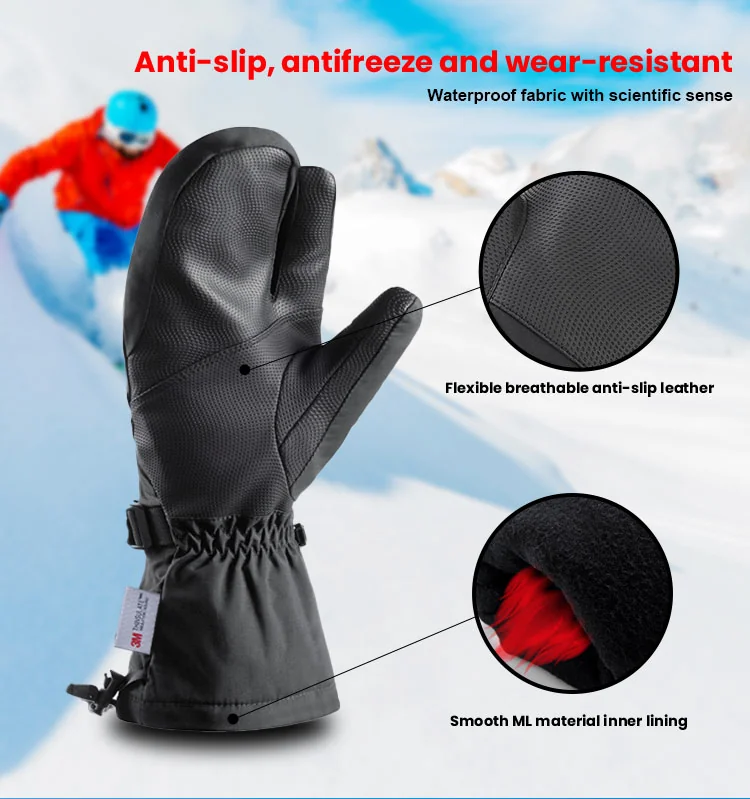
The global heated glove market is smaller than the heated jacket market in absolute dollars, but it has higher unit margins and stronger customer loyalty — repeat purchase rates are higher because end users tend to own multiple pairs (one for skiing, one for motorcycle, one for workwear). Demand falls into three sub-categories:
| Sub-category | Primary markets | Typical MOQ | Price tolerance (FOB) | End-user price band |
|---|---|---|---|---|
| Heated gloves for motorcycle (leather, waterproof, knuckle protection) | US, Germany, Italy, France | 300-600 pairs | $18-32/pair | $89-189 retail |
| Heated ski gloves (nylon, windproof, 5-finger heat) | Japan, US, Canada, Nordics | 200-500 pairs | $14-25/pair | $69-149 retail |
| Workwear heated gloves (carbon fiber reinforcement, 7.4V high-output) | Canada, Nordics, Germany | 300-800 pairs | $16-28/pair | $79-159 retail |
Each sub-category requires different materials, heating layouts, and certification paths. A factory strong on ski gloves isn’t necessarily the best partner for motorcycle — leather sourcing, EN13594 testing, and knuckle protection specs are entirely different.
The B2B buyer profile has matured. Three new buyer types have emerged: motorcycle gear brands adding heated gloves to extend their cold-weather SKUs, corporate gifting houses ordering 200-500 pairs per quarter, and ski resort operators sourcing branded gloves for retail shops and rental fleets. For all of them, the path is the same: find a battery heated gloves OEM, ODM, or contract manufacturing partner, negotiate a private label program, and bring the product to market under your own brand. B2B buyers can source from battery heated gloves wholesale suppliers at 1,000+ pairs, or go direct to a factory for private label programs starting at 300 pairs.
—
2. Heating Element Design: 5-Finger vs Back-of-Hand vs Wraparound
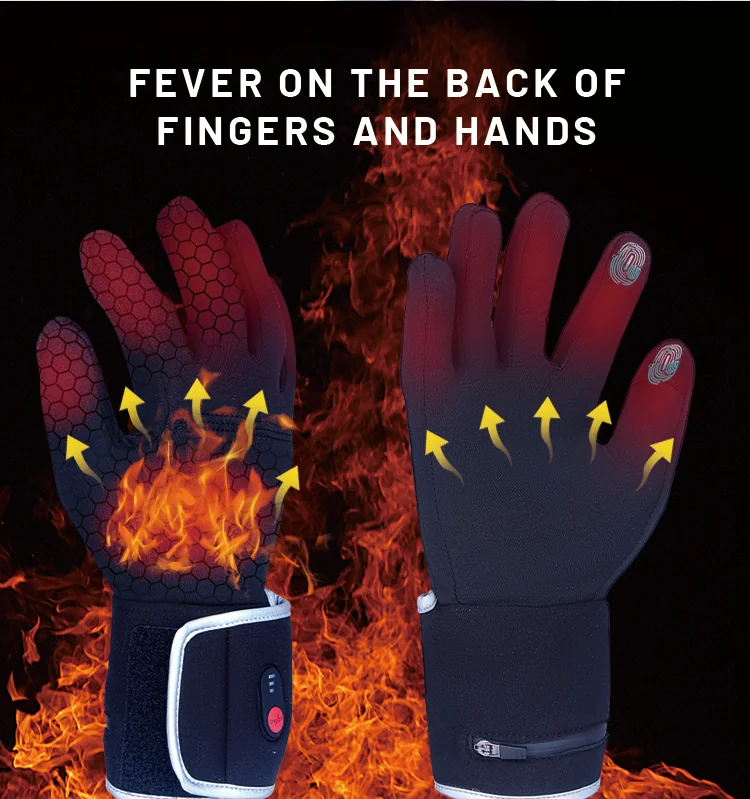
The most important engineering decision in a battery heated glove is the heating element layout. Unlike a jacket, a glove is small, heating zones compete for space, and end users have specific expectations about which fingers should feel warmth.
| Layout | Heat distribution | Battery drain | Typical use | Cost (relative) |
|---|---|---|---|---|
| Back-of-hand only (most common in entry-level) | Uneven — thumb and fingertips stay cold | Low (6-10h runtime) | Light outdoor, gifting | 1.0x baseline |
| 5-finger independent heat (each finger has its own micro-element) | Even — every fingertip reaches 40°C+ | Medium (4-7h runtime) | Premium ski, motorcycle, workwear | 1.4-1.7x |
| 360° wraparound (full-finger + back-of-hand loop) | Most even — full hand warmth | High (3-5h runtime) | Extreme cold (-20°C and below), industrial | 1.6-2.0x |
For most B2B buyers, 5-finger independent heat is the default for any glove retailing above $100. End users notice the difference immediately — a back-of-hand-only glove leaves the fingertips cold, and that single UX failure drives more warranty returns than any other factor. The trade-off is battery drain: a 5-finger layout draws 30-40% more current, requiring either a larger battery or shorter runtime. The OEM decision tree is simple: target retail $69-99 → back-of-hand + 5V/2200mAh, target retail $99-159 → 5-finger + 7.4V/2200mAh, target retail $159+ → 360° wraparound + 7.4V/3000mAh+ for extreme-cold buyers.
> B2B Soft Plant #1: Our factory’s 5-finger independent heat element uses calibrated micro-strips that reach 42°C within 30 seconds at 0°C ambient, with a uniform ±2°C distribution across all five fingertips. We can ship a working sample pair to your office in 7 days from order confirmation, with full heating curve data and wash-cycle test results included.
—
3. Battery & Heating Time: 5V vs 7.4V — Runtime and Certification
Battery platform is the second engineering decision — and in the glove category, it determines your export certification path more than any other spec. The two voltage tiers map directly to specific battery chemistries, runtime expectations, and shipping regulations.
| Voltage | Chemistry | Typical capacity | Runtime (low heat) | Runtime (high heat) | Certification complexity |
|---|---|---|---|---|---|
| 5V | USB power bank style (often removable) | 2,000-3,000 mAh | 3-6h | 1.5-2.5h | Easiest (most airlines allow, no UN38.3 for sub-100Wh) |
| 7.4V | Li-ion dedicated pack with DC jack | 2,200-3,000 mAh | 4-7h | 2.5-4h | Moderate (UN38.3 required, UL 2054 recommended) |
For B2B buyers, the choice is largely driven by target market and certification requirements. 5V gloves are easier to ship (most airline passengers can carry them in carry-on without declaration) and require less certification overhead. 7.4V gloves deliver better heating performance and runtime, but require UN38.3 testing on the battery pack and proper shipping documentation. Practical rule of thumb: retail under $100 → 5V, retail $100-200 → 7.4V, retail above $200 → 7.4V with swappable battery system.
> B2B Soft Plant #2: Our self-developed heated gloves with 7.4V battery pack is UN38.3 certified, UL 2054 tested, and ships with MSDS documentation for hassle-free international logistics. We also offer a private-label battery option where your brand label replaces ours on the battery housing — minimum 500 packs for the first custom tooling run.
—
4. Shell Materials: Goat Leather vs Nylon vs Softshell
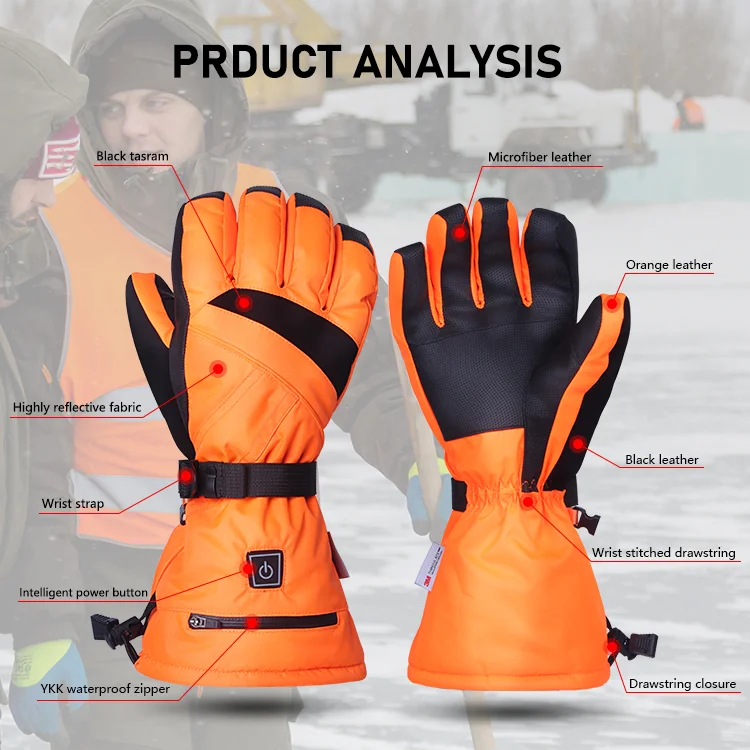
Shell material is the third engineering decision, and it interacts heavily with the heating element choice. A glove that runs hot internally but has a poorly insulated shell wastes battery; a glove with a great shell but a back-of-hand-only element leaves fingertips cold.
| Shell material | Cost (relative) | Durability | Water resistance | Best for | Trade-off |
|---|---|---|---|---|---|
| Goat leather (top-grain or split) | 1.0-1.3x | High (2-4 years regular use) | Good with DWR coating | Motorcycle, premium | Heavier, requires break-in |
| Nylon (400D-600D ripstop) | 0.7-0.9x | Medium (1-2 years) | Excellent with PU coating | Ski, workwear, lightweight | Less premium feel |
| Softshell (polyester + spandex) | 0.8-1.0x | Medium (1-2 years) | Moderate (water-resistant, not waterproof) | Casual, lifestyle, gifting | Less durable at high-wear points |
| Synthetic leather (PU-coated) | 0.5-0.7x | Low-Medium (6-12 months) | Variable | Entry-level, promotional | Lowest cost, shortest lifespan |
For most B2B buyers the decision tree is straightforward: motorcycle = goat leather, ski = nylon ripstop with PU coating, workwear = goat leather or reinforced nylon, gifting/promotional = softshell or synthetic leather. The interaction with heating is critical — leather holds heat longer (good for motorcycle at highway speeds) but is heavier; nylon is lighter and breaks in immediately, but lets heat escape faster (battery drains 10-15% faster); softshell is the easiest to live with daily but has the shortest service life.
—
5. OEM/ODM Customization: 8 Custom Areas for B2B Buyers
A B2B buyer evaluating a battery heated gloves factory should ask about eight specific customization areas. The depth of customization available is a strong signal of OEM/ODM program maturity.
| # | Customization area | Options | Typical setup cost | MOQ impact |
|---|---|---|---|---|
| 1 | Leather dye color | Pantone-matched, 12+ standard colors | $300-500 per color | MOQ 300 pairs |
| 2 | Lining fabric | Fleece, 3M Thinsulate, wool blend, custom knit | $500-1,500 | MOQ 500 pairs |
| 3 | Embroidery (logo) | 1-4 color, up to 8cm x 8cm area | $80-150 setup, $0.40-0.80/pc | MOQ 200 pairs |
| 4 | Battery branding | Private label on housing, custom cable color | $1,200-2,500 tooling | MOQ 500 packs |
| 5 | Accessories | Custom carry bag, gift box, multilingual manual | $0.80-2.50/pair | MOQ 300 pairs |
| 6 | Packaging | Retail box, polybag with header card, custom insert | $0.30-1.20/pair | MOQ 500 pairs |
| 7 | User manual | Multilingual (EN/DE/FR/JP/ES), branded layout | $0.10-0.30/pair | MOQ 300 pairs |
| 8 | Touchscreen fingertips | Conductive leather on index + thumb, custom pattern | $200-400 setup | MOQ 500 pairs |
The most popular B2B customization combinations in 2025-2026 are: logo embroidery + custom dye color + branded packaging (for retail brands) and battery branding + custom carry bag + multilingual manual (for premium gifting). Both add $2.50-4.50/pair to FOB — well within the margin envelope of a $100-200 retail product.
—
6. Certification Roadmap: CE EN13594 / FCC / UKCA
Certification is the area that catches first-time B2B importers off-guard the most. The single most important rule: EN13594 Level 1 KP is mandatory for any heated glove sold in the EU as motorcycle or ski personal protective equipment. A glove without EN13594 cannot be legally marketed in the EU as a motorcycle or ski glove, and most major EU retailers will not stock it.
| Certification | Region | Scope | Typical timeline | Typical cost |
|---|---|---|---|---|
| EN 13594 Level 1 KP | EU + UK (UKCA variant) | Motorcycle and ski glove PPE | 12-16 weeks | $3,500-7,000 per model |
| EN 511 | EU | Cold-protective gloves (industrial) | 8-12 weeks | $2,500-5,000 per model |
| FCC Part 15 | US | Electromagnetic compatibility | 4-8 weeks | $2,000-4,500 per model |
| UKCA | UK | Post-Brexit UK market access | 8-12 weeks | $2,500-5,000 per model |
| PSE (Japan) | Japan | Electrical safety for battery packs | 6-10 weeks | $1,800-3,500 per model |
| KC (Korea) | South Korea | EMC + safety | 8-12 weeks | $2,200-4,000 per model |
A B2B buyer planning to sell in both the EU and US markets should budget for EN13594 + FCC as the baseline. Critical trap: certification belongs to the importer, not the factory. The factory’s existing test reports can support your application, but the certificate is issued in the importer’s name. If a factory claims their “certification” covers your brand, ask for the specific certificate number and verify it in the EU CE marking database.
—
7. MOQ, Lead Time & Pricing for B2B Distributors
The MOQ and lead time structure is where most first orders succeed or fail. Numbers below reflect 2026 Q2 conditions for a quality battery heated gloves factory in China or Vietnam.
| Parameter | Standard product | Custom product | Premium private label |
|---|---|---|---|
| MOQ | 300 pairs | 500 pairs | 1,000 pairs |
| Sample lead time | 5-7 days | 10-14 days | 14-21 days |
| Bulk lead time | 30-40 days | 35-45 days | 45-60 days |
| FOB price (mid-spec 7.4V, goat leather, EN13594) | $18-22/pair | $22-28/pair | $26-35/pair |
| Payment terms | 30% T/T + 70% T/T against B/L copy | Same | 30% deposit, 40% pre-shipment, 30% against B/L |
| Sample cost | $35-60/pair (refundable against 500+ pair) | $80-150/pair (refundable) | Custom quote |
For B2B buyers new to the category, the path of least resistance is to start with a standard product (300 pair MOQ) to validate the market, then move to a custom program (500-1,000 pair MOQ) for the second order once the SKU is proven.
> B2B Soft Plant #3: Our factory has delivered OEM/ODM heated gloves for 8 European and North American brands in the past 18 months, with a combined 2025 shipment volume of 180,000 pairs. For first-time B2B buyers, we offer a 300-pair trial order with full EN13594 documentation included, upgradeable to custom tooling at the 1,000-pair threshold.
—
8. Top 5 Design Mistakes B2B Buyers Make (and How to Avoid Them)
Mistake #1: Skipping the finger-warmth test in the sample stage. Many B2B buyers approve samples based on back-of-hand heat alone, only to discover after launch that fingertips stay cold. Always test the sample in a 0°C environment for 20 minutes and verify all five fingertips reach at least 38°C.
Mistake #2: Underestimating EN13594 testing lead time. First-time EU importers often assume certification is a 4-week process. Plan for 12-16 weeks and budget accordingly. Last-minute certification pushes delay more product launches than any other factor.
Mistake #3: Specifying 5V when the retail price supports 7.4V. A 5V battery limits the heating element to back-of-hand only. If your retail price is $120+, end users expect 7.4V with 5-finger heat. Specifying 5V to save $1.50/pair typically costs 3-5x that in lost sales.
Mistake #4: Choosing the wrong shell for the heating layout. A 360° wraparound element in a softshell glove wastes heat. Match the shell to the heating: leather for high-output, nylon for medium, softshell for low-output only.
Mistake #5: Ordering 300 pairs of each of 6 colors instead of 1,800 pairs of 2 colors. Splitting MOQ across too many colorways drives up per-unit cost, slows production, and leaves you with dead stock in the slow-moving colors. Start with 2 colors, add 2 more after the first reorder.
—
9. FAQ — Battery Heated Gloves B2B Questions
Q1: What is the typical MOQ for a private label battery heated gloves program? A: 300 pairs for a standard product, 500 pairs for custom color or embroidery, 1,000 pairs for full custom tooling including branded battery packs.
Q2: How long does a custom heated glove sample take? A: 10-14 days for a custom product sample, including 5-7 days for material procurement. Rush samples are available at 2x cost with a 7-day turnaround.
Q3: Do I need EN13594 certification to sell heated gloves in the EU? A: Yes, if the glove is marketed as motorcycle or ski personal protective equipment. EN13594 Level 1 KP is the minimum standard. EN511 applies for industrial cold-protection gloves.
Q4: Can I private-label the battery pack with my own brand? A: Yes. Private-label battery packs require a 500-pack minimum for the first custom tooling run. The factory coordinates UL 2054 retesting on the relabeled pack.
Q5: What is the typical FOB price for a quality 7.4V heated glove in 2026? A: $18-28/pair FOB for mid-spec goat leather or reinforced nylon with 5-finger heat and EN13594 certification. Custom programs add $2-5/pair.
Q6: How do I verify a factory’s EN13594 certification is valid? A: Request the certificate number, then look it up in the EU CE marking database or request a copy of the full test report from the issuing lab (SGS, TUV, BV, or Intertek are the most common).
Q8: What’s the difference between 5V and 7.4V heated gloves in real-world use? A: 5V gloves run cooler, last longer on a single charge, and are easier to ship (most airlines allow in carry-on). 7.4V gloves run hotter, support 5-finger heating layouts, and require UN38.3 documentation for international shipping.
Q11: I’m a small retailer — can I source from a factory directly? A: Yes. Most battery heated gloves factories work with small retailers starting at 300 pairs. Smaller orders (under 200 pairs) typically go through a wholesaler or trading company with a 15-25% markup.
Q13: How do I evaluate a battery heated gloves factory in Vietnam vs China? A: Vietnam factories tend to be stronger on leather sourcing and assembly labor cost. China factories are stronger on battery integration, electronics certification (UL 2054, UN38.3), and rapid tooling changes. The best factory for your needs depends on your product spec, not just the country.
Q14: Can you help me source a battery heated gloves contract manufacturing partner if I have my own design? A: Yes. Our contract manufacturing program accepts customer-supplied tech packs, fabric specifications, and heating element designs. We provide a confidential manufacturing service with strict IP protection.
—
10. Conclusion: Why B2B Buyers Choose a Chinese & Vietnam Heated Gloves Factory Partner
A battery heated glove is a complex product at the intersection of leather or technical fabric, micro-electronics, and battery engineering. The right OEM/ODM partner can mean the difference between a profitable private label launch and a six-month quality nightmare.
The framework in this guide — heating element layout, battery platform, shell material, OEM/ODM workflow, EN13594 certification roadmap, and cost structure — is the same one experienced B2B buyers use to evaluate any new heated gloves supplier. Use it as your checklist, and don’t be afraid to ask hard questions about finger heat uniformity, certification ownership, and MOQ flexibility.
> Ready to start? Request a heated glove sample and FOB quotation by emailing [email protected] or via WhatsApp +86-13751041535. We respond to all serious B2B inquiries within 24 hours, and a working sample pair can be on its way to your office within 7 days.
Browse our graphene heated gloves collection, read more about our OEM/ODM manufacturing process, or explore B2B use cases from our existing clients.
—
This article is part of our B2B heated apparel manufacturing series. For more guides on heated jackets, heated socks, heated vests, and full OEM/ODM workflows, subscribe to our editorial newsletter or contact us directly.
Leave a Reply