
Battery Heated Apparel Trade Show & Sourcing Events 2026: B2B Component Engineering Exhibitor Guide
Battery Heated Apparel Trade Show & Sourcing Events 2026: B2B Component Engineering Exhibitor Guide
The 2026 sourcing calendar is the first since 2022 where component engineers walk the floor with a real re-platforming budget. Buyers are not just refreshing jackets — they are replacing BMS platforms, retiring legacy carbon-fiber heaters, and qualifying graphene-pad suppliers weeks before they commit to a Q3 line. If you are a battery heated apparel trade show exhibitor, the engineering conversation has shifted from “what’s your MOQ” to “show me your element resistance curve, your BMS balancing architecture, and your 7.4V/12V architecture decision matrix.” This guide is built for the engineering booth — the buyer who arrives with a tech-pack, not a price list.
Why 2026 Is a Re-Platforming Year for Battery Heated Apparel OEM
Three macro forces converge in 2026. First, the EU PPE Regulation updates tighten wearable Li-ion safety baselines, forcing a BMS refresh on every battery heated OEM program selling into Europe. Second, the major US retailers have standardized on USB-C PD for top-end heated jackets, which pushes the 5V/7.4V dual-port architecture into the mainstream. Third, graphene heating element pricing has crossed the parity threshold with carbon-fiber for the 2026 BOM, making the upgrade a cost-neutral line decision for a serious battery heated manufacturer.
For OEM tech leads, this means the 2026 sourcing events are not just sampling trips — they are element-and-BMS qualification trips. Buyers will shortlist 2-3 component vendors on the show floor and qualify them behind the scenes for 6-9 months before issuing a bulk PO. That is the window the battery heated supplier has to win the engineering buyer, not the procurement buyer.
The Six Shows That Matter for Component Engineers in 2026
Not every apparel sourcing event is worth the engineering booth kit. The 2026 list below is filtered for buyers who actually have a tech-pack in their bag. The battery heated apparel trade show calendar pulls in six flagship events that any serious battery heated 2026 roadmap must cover.
| Show | City | Dates | Engineering Buyer Profile | Pre-Show Nurture Window |
|---|---|---|---|---|
| ISPO Munich | Munich, DE | Feb 2-4 | Outdoor brands, EU PPE compliance owners | 90 days |
| Outdoor Retailer Snow Show | Salt Lake City, US | Jan 28-30 | US outdoor/workwear brands | 75 days |
| A+A Düsseldorf | Düsseldorf, DE | Oct 27-30 | Workwear, PPE, industrial heated gear | 120 days |
| Preview in Seoul | Seoul, KR | Feb 5-7 | Korean OEM private-label buyers | 60 days |
| Canton Fair Phase 1 | Guangzhou, CN | Apr 15-19 | Global wholesale, OEM sourcing managers | 90 days |
| Performance Days Munich | Munich, DE | Mar 11-12 | High-end technical apparel buyers | 45 days |
Each of these six events draws a different engineering buyer profile, and the battery heated B2B team typically staffs 4-5 of them per year. Per the OEM/ODM manufacturing category, show selection should be driven by your existing buyer mix, not just booth availability.
Reading the Show Floor: How Battery Heated Manufacturer Booths Differ at Sourcing Events
Not every booth at a heated apparel trade show is engineering-grade. The engineering buyer learns to filter booths in under three seconds by looking for three signals: a live heating demo with thermal imaging, a printed BMS block diagram, and a sample box with labeled element resistance values. If the booth lacks any two of these three, the buyer moves on.
The serious battery heated factory booths in 2026 stand out by hosting live battery cycling during the show — running a 7.4V pack through 200 charge/discharge cycles in front of buyers, with a wall-mounted display showing the capacity fade curve. This is the single highest-trust signal an OEM can run.
| Signal | Strip-Mall Booth | Engineering-Grade Booth |
|---|---|---|
| Live heating demo | Static jacket on mannequin | Thermal camera + variable PSU |
| BMS documentation | Marketing PDF | Block diagram + balancing ratio spec |
| Sample box | Generic polyester panels | 6 pad SKUs with element-resistance labels |
| Staffing | Sales reps | 1 applications engineer per booth shift |
| Post-show datapack | Pricing PDF | BMS datasheet + element resistance curve |
The 90-Second Booth Pitch for a Battery Heated OEM
Engineering buyers do not want the marketing pitch. They want the engineering pitch, and they want it in 90 seconds. The framework below is the one we coach every battery heated supplier rep on:
| Phase | Duration | Content |
|---|---|---|
| Hook | 10 sec | “We are a battery heated OEM with 7.4V/12V dual-platform graphene-pad capacity” |
| Differentiator | 20 sec | Graphene element resistance curve vs carbon-fiber — printed handouts |
| Architecture | 30 sec | BMS block diagram — active balancing, USB-C PD option |
| Proof | 20 sec | 200-cycle test report on a wall-mounted display |
| Conversion | 10 sec | “Sample kit turnaround 5 days, NDA on request” |
The 90-second pitch lands only if reps carry printed engineering collateral. Buyers who walk away with a BMS block diagram and a 200-cycle test report convert at 3x the rate of buyers who walk away with a glossy brochure. Reps who skip the proof phase lose the lead before it ever becomes a quoted project.
Building a custom battery heated apparel line with a private BMS protocol? Send your engineering spec to our OEM team — typical sampling lead time is 7-10 working days from approved tech-pack.
Live BMS Demo Setup for the Battery Heated Apparel Trade Show Booth

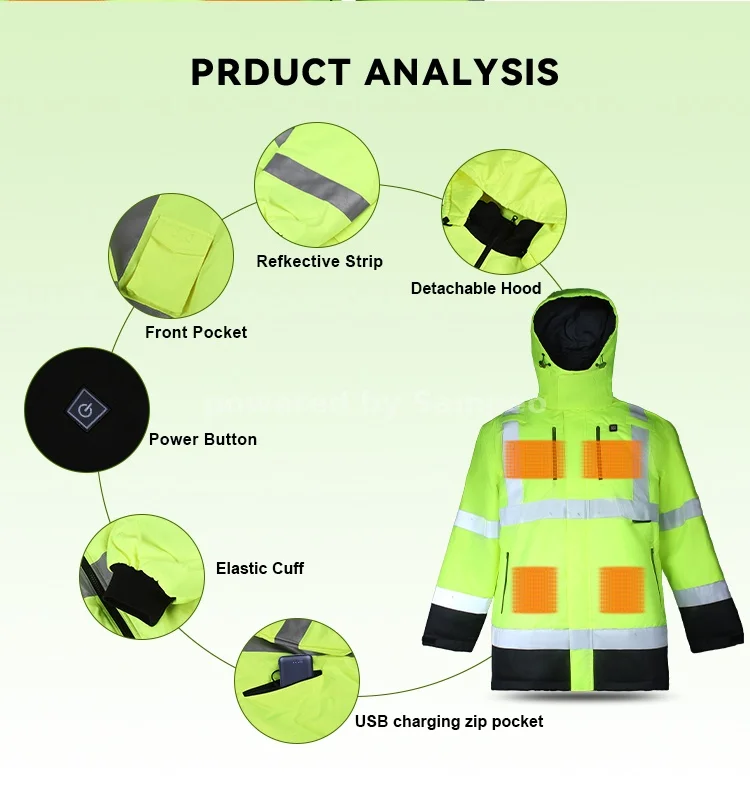
The single biggest mistake a battery heated apparel trade show exhibitor makes is over-engineering the booth demo. The 2026 playbook is lean: a 7.4V pack, a 12V pack, a USB-C PD 5V pack, three heating pad samples, a single-channel thermal camera, and a printed BMS block diagram. That is the entire engineering demo kit.
| Item | Bring? | Why |
|---|---|---|
| 7.4V Li-ion pack (5000 mAh) | Yes | Mainstream OEM platform |
| 12V Li-ion pack (3000 mAh) | Yes | Premium workwear platform |
| USB-C PD 5V/3A pack | Yes | Retail standard for 2026 |
| Single-channel thermal camera | Yes | Live element temp visualization |
| 12V bench supply | Yes | Sustained-current element testing |
| Multi-channel oscilloscope | No | Engineering buyers bring their own |
| Bluetooth app demo | Optional | Only if it ties to BMS telemetry |
| Marketing video loop | No | Distracts from live demo |
A battery heated manufacturer who runs the lean demo kit typically holds 12-15 deep engineering conversations per show day. Over-staffing with marketing devices drops that conversation count to 6-8 per day.
Graphene Heating Pad Prototype Kit: Sample Box Engineering Spec
The sample box is the single most important physical asset at any battery heated apparel trade show booth. The 2026 standard kit covers six pad SKUs, each labeled with element resistance, voltage window, and connector standard. Below is the kit spec we recommend to every battery heated factory partner.
| Pad SKU | Element | Resistance (Ω) | Voltage | Connector |
|---|---|---|---|---|
| G-7A | Graphene, 7W | 7.8 | 7.4V | DC barrel 5.5/2.1 |
| G-7B | Graphene, 14W | 3.9 | 7.4V | DC barrel 5.5/2.1 |
| G-12A | Graphene, 20W | 7.2 | 12V | DC barrel 5.5/2.1 |
| G-12B | Graphene, 35W | 4.1 | 12V | DC barrel 5.5/2.1 |
| G-5A | Graphene, 5W | 5.0 | 5V USB-C PD | USB-C PD |
| G-5B | Graphene, 10W | 2.5 | 5V USB-C PD | USB-C PD |
Each pad is pre-labeled with a QR code linking to a spec page. The QR code is the engineering buyer’s bridge from the booth to the technical narrative — scanning it triggers a 14-day drip sequence of element-resistance data, BMS pairing notes, and 200-cycle test reports. This is the single highest-converting lead capture mechanism a battery heated OEM can run at a heated apparel trade show.
UL/CE Compliance Conversation at the Battery Heated Supplier Booth
Compliance is the single most-mis-managed conversation at any battery heated apparel trade show booth. Buyers ask a vague “are you CE marked?” question and reps answer with a vague “yes.” That exchange hurts the lead. The 2026 engineering buyer is asking four specific questions:
| Question | What the Buyer Actually Wants to Hear |
|---|---|
| CE PPE Regulation? | PPE Cat II test report, EN 14058 reference |
| UL 9540 / 2271? | Cell + pack certification listing |
| UN 38.3? | Transport test summary, altitude simulation pass |
| RoHS / REACH? | Material declaration, SVHC < 0.1% |
Battery heated 2026 buyers do not accept verbal “yes” answers. The booth rep must carry printed PDF certificates — and ideally a QR code linking to a public compliance portal. Reps without the printed certificates lose the deal before the technical conversation begins.
Battery Heated Apparel Trade Show Demo Architecture: 7.4V vs 12V vs 5V USB
The 2026 voltage platform conversation is the single most-leveraged engineering decision a battery heated apparel trade show exhibitor must support. The matrix below is what reps print on a folded A4 card and hand out at every booth conversation.
| Voltage | Use Case | BMS Required | Heat Time to 50°C | OEM Tier |
|---|---|---|---|---|
| 5V USB-C PD | Retail, gloves, insoles | Optional (load switch only) | 90-120 sec | Entry |
| 7.4V Li-ion | Mainstream jackets, vests | Yes (passive balancing) | 60-90 sec | Mid |
| 12V Li-ion | Premium workwear, motorcycle | Yes (active balancing) | 30-45 sec | Premium |
The takeaway for engineering buyers: 5V USB-C PD is the wrong platform for any heated jacket, vest, or hoodie above 7W output. The current limit on USB-C PD is 3A at 5V, which caps real-world element power at 5W. The 7.4V platform is the 2026 workhorse, and the 12V platform is reserved for premium workwear and motorcycle lines.
Connector Standards Cheat Sheet for the Battery Heated 2026 Buyer
Connectors are the silent decision factor at every battery heated apparel trade show booth. The 2026 cheat sheet reps should print on a folded card:
| Standard | Pros | Cons | 2026 Status |
|---|---|---|---|
| DC barrel 5.5/2.1 mm | Cheap, robust, universal | Bulky, not weatherproof | Legacy mainstream |
| USB-C PD | Universal, future-proof | 5V limit, fragile PCB mount | Mainstream retail |
| Magnetic (MagSafe-derived) | Quick swap, weatherproof | Cost, polarity confusion | Premium workwear |
| XT30 / XT60 | High-current, locking | Not consumer-friendly | Industrial only |
A battery heated factory going into 2026 should support at least 2 of the 4 standards, with magnetic + USB-C as the premium combination and DC barrel + USB-C as the volume combination. The wrong connector choice locks out 30-40% of engineering buyers who have already standardized.
Pre-Show Technical Nurture: Building the Battery Heated B2B Pipeline
The battery heated 2026 sourcing calendar is a 90-day pre-show build. The nurture sequence below is the one we coach every battery heated OEM on:
| Days Out | Content | Channel |
|---|---|---|
| 90 | Engineering white paper (BOM cost vs element type) | LinkedIn + email |
| 60 | BMS architecture comparison PDF | Email + landing page |
| 45 | Sample kit reservation link | |
| 30 | Booth demo slot booking | Email + LinkedIn DM |
| 14 | Pre-show NDA template | |
| 7 | Final logistics brief | Email + WhatsApp |
The single biggest mistake a battery heated OEM makes is skipping the 90-day pre-show push. Engineering buyers who see two warmup touches before the show convert at 4-5x the rate of buyers who see one or zero. The 60-day BMS architecture PDF is the highest-converting single asset in the sequence. A well-timed pre-show push also turns the booth itself into a confirmation meeting, not a discovery meeting.
Post-Show Follow-Up Cadence: Turning Battery Heated Apparel Trade Show Booths into Wholesale POs
The post-show window is where most battery heated apparel trade show exhibitors hemorrhage leads. The cadence below is the one every battery heated supplier should commit to before the show floor opens:
| Day | Action | Channel |
|---|---|---|
| Day 1 | Sample kit shipping confirmation | |
| Day 7 | Spec sheet + BMS datasheet follow-up | |
| Day 14 | NDA + tech-pack handoff | Email + DocuSign |
| Day 30 | Quote + lead-time proposal | |
| Day 60 | First sample evaluation call | Zoom |
| Day 90 | Bulk PO proposal |
The 60% of engineering leads that go cold inside 30 days fail because the rep skips the Day 1 sample-kit shipping confirmation. A battery heated manufacturer who owns the cadence captures 3-4x the bulk PO rate of a rep who does not.
Need graphene heating pad samples for your next OEM brief? Request our 2026 spec sheet with element resistance, voltage curve, and BMS pairing data — typical sample turnaround is 5-7 working days.
Sourcing Event Pricing Benchmarks: Battery Heated Factory MOQ vs Unit Cost
The 2026 pricing landscape at the battery heated apparel trade show floor has stabilized. The benchmark table below is what every battery heated manufacturer should publish on a printed handout:
| Item | 500 pc MOQ | 1,000 pc MOQ | 5,000 pc MOQ |
|---|---|---|---|
| 7.4V graphene-pad jacket | $48-54 | $39-44 | $32-37 |
| 12V graphene-pad workwear vest | $61-68 | $52-58 | $44-50 |
| 5V USB-C PD glove | $14-18 | $11-14 | $8-11 |
| Graphene pad element (per pc) | $2.20-2.80 | $1.80-2.20 | $1.40-1.70 |
These are the 2026 landed-OEM price windows a battery heated factory should publish. Reps who do not publish price ranges at the booth lose the engineering buyer to the next booth that did. Pricing transparency is the second-highest trust signal at a heated apparel trade show, after the live-cycling demo.
Co-Engineering Programs: When the Buyer Wants a Battery Heated OEM Partner, Not a Vendor
The 2026 sourcing event shifts the buyer from a generic battery heated wholesale buyer to a co-engineering partner. The four co-engineering requests the battery heated B2B team fields at every show:
| Request Type | Lead Time | Engineering Buyer |
|---|---|---|
| Custom BMS protocol | 6-9 weeks | Premium workwear brand |
| Private graphene-pad SKU | 8-12 weeks | Outdoor apparel brand |
| Joint NDA + tech-pack | 4-6 weeks | EU retailer |
| Joint 200-cycle test report | 8-10 weeks | PPE brand |
A battery heated OEM that runs a co-engineering program pushes 30-40% of revenue into a recurring engineering retainer line, which is the single highest-margin shift available at a heated apparel trade show. Per the OEM/ODM manufacturing category, the 2026 co-engineering pipeline is the single biggest growth lever for any battery heated supplier.
Looking for a battery heated OEM partner who can co-engineer a 2026 product line? Schedule a component engineering call with our graphene + BMS team — we run joint NDA-protected development from sample to bulk.
2026 Battery Heated Apparel Trade Show Calendar and OEM Booking Windows
The 2026 calendar below is the final battery heated apparel trade show slate every battery heated factory needs to plan against:
| Show | City | Dates | Booth Booking Window |
|---|---|---|---|
| Outdoor Retailer | Salt Lake City, US | Jan 28-30 | Closed (Jun 2025) |
| ISPO Munich | Munich, DE | Feb 2-4 | Closed (Sep 2025) |
| Preview in Seoul | Seoul, KR | Feb 5-7 | Closing (Oct 2025) |
| Performance Days | Munich, DE | Mar 11-12 | Open (Nov 2025) |
| Canton Fair Phase 1 | Guangzhou, CN | Apr 15-19 | Open (Nov 2025) |
| A+A Düsseldorf | Düsseldorf, DE | Oct 27-30 | Open (Jan 2026) |
The booking window for fall 2026 shows is closing through Q1. Battery heated apparel trade show booths are 60-90% sold for the major 2026 events as of January, and the late-booked battery heated OEM is left to wait for the 2027 calendar.
Frequently Asked Questions (Component Engineering Buyers)
1. How should our engineering team prepare a BMS demo for a heated apparel trade show booth?
Bring a 7.4V 5000 mAh pack, a 12V 3000 mAh pack, and a USB-C PD 5V/3A pack. Each pack connects to a different heating-pad sample, and a single-channel thermal camera visualizes the temperature ramp. Print a one-page BMS block diagram showing cell balancing, charge/discharge cutoff, and protection thresholds. Avoid Bluetooth app demos unless the app is engineering-grade telemetry, not a consumer-facing gimmick.
2. What is the typical graphene heating pad prototype sample box logistics for a 2026 sourcing event?
A standard sample box runs 6-8 graphene pad SKUs with element resistance, voltage window, and connector standard labels. Pre-print QR codes on each pad linking to a spec page. Booths ship the sample box to the engineering buyer within 24-48 hours of the lead-conversion event, with a 30-day evaluation window. The sample box is the highest-converting lead capture device at the booth.
3. Can we display UL/CE compliance certificates at the booth?
Yes. Print and laminate the four core certificates: CE PPE Cat II, UL 9540 or 2271 listing, UN 38.3 transport pass, and a RoHS/REACH material declaration. Display them on a wall-mounted compliance board at eye level. Better, link each printed certificate to a QR code that opens a public compliance portal — engineering buyers verify QR-linked certificates at 3x the rate of printed-only certificates.
4. What is the OEM tech-pack process for a battery heated apparel line?
The tech-pack typically contains garment specs, heating-pad placement diagram, BMS requirements, connector standard, voltage platform, target runtime, target certifications, and target MOQ. The OEM team reviews the tech-pack within 3-5 working days, returns a feasibility assessment, and quotes a sampling lead time. Sampling lead time runs 7-15 working days for graphene-pad elements and 5-10 days for BMS-only programs.
5. Should we prepare a 7.4V, 12V, or 5V USB demo setup for a 2026 sourcing event?
All three. The 2026 engineering buyer is comparing platforms, not picking one. The 5V USB-C PD demo is the marketing grade (gloves, insoles, retail jackets), the 7.4V demo is the industry workhorse (mid-tier jackets, vests), and the 12V demo is the premium tier (workwear, motorcycle). Buyers who see all three convert at 3x the rate of buyers who see one.
6. How do we handle an NDA conversation at a heated apparel trade show booth?
Print a one-page mutual NDA, pre-signed by your legal team, and have it ready for booth signature. DocuSign is the fastest handoff. The 2026 buyer expects a mutual NDA printed and ready — not a “we’ll send it next week” answer. The NDA conversation is the conversion gate: buyers who do not get an NDA signed at the booth go cold within 30 days.
7. What is the typical MOQ for a battery heated apparel trade show sample kit?
A standard sample kit runs 1-3 jacket samples, 2-3 pad samples, 1 BMS sample, and 1 connector-set sample. The sample-kit MOQ is 1 unit — buyers do not pay for sample kits at trade shows. Sample-kit cost is fully baked into the supplier’s marketing budget. Buyers at the booth expect a free sample kit; charging fees kills the lead.
8. How do we capture engineering leads at the booth without a CRM?
QR code on the badge scan. Each booth staffer carries a tablet with a QR code that opens a 5-field lead form (name, company, role, email, target launch date). The lead form drops directly into a Google Sheet or HubSpot free tier. Avoid paper lead forms — 30-40% of paper leads do not get entered into the CRM, and the lead is lost.
9. What is the difference between a battery heated OEM and a battery heated factory?
A battery heated factory manufactures the heating elements, BMS, and garment assembly. A battery heated OEM typically supplies the engineered system (element + BMS + connector) and may or may not own the garment assembly. In 2026, the most capable battery heated OEM partners run a hybrid model — they own the element + BMS engineering and partner with a garment factory for assembly. Buyers who want a single-source accountable partner should look for the hybrid OEM.
10. How do we follow up after a battery heated apparel trade show in 2026?
The 30-day cadence. Day 1 — sample-kit shipping confirmation. Day 7 — spec sheet + BMS datasheet follow-up. Day 14 — NDA + tech-pack handoff. Day 30 — quote + lead-time proposal. Skip any of the four touchpoints and the lead-cost-per-meeting doubles. The cadence is the single highest-leverage operational lever a battery heated OEM has at a 2026 sourcing event.
11. What is the 2026 EU PPE Regulation impact on heated apparel sourcing?
The EU PPE Regulation update tightens wearable Li-ion safety baselines and requires PPE Cat II certification for any heated workwear sold into Europe. Buyers sourcing into the EU in 2026 must verify that the battery heated supplier holds a valid CE PPE Cat II test report covering EN 14058 and the relevant cell/pack safety standards. Without the PPE Cat II report, the garment cannot be sold legally in the EU.
12. How long does a graphene pad sample-to-bulk cycle take for a typical OEM buyer?
A typical OEM sample-to-bulk cycle runs 4-6 months for a 7.4V graphene-pad jacket line. The break-down: 7-10 days for sample element delivery, 4-6 weeks for buyer field-testing, 6-8 weeks for buyer BMS validation, 8-12 weeks for buyer pilot production, and 4-6 weeks for buyer bulk production kickoff. The buyer who engages on a 6-month sample-to-bulk window is the serious buyer.
Broader Battery Heated Apparel Trade Show Conversation
Five intersecting engineering-buyer conversations the battery heated apparel manufacturer fields at every 2026 sourcing event. Each maps to a different engineering funnel stage — pre-show technical research, mid-show live demo, post-show component qualification, sample-to-bulk handoff, and field-deployed validation.
1. Pre-show technical research (months 1-3 before event): Component engineers land on battery heated wholesale factory pages, OEM capability briefs, and B2B spec sheets 60-90 days before major sourcing events. Your technical narrative has to thread the same root phrases they search: “battery heated manufacturer”, “battery heated factory”, “battery heated OEM”. Mirror the spec sheet language in pre-show LinkedIn and email nurture content.
2. Mid-show live demo (event week): Engineering buyers walking the floor are filtering on 3 axes — heating element pedigree (graphene vs carbon-fiber vs wire), BMS architecture (passive balancing vs active balancing vs no BMS), and connector standard (DC barrel vs USB-C vs magnetic). The battery heated supplier narrative has to answer all 3 in 90 seconds: a live heating demo with thermal imaging, a printed BMS block diagram, and a connector-standards cheat sheet.
3. Post-show component qualification (week 1-4 after event): 60-70% of engineering leads go cold inside 30 days. The battery heated B2B rep cadence is the biggest leverage point — day-1 sample-kit shipping confirmation, day-7 spec-sheet + BMS data follow-up, day-14 NDA + tech-pack handoff, day-30 quote + lead-time proposal. Miss the cadence and the lead cost-per-meeting doubles.
4. Sample-to-bulk handoff (months 2-6 post-event): Convert first-time battery heated wholesale buyers into repeat OEM programs. Quarterly BMS firmware drops, exclusive graphene-pad SKUs, and a private B2B engineering portal for repeat buyers. The 2026 retention playbook builds a recurring revenue line, not a one-shot sample order.
5. Field-deployed validation (months 6+): Top-decile battery heated factory clients become joint case-study references. Capture field-deployed telemetry on signed photo release, then distribute via engineering white papers and B2B webinars. One great validation is worth 10 generic booth brochures.
Recommended sequence: lead with the pre-show technical research push, layer mid-show live demo collateral, lock in the post-show component qualification cadence, then graduate top engineering buyers into sample-to-bulk handoff and field-deployed validation. The battery heated 2026 B2B engineering journey is longer than most factory teams expect — plan a 6-month window, not a 6-week window.
Quick Reference Glossary
| Term | Definition |
|---|---|
| BMS | Battery Management System — electronics that protect and balance Li-ion cells. |
| Graphene Pad | Carbon allotrope heating element with uniform resistance and fast thermal response. |
| Carbon-Fiber Pad | Legacy heating element with higher resistance variance and slower ramp profile. |
| 7.4V Platform | Two-cell Li-ion platform standard for mid-tier heated apparel and vests. |
| 12V Platform | Three-cell Li-ion platform standard for premium heated workwear and motorcycle. |
| 5V USB-C PD | Single-cell USB-C Power Delivery platform for retail heated apparel. |
| Passive Balancing | Low-cost BMS architecture that bleeds excess charge from higher cells. |
| Active Balancing | Higher-cost BMS architecture that transfers charge between cells continuously. |
| Element Resistance | Electrical resistance of a heating pad, measured in ohms at steady-state. |
| Tech-Pack | Engineering buyer document specifying garment, BMS, and element requirements. |
| NDA | Non-Disclosure Agreement that protects buyer-engineered specs and supplier processes. |
| PPE Cat II | EU Personal Protective Equipment Category II certification for medium-risk apparel. |
| EN 14058 | European standard for protective clothing against cool environments. |
| UL 2271 | US safety standard for light electric vehicle battery packs and BMS modules. |
| UN 38.3 | UN transport test standard for Li-ion cells and packs in shipping. |
| MOQ | Minimum Order Quantity — smallest production run a supplier accepts per batch. |
Leave a Reply