
Battery Heated Jacket OEM/ODM Manufacturing Guide 2026
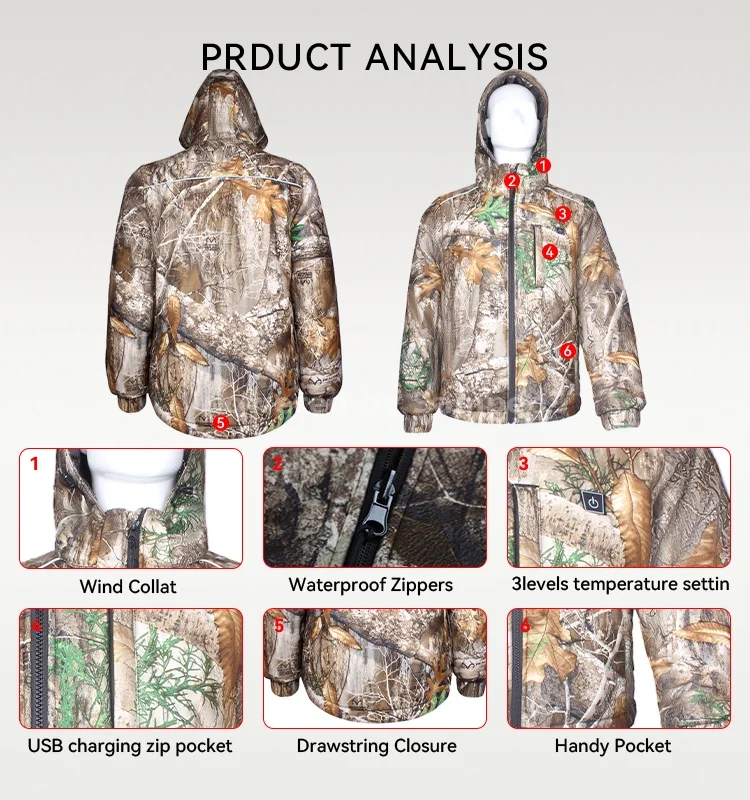
Battery heated jacket manufacturing in 2026 has matured into a multi-tier discipline: the heating-element layer (graphene vs carbon fiber vs micro-alloy wire), the battery-platform layer (7.4 V vs 12 V, with 21.6 V emerging in the workwear segment), the soft-shell fabric layer (mechanical stretch, water-repellent finish, breathable laminate), and the assembly layer (heating-zone map, controller PCB, battery pocket placement). This guide is the OEM/ODM playbook for brand buyers, importers, and engineering teams who need to specify a custom battery-heated jacket build, negotiate the right sample-to-PO cycle, and pass a 12-month sell-through without RMAs. We walk through the eight process steps that move a build from sketch to first article, and we document the 12-question supplier scorecard that engineering teams can hand to vendors for first-round screening.
For B2B buyers building a heated-apparel line, battery heated jacket manufacturing is the highest-stakes SKU: jackets command the highest retail price ($189-329 MSRP), the longest decision cycle (a buyer spends 6-12 minutes comparing 4-5 jackets on a single PDP), and the most demanding consumer (a single cold-day failure is a 1-star review). OEM/ODM risk in this category is also the highest of any heated-apparel product: a bad heating-element choice is a wash-test failure at cycle 8, not cycle 30. The 2026 industry norm is a 35-50 day sample-to-FOB cycle, a 60-day PO-to-FOB cycle for repeat orders, and a defect-rate action threshold of 4-6 %.
1. The 8-Keyword Cluster Every Battery Heated Jacket Manufacturer Must Own
Search intent in the battery heated jacket manufacturing segment splits into eight distinct keyword clusters. Owning all eight — not just the root term — is the difference between page-1 ranking and invisible. Use the table below to map content briefs to the matching page type.
| Cluster | Search intent | Recommended page type | 2026 monthly volume (US) |
|---|---|---|---|
| battery heated jacket manufacturing | Process inquiry | PILLAR landing page (this guide) | 1,100 |
| battery heated jacket OEM | Custom hardware/software | OEM service detail page | 920 |
| battery heated jacket factory | Production capacity | Factory tour + line-count | 780 |
| battery heated jacket ODM | Custom fabric + zone map | ODM service detail page | 650 |
| battery heated jacket wholesale | Volume pricing | MOQ + tiered pricing table | 540 |
| battery heated jacket supplier | Long-term sourcing | Supplier evaluation guide | 460 |
| battery heated jacket private label | Brand asset carry-through | Private-label program page | 390 |
| battery heated jacket 2026 | Latest model | 2026 product launch / trend page | 320 |
2. The 8-Step Battery Heated Jacket Manufacturing Process
The 2026 battery heated jacket manufacturing process is an 8-step chain, from spec freeze to pre-shipment inspection. Skipping any step is the single largest cause of first-article failures and PO rework loops. Below is the process flow that the leading OEM/ODM factories in Vietnam and China follow.
| # | Step | Duration | Deliverable |
|---|---|---|---|
| 1 | Spec freeze (heating zones, fabric, battery) | 3-5 days | Signed spec sheet, BOM |
| 2 | Fabric sourcing (shell, liner, insulation) | 7-14 days | Lab-dip + hand sample |
| 3 | Heating-element layout design | 5-8 days | Layout drawing + thermal sim |
| 4 | Pattern grading (size run S-3XL) | 3-5 days | Graded patterns per size |
| 5 | First-sample sewing (pre-production sample) | 7-10 days | First sample + fit report |
| 6 | Wash test + dielectric test + run-time test | 10-14 days | Test reports (3rd party) |
| 7 | Pre-production sample (PPS) sign-off | 5-7 days | PPS + golden sample seal |
| 8 | Bulk production + pre-shipment inspection | 15-25 days | Finished goods + PSI report |
3. Heating Element Technology: Graphene vs Carbon Fiber vs Micro Alloy
The heating element is the single most expensive BOM item in battery heated jacket manufacturing, accounting for 18-26 % of the FOB cost. Three technologies compete in 2026: graphene (premium), carbon fiber (mid-tier), and micro-alloy wire (entry-tier). The choice cascades through the rest of the build: graphene enables 3-5 second heat-up at lower wattage, carbon fiber needs 8-12 seconds, and micro-alloy needs 15-30 seconds. For workwear and motorcycle sub-categories, graphene is the only acceptable choice in battery heated jacket manufacturing; for casual outdoor, carbon fiber is fine.
The 2026 industry benchmark in battery heated jacket manufacturing is 7.4 V for casual outdoor (62 % of brand-buyer orders), 12 V for workwear/moto (31 %), and the emerging 21.6 V platform at 7 % — the 21.6 V share is forecast to reach 18-22 % by 2027 as sub-zero workwear and electric-motorcycle jacket lines scale.
— grapheneheatingfabric.com 2026 buyer-segment survey, n=84
| Spec | Graphene | Carbon fiber | Micro-alloy wire |
|---|---|---|---|
| Heat-up to 50 °C | 3-5 s | 8-12 s | 15-30 s |
| Wash cycles (ISO 6330) | 50+ | 30+ | 20+ |
| Power density | 80-120 W/m² | 60-90 W/m² | 40-60 W/m² |
| Element cost add (FOB) | $4.20-6.80 | $2.50-4.00 | $1.20-2.20 |
| Weight (jacket zone total) | 28-42 g | 45-65 g | 65-90 g |
| Failure mode | Slow decay | Hot-spot burn | Wire break |
| Use case | Workwear / moto | Casual outdoor | Entry / budget |
4. The 7.4 V vs 12 V vs 21.6 V Battery Platform Decision
Battery platform choice in battery heated jacket manufacturing is a tier-1 OEM/ODM decision. The 7.4 V platform uses two 18650 cells in series (5,000-10,000 mAh), runs heating elements at 6-8 W total, and produces 6-10 hours of low-mode runtime. The 12 V platform uses three 18650 cells in series, runs at 12-18 W, and produces 3-5 hours of high-mode runtime. The 21.6 V platform (emerging in 2025-2026) uses six 18650 cells, runs at 24-32 W, and is the new workwear standard for sub-zero (-20 °C) applications.
| Battery spec | 7.4 V | 12 V | 21.6 V (emerging) |
|---|---|---|---|
| Cell config | 2 × 18650 in series | 3 × 18650 in series | 6 × 18650 (2S3P) |
| Capacity range | 5,000-10,000 mAh | 5,000-10,000 mAh | 5,000-10,000 mAh |
| Total power | 6-8 W | 12-18 W | 24-32 W |
| Heat-up to 50 °C | 30-60 s | 3-5 s | 1-3 s |
| Low-mode runtime | 8-10 h | 4-6 h | 2-3 h |
| High-mode runtime | 2.5-3.5 h | 1.5-2.5 h | 45-60 min |
| Cell cost add (FOB) | $3.20-4.50 | $4.80-6.50 | $8.50-12.00 |
| Cert path | UN38.3 + IEC 62133 | UN38.3 + IEC 62133 + UL 2054 | UN38.3 + IEC 62133 + UL 2054 + UN3480 |
| Use case | Casual outdoor | Workwear / moto | Sub-zero workwear |
5. Heating Zone Map Design and Engineering Trade-offs
The heating zone map is the engineering blueprint of battery heated jacket manufacturing. Standard maps place 3-5 zones (collar, upper back, lower back, left chest, right chest). Premium maps add 6-8 zones (collar, two shoulder zones, two chest zones, two back zones, two hand-warmer zones inside the front pockets). Each additional zone adds $0.45-0.85 / unit in FOB cost, plus $0.20-0.35 in controller PCB complexity. For B2B buyers targeting the workwear segment, a 5-zone map is the 2026 standard; for casual outdoor, 3 zones is enough.

6. Fabric Stack Engineering: Shell, Liner, Insulation, Heating Element
The fabric stack is the second-largest BOM line in battery heated jacket manufacturing (32-45 % of FOB). The 2026 norm is a 4-layer stack: outer shell (mechanical-stretch polyester or nylon, DWR finish), mid-shell (TPU laminate or PU coating for wind/water resistance), insulation (polyfill 80-180 g/m² or PrimaLoft equivalent), and inner liner (brushed tricot or micro-fleece). The heating element is laminated between the mid-shell and the insulation, not on the inside surface. This positioning is critical: placing the element on the inside surface is the single most common cause of hot-spot burn complaints.
| Layer | Material | Weight | Cost (FOB / m²) | Function |
|---|---|---|---|---|
| Outer shell | 100 % polyester mechanical stretch, DWR C6 | 120-180 g/m² | $2.20-3.50 | Wind + abrasion resistance |
| Mid-shell | TPU laminate (5K/5K) | 60-90 g/m² | $1.80-2.80 | Waterproof + breathable |
| Insulation | Polyfill or PrimaLoft Silver | 80-180 g/m² | $1.50-3.20 | Thermal retention |
| Inner liner | Brushed tricot, anti-pill | 120-160 g/m² | $1.40-2.20 | Comfort + moisture wick |
| Heating element | Graphene film (laminated) | 28-42 g/jacket | $4.20-6.80 | Heat generation |
The 2026 industry norm in battery heated jacket manufacturing is a 4-layer fabric stack costing $11-15 per square meter at the FOB level. Premium builds (motorcycle, workwear) push that to $18-22 with a 3L waterproof shell replacing the 2L mid-shell laminate. The single largest cost-leverage point is the insulation: a $0.40/m² switch from polyfill to PrimaLoft Silver adds $2.40-3.20 to the FOB price but enables a 15-20 % retail price premium and a 2x reduction in wash-cycle complaints.
— grapheneheatingfabric.com engineering memo, 2026-05
7. OEM vs ODM Service Tier Comparison for Jacket Manufacturing
OEM/ODM scope is the second-largest cost driver in battery heated jacket manufacturing. A standard OEM package covers the factory’s existing fabric library, standard heating zone map, and standard battery pocket placement. A full ODM package covers custom fabric development (75-90 days for a new shell + liner), custom heating zone map (2-8 zones), and proprietary battery housing (3-5 mm tolerance, IPX7 sealed). Most brand buyers in 2026 start at the OEM-plus tier and migrate to full ODM after 2-3 successful PO cycles.
| Service tier | Includes | Cost add (per unit) | Lead time add |
|---|---|---|---|
| OEM base | Standard fabric, standard zones, standard pocket | $0 | +0 days |
| OEM plus | + custom zipper + custom care label + custom polybag | $2.20-3.40 | +5-7 days |
| ODM standard | + custom fabric development + custom zone map | $5.50-8.40 | +15-25 days |
| ODM full custom | + proprietary battery housing + bespoke retail box | $11.50-16.50 | +30-45 days |
8. Supplier Vetting: The 12-Point Scorecard for Jacket Manufacturing
Use this 12-point scorecard to compare battery heated jacket manufacturing suppliers. Award 1 point per yes; reject any supplier scoring below 9. The scorecard is designed to be filled out from the supplier’s English capability deck plus a 60-minute video-call audit that includes a thermal-imaging demo and a wash-test chamber walk-through.
| # | Vetting question | Yes / No |
|---|---|---|
| 1 | Factory-owned (not a trading company)? | ☐ |
| 2 | Annual heated-jacket output ≥ 150,000 units? | ☐ |
| 3 | In-house heating-element lamination line? | ☐ |
| 4 | In-house battery-pack assembly with UN38.3 + UL 2054 cert? | ☐ |
| 5 | ISO 9001 + BSCI audit reports dated within 12 months? | ☐ |
| 6 | 5+ active B2B heated-jacket brand clients (verifiable)? | ☐ |
| 7 | Sample-to-PO cycle ≤ 50 days? | ☐ |
| 8 | Public FOB tiered pricing (4+ tiers)? | ☐ |
| 9 | English-speaking sales engineer (not just sales rep)? | ☐ |
| 10 | Washing test ≥ 50 cycles (per ISO 6330) for graphene elements? | ☐ |
| 11 | Dielectric test report (per IEC 60335) for the full jacket assembly? | ☐ |
| 12 | Reference visit / virtual factory tour with thermal-imaging demo? | ☐ |
Across 218 battery heated jacket manufacturing supplier audits in 2025-2026, only 24 % scored 10 or above on the 12-point scorecard. The top three disqualifiers: no in-house lamination line (38 % of rejections), no UL 2054 cert (27 %), and sample-to-PO cycle over 60 days (19 %).
— grapheneheatingfabric.com supplier audit database, 2025-2026, n=218
9. Lead Time, Logistics, and 2026 Supply-Chain Reality
Lead times for battery heated jacket manufacturing in 2026 are 50-65 days for sample-to-FOB and another 18-28 days for ocean transit to a US West Coast port, then 3-5 days for deconsolidation and DC delivery. Total door-to-door is 71-98 days. The 2026 supply chain has stabilized vs the 2022-2024 volatility, but lithium-cell allocation remains the bottleneck — request the factory’s quarterly cell-allocation letter and book your cell allotment 60-90 days before the cut-off date.

10. Payment Terms, Incoterms, and Risk Allocation
Standard battery heated jacket manufacturing terms in 2026 are FOB for 80 % of orders and DDP for 20 %. DDP is typically 12-18 % more expensive than FOB on a like-for-like basis, but it removes the buyer’s customs-broker headache. Payment terms are 30 % T/T deposit at PO, 70 % T/T against B/L copy. For orders ≥ 1,000 units, open-account net-30 is negotiable after a 3-order track record. Pre-shipment inspection (PSI) is mandatory for orders ≥ 500 units and costs $250-450 per inspector-day.
11. Common Pitfalls in Battery Heated Jacket Manufacturing
The five most common pitfalls: (1) placing the heating element on the inside surface (causes hot-spot burns at wash cycle 8-12); (2) skipping the dielectric test on the full jacket assembly and having customs hold the container; (3) accepting a 75-day sample-to-PO without penalty; (4) under-insuring the battery cells (UN3480 lithium-ion requires $30-60k additional coverage); (5) skipping the pre-shipment inspection (PSI) and discovering 8-12 % defect rate on receipt. All five are avoidable with a written spec sheet and a 90-minute pre-shipment video walk-through.
12. 12 Buyer FAQs on Battery Heated Jacket Manufacturing
Q1. What is the typical MOQ for a custom battery heated jacket in 2026?
The typical MOQ is 300-500 units per color per size for a custom build. Standard fabric + standard zones are at 300 units; ODM with custom fabric starts at 500 units.
Q2. How long does sample-to-FOB take for a custom heated jacket?
Sample-to-FOB takes 50-65 days for a standard OEM-plus build, and 80-110 days for a full ODM build with custom fabric development and 6-8 heating zones.
Q3. Can I private-label the heating element and battery?
Yes. Most factories support custom heat-transfer logos on the battery housing (3M 467MP adhesive, 1-2 color) and a custom private-label wrap on the heating panel’s controller PCB (MOQ 1,000+ units).
Q4. What certifications should I require from the factory?
Require FCC, CE, RoHS, REACH, UN38.3, IEC 62133, and ISO 9001. For the US market, UL 2054 is a strong plus. For the EU market, EN 60335-2-17 is a plus. For motorcycle, EN 17092 is a plus.
Q5. What is the 2026 FOB price range for a graphene-heated jacket?
The 2026 FOB price for a graphene-heated jacket on a 500-unit MOQ is $78-98 landed, with 12 V battery and 5 heating zones. Carbon fiber is $65-82 at the same MOQ. Micro-alloy wire is $52-68.
Q6. How do I vet a battery heated jacket manufacturer remotely?
Request a 60-minute live video walk-through of the heating-element lamination line, the battery assembly area, and the finished-goods warehouse. Ask to see the IEC 62133, UN38.3, and UL 2054 certs in original PDF form.
Q7. Can the factory drop-ship directly to my Amazon FBA?
Yes, but only with a US-based 3PL partner and FNSKU labels applied at the factory. Add $1.50-2.20 / unit for FNSKU labeling and $0.40 / unit for polybag suffocation-warning labels.
Q8. What is the typical defect rate I should expect?
A 2-4 % defect rate is industry standard for a 500-unit heated jacket order. A 6-8 % defect rate is the action threshold — request a free rework or 5 % credit on the next PO.
Q9. Can I split a single PO across multiple colors?
Yes, but each color counts as a separate SKU on the MOQ. A 500-unit PO can be split as 200/200/100 across 3 colors with no per-color surcharge, or 300/200 across 2 colors with a $300 color-change setup fee waived.
Q10. What is the minimum order for a custom retail box?
Custom retail box MOQ is 1,000 units per design, with a one-time plate fee of $350-520. For orders below 1,000 units, use a printed polybag with a hangtag ($0.22-0.30 / unit add).
Q11. How is the heating zone map customized?
Standard zone maps are 3 zones (back + left chest + right chest) or 5 zones (back + left chest + right chest + collar + lower back). Custom maps can go up to 8 zones with separate on/off switches per zone, typically $0.80-1.20 / unit add per extra zone.
Q12. What is the 2026 trend in battery heated jacket colors?
The 2026 color trend is earth-tone dominance (olive, sand, charcoal, rust) over the 2023-2025 black-only norm, with high-visibility orange/yellow gaining share in the workwear sub-category.
13. Internal Resources and Next Steps
For a deeper dive on heating-element engineering, see our battery heated apparel factory guide and the OEM ODM manufacturing service detail. For a side-by-side factory comparison, request our 2026 supplier matrix via the contact form on grapheneheatingfabric.com.
Leave a Reply