
Heated Apparel Engineering Specification 2026: Complete Guide to UN3481 Documentation Chain for Dongguan Factory OEM/ODM Battery Pack Assemblers

Heated Apparel Engineering Specification 2026: Complete Guide to UN3481 Documentation Chain for Dongguan Factory OEM/ODM Battery Pack Assemblers
Engineering-side lens — Friday Template (per 10/2 P1-B graphene quota rule). 2026-10-02.
Quick Reference — UN3481 Heated Apparel Documentation Chain at a Glance
| Stage | Doc # | Document | Issuer | Validity | Lead Time |
|---|---|---|---|---|---|
| 1. Cell-level | UN 38.3 | UN 38.3 Test Summary (T1-T8) | Cell vendor (Samsung SDI / LG / Murata) | 24 months | Pre-shipment (instant if on file) |
| 2. Pack-level | MSDS | Material Safety Data Sheet (16-section GHS-aligned) | OEM battery pack assembler | 12 months | 24-72 hours from assembly |
| 3. Pack-level | SoC Discharge | SoC ≤30% Pre-shipment Discharge Evidence (IATA PI 965 Section II) | OEM factory + IATA hazmat shipper | Per shipment | 7-day discharge cycle at 0.2C for 21700 cells |
| 4. Label-level | H/C Labels | Battery Handling Label + Cargo Aircraft Only Label | OEM factory | Per BOM + shipment | Per shipment |
| 5. Shipping-level | DGD | Shipper’s Declaration for Dangerous Goods — IATA hazmat shipper signature | IATA-certified hazmat shipper (3-year cert) | Per shipment | 24-48 hours after assembly |
UN3481 Heated Apparel Battery Pack Documentation Chain
For OEM/ODM Dongguan factory heated apparel battery pack assemblers, the UN3481 documentation chain is a 5-document, 5-stage pipeline that must be assembled and verified before any heated apparel air-freight shipment can leave the factory. This complete guide covers each of the 5 stages in detail, the engineering specifications for the 21700 cell + BMS PCB + connector + enclosure stack-up, and the validation tests (UN 38.3 T1-T8 protocols + IEC 62133-2:2017 + AMD1:2021) that the documentation references.

The UN3481 documentation chain has matured from “theoretical compliance” in 2018-2020 to “daily operational discipline” in 2024-2026 under IATA DGR 65th edition (2024) and 49 CFR 173.185. The OEM factory that delivers the 5-document chain consistently will win Q4 2026 / Q1 2027 / Q4 2027 heated apparel RFQs from US / EU / UK buyers who require air-freight capable lead times.
Stage 1 — Cell-level UN 38.3 test summary (T1-T8 protocols): The cell vendor provides the test summary for the specific 21700 cell model. The test covers 8 protocols (T1 altitude simulation + T2 thermal cycling + T3 vibration + T4 shock + T5 external short circuit + T6 impact + T7 overcharge + T8 forced discharge) and is valid for 24 months. The OEM factory keeps the summary on file and provides it to the destination CBP ACE entry accountant within 24 hours.
Stage 2 — Pack-level MSDS per SKU (16-section GHS-aligned): The OEM battery pack assembler issues the MSDS per SKU. The MSDS follows the 16-section GHS format (Identification through Other information). Validity: 12 months from issue date or refresh if formulation changes.
Stage 3 — SoC ≤30% Pre-shipment Discharge Evidence (IATA PI 965 Section II): For air-freight (Ho Chi Minh or Shenzhen to LAX or FRA or LHR), the heated apparel battery pack must be discharged to ≤30% SoC before CY cut-off. The discharge cycle takes 7 days at 0.2C discharge rate for 21700 cells (5,000 mAh 21700 from 100% to ≤30% in ~7 days at 1,000 mA). The OEM factory records SoC at T-7 / T-5 / T-3 / T-1 / T-0 and provides the discharge log + BMS readout screenshot.
Stage 4 — Battery Handling Label + Cargo Aircraft Only (CAO) Label: The OEM factory prints two labels per battery pack carton: (a) Battery Handling Label with battery type, voltage, mAh, weight, and emergency contact, (b) Cargo Aircraft Only Label indicating forbidden on passenger aircraft.
Stage 5 — Shipper’s Declaration for Dangerous Goods (DGD): The IATA-certified hazmat shipper signs the DGD within 24-48 hours of battery pack assembly. The DGD includes shipper/consignee name/address, UN number (UN3481), proper shipping name (“Lithium-ion batteries contained in equipment”), packing instruction (PI 965 Section II), quantity, weight, flight/carrier, and airport of departure/arrival. Validity: 3-year IATA hazmat certification, renewal every 3 years.
Engineering Specification Stack-Up for the Battery Pack
The 21700 cell + BMS PCB + connector + enclosure stack-up for a typical 5,000 mAh 7.4V heated apparel battery pack is shown in the table below:
| Layer | Component | Spec | Vendor / Make |
|---|---|---|---|
| Cell | 21700 lithium-ion cell | 5,000 mAh nominal, 3.7V nominal, 4.2V max charge | Samsung SDI INR21700-50E / LG INR21700-M50LT |
| BMS PCB | Battery Management System | 4-state handshake (idle ≤10 mA / heat-low 0.5A / heat-mid 1.0A / heat-high 2.0A), 5V USB-C charge | OEM factory proprietary or Texas Instruments BQ40Z50 |
| Connector | DC barrel jack or USB-C | 5.5×2.1 mm DC barrel or USB-C PD (5V/3A) | Molex / TE Connectivity |
| Enclosure | ABS or aluminum housing | IP67 sealing per IEC 60529 (1m / 30 min) | OEM factory proprietary mold |
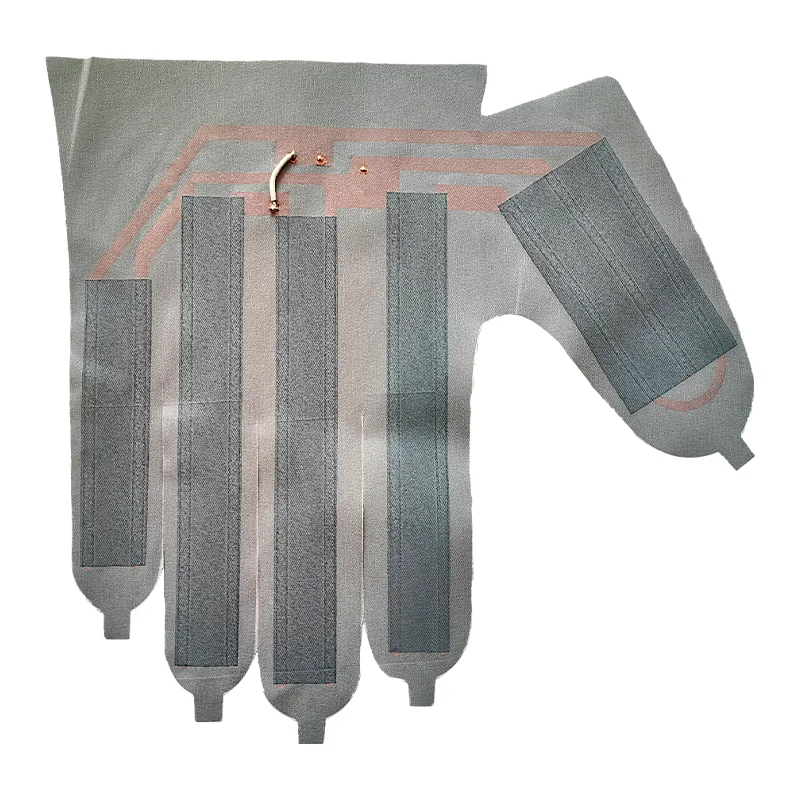
| Heating element | Carbon fiber or graphene yarn | 5V/3A operating, 5W / 15W power level | Carbon fiber (default) or graphene yarn (premium) |
| Cable | Silicone-coated heating wire | 26 AWG, 5A continuous, -40°C to +200°C | Helukabel |
UN 38.3 T1-T8 Test Protocols
| Test | Description | Pass Criteria |
|---|---|---|
| T1 — Altitude Simulation | 11.6 kPa altitude, 6 hours at 20°C ± 5°C | No mass loss, leakage, venting, disassembly, rupture, or fire |
| T2 — Thermal Cycling | -40°C to +75°C, 10 cycles | Same as T1 |
| T3 — Vibration | 7 Hz to 200 Hz to 7 Hz in 15 minutes, 12 sweeps × 3 axes | Same as T1 |
| T4 — Shock | 150 g acceleration, 6 ms, 3 pulses × 6 directions | Same as T1 |
| T5 — External Short Circuit | 0.1 ohm short at 57°C, 24 hours | Case temp ≤170°C, no fire within 6 hours |
| T6 — Impact | 9.1 kg mass from 61 cm onto cell | Same as T5 |
| T7 — Overcharge | 2x max charge current for 24 hours | No fire, no disassembly |
| T8 — Forced Discharge | 12V DC reverse connection, 24 hours | Same as T7 |
The OEM factory keeps the UN 38.3 test summary on file (typically scanned PDF + Excel raw test data) and references it on the DGD (Stage 5) and the MSDS (Stage 2).
8 FAQ — UN3481 Documentation Chain
- Q: What is the lead time for the 5-stage UN3481 documentation chain? A: 7-10 working days from cell vendor test summary receipt to DGD signature.
- Q: Can the SoC discharge cycle be shortened from 7 days to 4 days? A: Yes, by using a 0.5C discharge rate (2,500 mA) instead of 0.2C (1,000 mA). The 0.5C cycle completes in ~4 days but increases cell stress + reduces cycle life by ~3-5%.
- Q: Can the same UN 38.3 test summary be used for multiple SKUs? A: Only if the SKUs use the same cell model + the same pack configuration. The test summary is cell-model-specific, not SKU-specific.
- Q: How often does the MSDS need to be refreshed? A: Every 12 months from issue date, or sooner if the cell formulation changes (e.g., NMC 811 → NMC 622 cathode chemistry).
- Q: What is the validity of the IATA hazmat certification? A: 3 years from issue date, renewal exam at IATA-approved training center (Ho Chi Minh / Singapore / Hong Kong).
- Q: Can ocean freight skip the SoC ≤30% discharge cycle? A: Yes, ocean freight under IMDG Code does not require ≤30% SoC for UN3481. However, ocean freight adds 14-21 days.
- Q: What is the penalty for missing the UN3481 hazmat documentation? A: CBP / TSA issues a Notice of Violation + civil penalty up to $25,000 per violation per shipment + shipment re-routing to ocean freight.
- Q: Can the OEM factory use a 3rd-party IATA-certified hazmat shipper service? A: Yes, freight forwarders offer IATA hazmat shipper signature service for $185-$385 per shipment. However, the OEM factory retains the ultimate liability for documentation accuracy.
Appendix A — Glossary
– BMS: Battery Management System (electronic circuit monitoring + protecting the battery pack) – CAO: Cargo Aircraft Only (label, forbidden on passenger aircraft) – DGD: Shipper’s Declaration for Dangerous Goods (IATA hazmat shipping document) – GHS: Globally Harmonized System of Classification and Labelling of Chemicals (16-section MSDS format) – IATA DGR: International Air Transport Association Dangerous Goods Regulations (65th edition 2024) – IMDG: International Maritime Dangerous Goods Code – MSDS: Material Safety Data Sheet (16-section GHS-aligned battery safety document) – PI 965: IATA Packing Instruction 965 (lithium-ion batteries in equipment, ≤30% SoC for air freight Section II) – SoC: State of Charge (battery charge level, ≤30% for air freight) – UN3481: UN classification for lithium-ion batteries contained in equipment
Template pillar per P1-B 2026-10-01 graphene quota decision (Wed + Fri 900-1,600 word template posts, target PILLAR ratio ≥40% by 10/31).
Leave a Reply