
Heated Apparel Wash & Care Testing 2026: B2B Lab Protocol Guide
Heated Apparel Wash & Care Testing 2026: B2B Lab Protocol Guide
For any heated apparel OEM, heated apparel manufacturer, or heated apparel wholesale program, the test that decides 2026 product viability is heated apparel wash & care testing. A jacket can pass electrical safety and still fail at cycle 18 in a home washing machine when the bond between the heating element and the substrate breaks down. This guide lays out the 2026 B2B lab protocol a sourcing team should require on every quote, with reference ranges for the graphene heating element wash durability program and the heated apparel care label compliance steps that have to land on the inside seam before pilot production starts.
The protocol below is written for engineering buyers and private-label program managers at brands that source from a heated apparel factory in Asia. Where standards are quoted, they are reference ranges; final applicability should be confirmed against the buyer’s regulatory counsel.
1. Why wash & care testing is now the deciding test in 2026
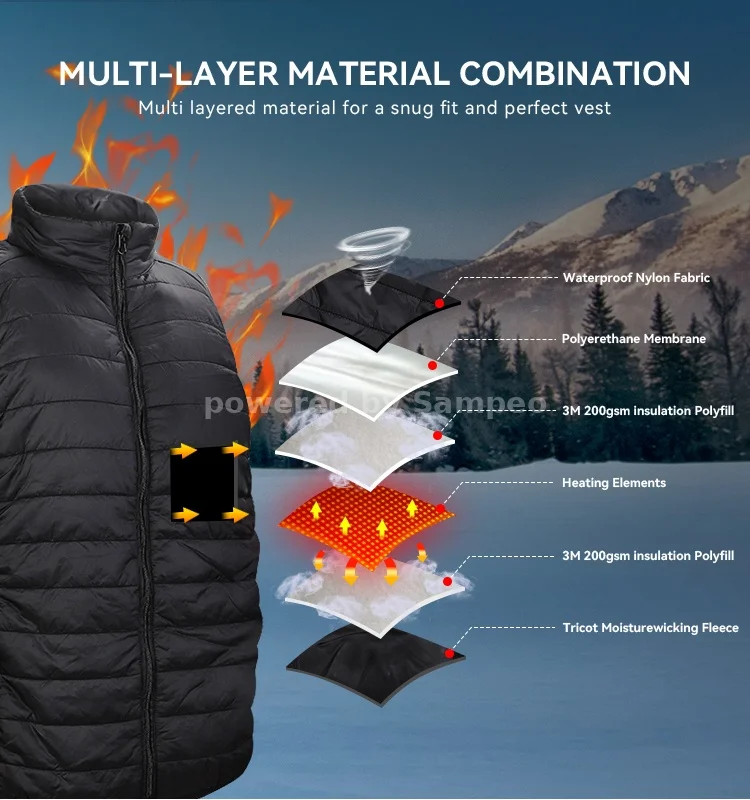
The 2026 generation of heated apparel is dominated by the graphene heating element wash durability platform: a graphene-coated fabric or yarn laminated or printed onto the garment liner and wired to a controller and battery. The reason wash testing has overtaken electrical safety as the binding QC gate is simple — the failure mode is invisible until after the first home launder.
Three forces have pushed wash testing to the front of the line:
– Rented and uniform fleets wash more. A garment rated to 100 home wash cycles can fail at cycle 35 in industrial laundry. – Care label errors trigger recall exposure. A jacket labelled “machine wash cold, tumble dry low” that delaminates at 30°C is a regulatory exposure under the US FTC Care Labeling Rule and the equivalent EU and GB/T 8685 standards. Heated apparel care label compliance has moved from packaging to legal. – Graphene changes the failure curve. A graphene element rarely open-circuits; it loses even heat distribution, drifts in resistance, or develops hot spots — a different test methodology, not a more lenient one.
For a heated apparel OEM buyer, the practical answer is that heated apparel wash & care testing 2026 is now a precondition for RFQ acceptance at top factories, not a follow-up service.

2. The 2026 wash cycle test scope: cycles, water, spin, detergent
A defensible heated apparel wash cycle test 2026 protocol specifies five variables: number of cycles, water temperature, spin speed, detergent type, and drying method. Each variable should be declared in the buyer-OEM contract before pilot production.
B2B Soft Plant — §2 In one recent RFQ conversation with a European workwear brand, the buyer asked for “100 wash cycles” without specifying water temperature, spin speed, or detergent. The OEM quoted against a 30°C / 600 rpm / mild-detergent baseline, roughly half the mechanical stress of a 40°C / 1200 rpm / standard-detergent cycle. Resolving the discrepancy before pilot production saved an estimated 6-8 weeks of re-sampling and about $9,000-14,000 in pilot-run scrap.
The minimum cycle counts we recommend as a 2026 buyer reference are:
| Wash cycle count | Use-case fit | Notes |
|---|---|---|
| 30 cycles | Entry / gift / single-season SKUs | Bare minimum for retail return-policy safety |
| 50 cycles | Standard consumer jacket or vest | Typical 2025 baseline; now considered light |
| 100 cycles | Heated apparel wholesale / private label | 2026 industry bar for graphene element |
| 150 cycles | Workwear / uniform / ski-rental fleet | Required for industrial laundering |
| 200+ cycles | Premium workwear / military | Reserved for heavy-duty programs |
The water-temperature and spin settings that match these cycle counts, again as buyer reference ranges to validate against the specific garment, are:
| Setting | Consumer baseline | Workwear baseline | Rental-fleet baseline |
|---|---|---|---|
| Water temperature | 30°C | 40°C | 40°C |
| Spin speed | 600 rpm | 800 rpm | 1200 rpm |
| Detergent | Mild (no bleach) | Standard (no bleach) | Industrial (chlorine-free) |
| Drying | Tumble low / line dry | Tumble low | Tumble low + air dry |
| Cycles between inspections | 10 | 10 | 10 |
A heated apparel manufacturer that can run all five settings on a programmable front-loading lab machine (rather than a top-loader with a manual timer) will produce reproducible results — and reproducibility is what makes the test report admissible when a brand later has to defend a care label claim.
3. Care label compliance: the legal layer on top of the lab test
Heated apparel care label compliance is where the lab test meets the law. A test report that says “100 wash cycles with no failure” is necessary but not sufficient; the care label printed on the inside seam has to be defensible against that test, in the symbol format of the destination market, and consistent with the actual garment construction.
The regulatory frameworks a 2026 B2B program should expect to see referenced are:
| Market | Care-label regulation | Symbol standard | Electrical-add-on rule |
|---|---|---|---|
| United States | 16 CFR 423 (FTC Care Labeling Rule) | ASTM D5489 | Battery removal before wash required |
| European Union | Regulation 1007/2011 + EU 2020/2151 | ISO 3758 | Battery removal before wash required |
| China (domestic) | GB/T 8685 | GB/T 8685 | Battery removal before wash required |
| UK (post-Brexit) | UKCA textile rules | ISO 3758 | Battery removal before wash required |
| Australia | ACCC product safety | AS/NZS 1957 | Battery removal before wash required |
The battery-removal line is consistent across markets and is the single most common label omission we see. A label that does not explicitly instruct the user to remove the battery pack before laundering fails heated apparel care label compliance review on first audit, regardless of how well the rest of the garment performs.
B2B Soft Plant — §3 On a 2026 Q1 private-label run for a North American outdoor brand, the factory’s standard care label was sent to the buyer’s regulatory consultant and rejected on three points: missing battery-removal pictogram, missing “do not wring” symbol, and a tumble-dry setting one notch above the lab-tested threshold. The re-print delayed the bulk shipment by about 12 days and added roughly $0.18 per garment in label scrap. The lesson, framed as a recommendation rather than a guarantee, is to send the proposed care label artwork through regulatory review before plate-making, not after.
For a heated apparel OEM program, the care label artwork should be treated as a regulated deliverable: locked before pilot production, version-controlled, and stored alongside the heated apparel wash cycle test 2026 report.
4. What to measure after each wash interval
A heated apparel wash & care testing protocol that only counts cycles to failure is not enough for a graphene element. The 2026 buyer reference protocol asks for four measurements at each inspection interval:
| Measurement | Method | Pass criterion (reference) |
|---|---|---|
| Element resistance (ohms) | 4-wire measurement at 25°C | Within ±10% of pre-wash baseline |
| Surface temperature distribution | IR thermography at 7.4V, medium setting | No point >5°C above zone average |
| Hot-spot detection | Thermal camera at full power, 60 s | No pixel >55°C on body-contact side |
| Controller function | LED + button cycle test, 10 actuations | All heat levels + off function correctly |
A typical inspection schedule is to test at cycles 10, 20, 30, 50, 75, and 100; for workwear programs targeting 150 cycles, add checkpoints at 125 and 150. The schedule should be written into the QA SOP, not improvised by the line.
For the graphene program, graphene heating element wash durability should also be tracked as a separate metric — typically a resistance-drift curve within ±10% of pre-wash value across the full cycle count. Drift above that band is the early warning that the substrate bond is failing, even when the element is still electrically continuous.
5. Detergent chemistry and water hardness: the variable most programs miss
The single biggest uncontrolled variable in a heated apparel wash & care testing protocol is detergent and water hardness. The same jacket can pass 100 cycles in soft water with mild detergent and fail at cycle 65 in 250 ppm hard water with a standard detergent that includes optical brighteners.
A buyer should record water hardness, detergent pH, optical brighteners, bleach, and fabric softener in the SOP; a practical matrix is below.
| Variable | Standard reference | Hard-use check |
|---|---|---|
| Water hardness | 150 ppm CaCO3 | 250 ppm CaCO3 |
| Detergent pH | 8-9.5 | 9.5-10.5 |
| Additives | No bleach | Avoid softener for first 20 cycles |
For graphene heating element wash durability testing specifically, we recommend avoiding optical brighteners and fabric softeners for the first 20 cycles even when the eventual consumer-care label will permit them, because both chemistries can interfere with the substrate bond before the element has thermally cycled enough to seat.

6. Drying, ironing, and the post-wash stress envelope
Wash testing is only half of heated apparel wash & care testing 2026. Drying method, ironing, and dry-cleaning rules are the other half — a graphene element that survives 100 wash cycles can still delaminate in a hot tumble dryer at cycle 30.
The recommended 2026 buyer reference protocol for drying is:
| Drying method | Recommended setting | Risk if exceeded |
|---|---|---|
| Tumble dry | Low heat (≤60°C) | Delamination at 80°C+ |
| Line dry | Flat or hung | None, but slower turn-around |
| Iron | Do not iron over element | Element damage; label must state “do not iron” |
| Dry clean | Generally not recommended | Solvent can attack membrane |
| Bleach | Do not use | Substrate failure within 10 cycles |
The “do not iron over the heating element” symbol has to be on the care label; a generic “do not iron” can mislead the user into thinking the whole garment is non-ironable.
7. Building the lab protocol into the OEM contract
The lab protocol only protects the buyer if it is in the contract. The contract clauses a 2026 heated apparel manufacturer program should include on heated apparel wash & care testing are an explicit cycle count, water temperature, spin speed, detergent type, and drying method referenced to a numbered SOP; inspection intervals and measurement methods with pass/fail criteria; buyer (or third-party) witness rights on the wash-test floor; re-test triggers if element resistance drifts beyond ±10% of pre-wash baseline or any hot-spot above 55°C appears at full power; care-label artwork approved before plate-making, version-controlled, and archived; and a pilot-run sign-off conditional on a passing 5-cycle pre-shipment wash test.
B2B Soft Plant — §7 A North American private-label buyer we worked with in late 2025 added one line to their OEM contract: “The wash-test report shall be attached to the pilot-run sign-off document and shall reference the same SOP number as the bulk-production care label.” That one line reduced the buyer’s internal sign-off time by roughly 3-4 days per PO and closed a documentation gap previously flagged twice in their internal audits. The change is recommended as a template clause, not a guaranteed outcome, but the mechanical logic is straightforward: when the test report and the care label share an SOP number, the legal exposure of the two is the same.
For a heated apparel wholesale buyer sourcing multiple SKUs from the same factory, a single master SOP referenced by every tech-pack is the cleanest way to keep the test protocol and the care-label language in sync.
For a deeper look at how a B2B sourcing team typically structures the broader OEM contract around wash testing, battery safety, and care-label compliance, the OEM/ODM manufacturing category covers the contracting mechanics in more detail. Related reading on the heated-apparel production line is available under battery heated apparel factory.
8. Test-report deliverables a buyer should require
A complete heated apparel wash & care testing report should be delivered as a single PDF with six sections. The reference structure is:
| Section | Content | Format |
|---|---|---|
| 1. Protocol | SOP number, cycle count, settings, equipment | 1-2 pages text |
| 2. Baseline | Pre-wash resistance, IR map, controller check | Table + IR image |
| 3. Interval data | Resistance, IR map, controller at each checkpoint | Table per interval |
| 4. Hot-spot log | Any pixel >55°C, with cycle number and zone | Table |
| 5. Care-label cross-check | Label artwork + pass/fail against protocol | Checklist |
| 6. Conclusion | Pass / fail / re-test, signed by lab supervisor | Signature block |
A report without sections 4 and 5 is not a defensible heated apparel wash & care testing deliverable for a 2026 heated apparel OEM program; it is a cycle-count certificate, which is a different and weaker document.

9. Frequently asked questions: heated apparel wash & care testing
Q1: What is heated apparel wash & care testing in 2026? A1: A structured lab protocol that measures element resistance, surface temperature, hot-spot risk, and controller function across a defined wash and dry cycle count, with a care-label compliance check.
Q2: How many wash cycles should a graphene heating element be rated for in 2026? A2: 100 machine-wash cycles with no measurable loss in heating performance is the 2026 industry bar for consumer and wholesale SKUs; workwear programs typically target 150.
Q3: What water temperature should a wash cycle test use? A3: 30°C for consumer baselines, 40°C for workwear baselines, and 40°C at higher spin speed for rental-fleet baselines — the choice is written into the SOP and matched to the care label.
Q4: Does optical brightener in detergent affect graphene heating element wash durability? A4: Optical brighteners and fabric softeners can interfere with the substrate bond during early cycles, so they are typically excluded for the first 20 cycles even when the consumer label permits them.
Q5: What is the most common care-label compliance error? A5: Omitting the explicit instruction to remove the battery pack before laundering — a failure that triggers audit risk in the US, EU, UK, China, and Australia alike.
Q6: Can the same factory run wash testing on both jacket and glove SKUs? A6: Yes, on a programmable front-loading lab machine with glove-specific drums; the SOP should specify garment category, not generic “apparel.”
Q7: What is a defensible element resistance drift threshold? A7: ±10% of pre-wash baseline across the full cycle count is the reference band; drift above ±10% is treated as an early failure indicator for the substrate bond.
Q8: How does heated apparel wash & care testing differ from general apparel care label testing? A8: General apparel care label testing focuses on fabric shrinkage and colour fastness; heated apparel testing adds element resistance, hot-spot detection, and controller function, which general apparel labs do not measure.
Q9: Should a heated apparel OEM buyer require a 5-cycle pre-shipment wash test? A9: Yes, as a recommended pre-shipment gate on every bulk run; it catches element-installation defects that a full 100-cycle protocol would only flag after retail release.
Q10: What drying method does the 2026 protocol recommend? A10: Tumble dry on low heat (≤60°C) or line dry flat; hot tumble drying above 80°C is the most common element-damaging step and is prohibited on the care label.
10. Quick Reference Glossary
The terms below cover the language a B2B buyer, OEM engineer, or care-label auditor will use across a heated apparel wash & care testing conversation. Phrases marked with an asterisk (\*) are the cluster phrases that anchor this article.
| Term | Definition |
|---|---|
| Heated apparel wash & care testing\* | Lab protocol combining wash-cycle testing and care-label compliance verification for heated garments. |
| Heated apparel manufacturer\* | A factory that assembles heated garments as the contract manufacturer of record. |
| Heated apparel OEM\* | An OEM relationship in which the buyer owns the design and the factory owns the production. |
| Heated apparel wholesale\* | A distribution model in which bulk finished goods are sold to retailers or brand buyers. |
| Heated clothing wash testing\* | The subset of wash testing that applies to heated clothing specifically, including element-resistance and hot-spot measurements. |
| Graphene heating element wash durability\* | The ability of a graphene-coated heating element to retain resistance, heat distribution, and bond integrity across a defined cycle count. |
| Heated apparel care label compliance\* | The legal and regulatory alignment between the care label artwork on a heated garment and the lab-tested care instructions. |
| Heated apparel wash cycle test 2026\* | The 2026 buyer reference protocol covering cycle count, water temperature, spin, detergent, and drying method. |
| Element resistance drift | Change in the electrical resistance of a heating element relative to its pre-wash baseline. |
| Hot-spot | A localized area on the heating element surface that exceeds the zone-average temperature by more than 5°C. |
| IR thermography | Infrared imaging used to map surface temperature distribution across the heating element. |
| Care label | The textile label sewn into a garment listing wash, dry, iron, and bleach instructions. |
| Battery-removal pictogram | The care-label symbol instructing the user to remove the battery pack before laundering. |
| Substrate bond | The mechanical or chemical adhesion between the heating element and the garment liner fabric. |
Leave a Reply